Actors union challenges AI performer Tilly Norwood
The actors union’s 2025 statement about Tilly Norwood and later reporting raise questions about synthetic casting, consent, and compensation.

Correction added October 1, 2026. The performers union’s statement about Tilly Norwood was published on September 30, 2025. It should not have been presented here as a response issued within days of the July 2026 film plan reported by The Next Web.
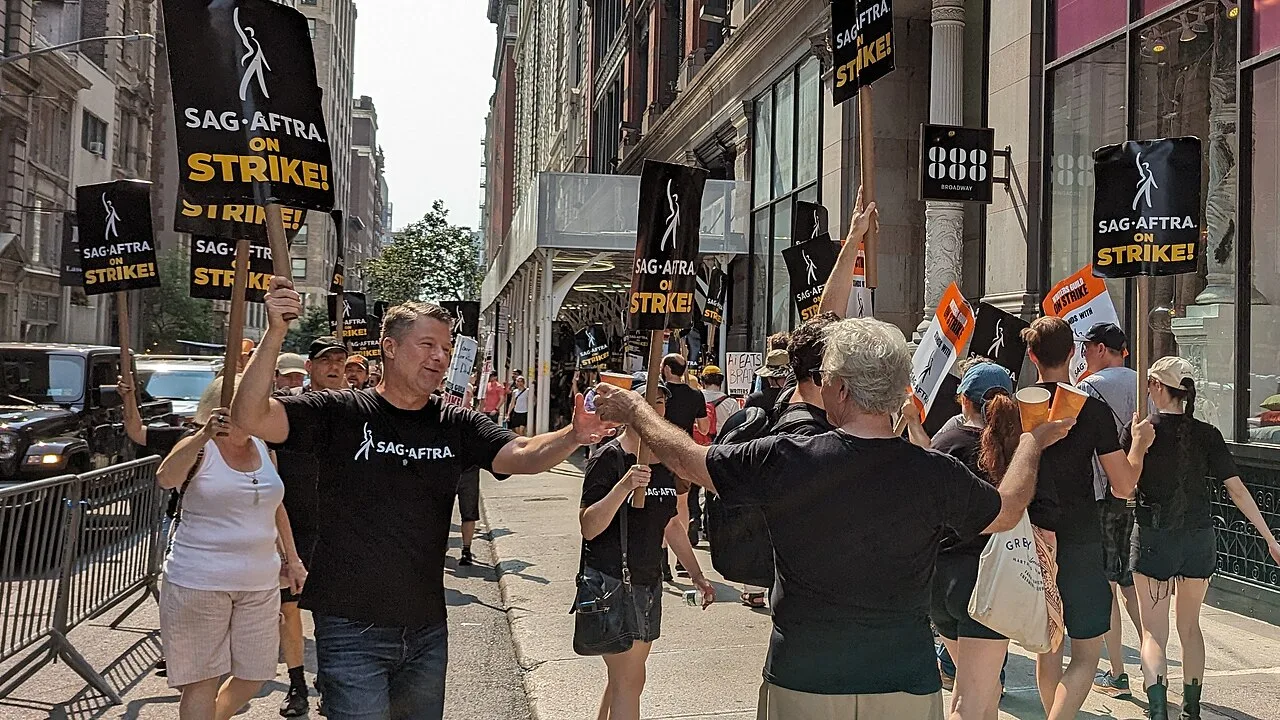
Archival photograph. Actors union members picketing in New York in July 2023. Photo by Eden, Janine and Jim under CC BY 2.0.
Synthetic performers raise questions about consent, credit, and compensation. The earlier union statement and later film reporting provide different pieces of that debate.
Who Tilly Norwood is and what Particle6 announced
The Next Web’s July 20, 2026 report describes Particle6’s plan to put Norwood in a film called Misaligned. That report does not establish that the synthetic character first appeared that month.
That distinction matters to studios and terrifies performers. A wholly invented “actress” lets producers argue they are not copying any one person. Unions hear something else: a composite built from countless performances scraped and remixed without permission or pay. The plot of Misaligned almost writes the press release for them. An AI plays an AI. The meta joke lands differently if your residual check depends on being irreplaceable on camera.
The union’s position on synthetic performers
In its 2025 statement, the union described Norwood as a computer generated character rather than an actor. It criticized the use of performers’ work without permission or compensation and pointed signatory producers to contractual notice and bargaining obligations.
This is not abstract philosophy. The same union has urged members to opt out of Meta’s Muse image tool when public photos risk becoming training fuel. Music is already fighting models trained on artists who never agreed. Hollywood’s version arrives as a named face with a movie title attached, which makes the consent argument harder to dismiss as futurism.
The wider debate also includes Christopher Nolan’s concerns about AI in filmmaking. Those remarks belong to the later reporting, not the original union statement.
How a Tilly Tax would work
Under the culture war sits a payroll question. If a studio uses a synthetic performer instead of a human, should it pay for the privilege?
The Next Web’s July 2026 report describes the so called Tilly Tax as a proposed royalty arrangement. The 2025 union statement is separate evidence and does not set out that proposal.
Watch the definition fight. If “invented” means “trained on everyone, credited to no one,” the tax is how labor tries to put a meter on the training commons. If studios win the invented-character carve-out, synthetic leads become a cost-avoidance product with better PR than non-union extras.
Why synthetic performers became a summer flashpoint
The Norwood story did not land in a vacuum. Netflix’s roughly 300 titles touched by generative AI, Animation Guild contract language, and CVL Economics estimates of six-figure job absorption all arrived in the same season. Synthetic performers are the visceral version of a quieter inventory shift.
Credit stays human on the poster. The dataset does not. The Tilly Tax is an attempt to make that asymmetry expensive. Whether it survives bargaining is unsettled. The category fight is not. Once a studio can cast a generated lead and call her an actress, every working performer has to renegotiate what the job even is.
The practical questions concern how contracts define synthetic performers, how consent is obtained, and how any compensation arrangement would work. A proposal should not be presented as a settled contract term.


.jpg)