Google’s TPU 8tx and 8i Max target different bottlenecks

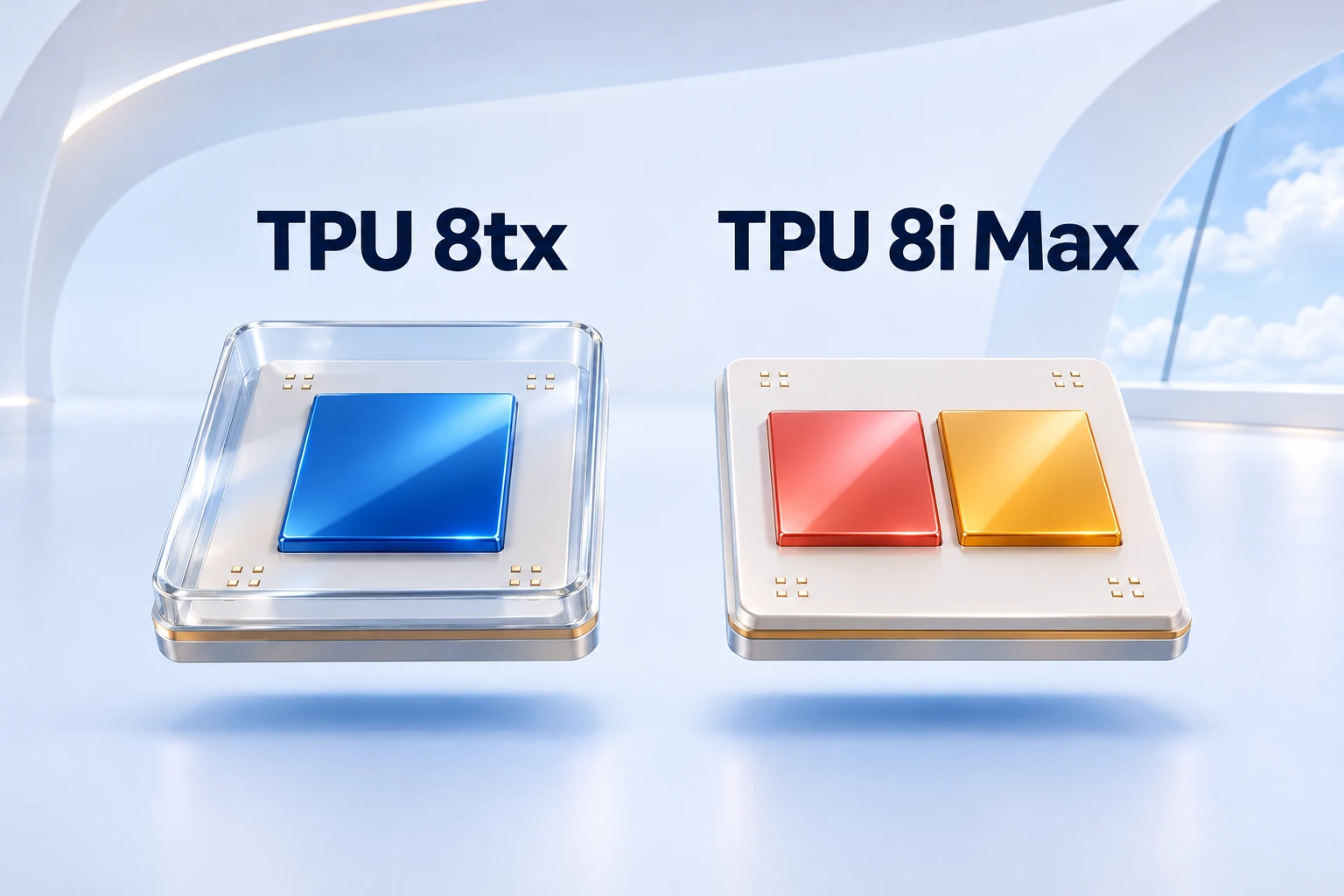
Google announced TPU 8tx and TPU 8i Max on November 9. TPU 8tx is designed for confidential inference and smaller training jobs, while TPU 8i Max pairs two chips to handle workloads that move large amounts of data, such as long prompts. Google Cloud still lists both as coming soon.
The choice for an AI team starts with the bottleneck. A private fine tuning job, a long prompt and an agent waiting for a tool each put different demands on infrastructure. A new accelerator name alone does not tell you which part of your application will improve.
What the two TPU systems change
TPU 8tx combines the same silicon as TPU 8t with fifth-generation AMD EPYC hosts and Google’s Boardfly network. Google says the hardware is designed to protect data and model weights while they are in use. It claims latency as low as half that of TPU 8t in its comparison. ByteForward has not tested either system.
TPU 8i Max puts two TPU 8i chips in one package. Google reports twice the compute, on-chip SRAM and high-bandwidth memory (HBM) bandwidth of TPU 8i. That is not a claim of twice the HBM capacity, supported prompt length or end-to-end speed. Google’s announcement includes an animated illustration of the dual-chip package.
Treat the latency figure as a vendor claim tied to its comparison, rather than a promise that your whole application will run twice as fast. Likewise, memory bandwidth measures the rate of data movement. It is a different quantity from how much model state or context fits in memory.
The software path starts with TorchTPU
The software groundwork predates these systems. Google’s October 20 TorchTPU release brought native PyTorch support to TPUs, with eager execution for debugging and torch.compile for optimization. Google describes existing PyTorch workloads as needing minimal code changes. Its release also covers vLLM and SGLang integrations, plus Hugging Face model support.
The current PyTorch on Cloud TPU documentation recommends TorchTPU for new workloads and migration from PyTorch/XLA. It distinguishes the TorchTPU serving backends from maintained JAX routes. That is useful when planning a move: an existing JAX deployment and a new PyTorch project do not necessarily need the same migration.
The software timelines are separate. Cloud Pathways on Google Kubernetes Engine is generally available for supported TPU generations, and GKE dynamic slicing is generally available starting with Ironwood, or TPU7x. The TPU agent suite remains in preview. None of those statuses makes 8tx or 8i Max orderable.
A practical first test is deliberately small. Load the intended checkpoint, run representative requests and compare outputs before tuning throughput. Keep the original environment available while checking numerical differences, compilation behavior and failure recovery. These are suggested evaluation steps, not tests performed by ByteForward.
Measure the workload rather than the package
For interactive inference, record time to the first token and the delay between subsequent tokens. Test short and long prompts separately, then repeat under concurrent load. A low latency result from one request can hide queueing delays when many users arrive together.
For agents, include the complete task. Separate model generation time from database calls, code execution and human approval waits. Faster inference may help the model stage while leaving the slowest external step unchanged.
For confidential workloads, ask for the supported protection boundary and operational requirements before moving real data. Establish which components handle plaintext, how the deployment is verified and which logs or exports retain information. A hardware capability does not by itself settle an application’s access controls or compliance obligations.
Availability still needs confirmation
As of November 21, Google’s Cloud TPU product page lists 8tx and 8i Max as coming soon, alongside 8t and 8i. Ironwood and Trillium are already generally available and can be used for supported workloads. The Cloud TPU zones list does not show either new system, and Google has not published orderable regions, prices or a general availability date for them.
Request those details alongside the precise configuration and capacity commitment. Compare total serving cost at the same output quality and response target, including idle time, storage and data movement. Without a price and deployable configuration, a procurement comparison remains incomplete.
For context, our coverage of Google Cloud A5X availability examines the separate Rubin GPU offering. Our Oracle TPU deployment report covers the planned 2027 route through OCI. Neither announcement establishes availability of these new TPU configurations.