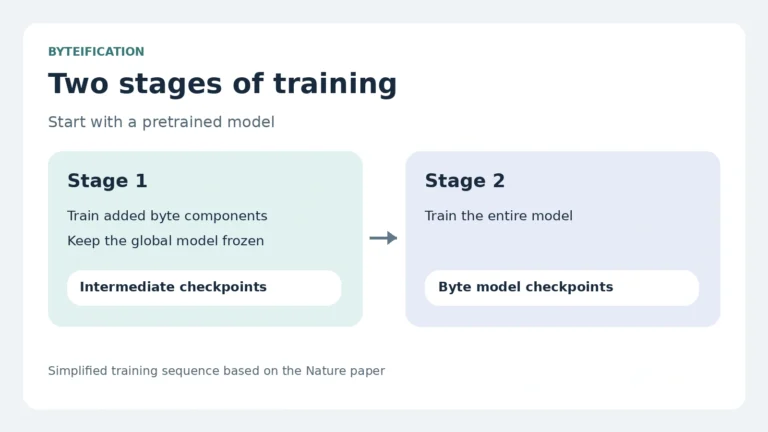
Ai2 announces Bwen and Blama byte model checkpoints
Ai2 announces Qwen and Llama based byte model checkpoints alongside its Nature paper, with Stage 1 models for research.
Accessibility Adjustments
Use these optional tools to adjust reading and display preferences. These tools cannot resolve every accessibility barrier. Please contact the website owner if you need assistance.
AI models shape what today’s assistants can reason through, create and automate. ByteForward covers large language models, multimodal systems and open weight releases with a focus on what their capabilities mean in practice. Explore reporting on reasoning performance, coding ability, context windows and the tradeoffs between speed and cost. Model benchmark comparisons are most useful when the test setup, version and limits stay attached to the score. API pricing, licensing terms and access restrictions also matter when choosing a model for a real workload. Our AI model release coverage follows new launches and major updates from announcement to availability. For the methods behind performance claims, explore our AI research reporting. Start with the stories below to understand what changed, what the evidence supports and which questions remain open.
Ai2 announces Qwen and Llama based byte model checkpoints alongside its Nature paper, with Stage 1 models for research.
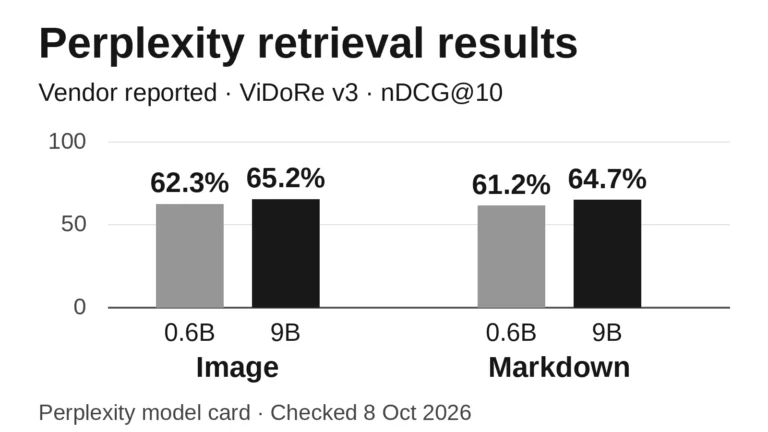
Perplexity’s smaller retrieval model can query an index built with its larger counterpart.

Uratori returns evidence judgments without generating an answer.

A new preprint studies motion transfer while limiting copied appearance.

Anthropic said Haiku 5.5 would arrive in the coming weeks on September 28. The exact date, pricing and public access details remain unconfirmed.

OpenAI lists GPT 6 Astra and GPT 6.1 Sol. Here is the confirmed release timeline and what remains unknown about a GPT 6.1 Astra launch.

Researchers test synthetic video detection across 46 generator variants. Code and model releases remain pending.
The update adds image inputs and more detailed video segmentation.
ByteForward’s launch analysis examines specialist results, API pricing and the checks that matter before adding Mistral Large 4 to a workflow.
The 740 million parameter release combines text, image, video and audio embeddings for local retrieval.
Nano Banana 2.1 is available in the Gemini API. Google’s current documentation lists no shutdown date for the older Nano Banana 2 model.

An expanded HuatuoGPT 3 paper reports medical benchmark gains while warning that clinical validation remains necessary.
BioRender’s Leo guides figure planning with sketches and editable drafts. Access requires a paid add on plan.
Liquid AI has enabled image inputs in its paid d1 API, expanding structured decisions to visual inspection and screenshot tasks.

Free Gemini accounts face an October 9 change, while Plus timing comes by email. Argon access and the value of the Google bundle are separate questions.

Mistral’s new flagship has 1.05 trillion parameters and a million token context window. Downloadable weights are planned for later in October.

The research preview combines visual generation and understanding within shared context.

Creators can group songs into an album or convert an existing playlist into a release.
The download combines a reasoning core with specialist tools and needs a GPU with 80 GB of memory.
Early access is limited while Reflection completes safety evaluations.

A US test is planned for later October as OpenAI expands conversion tracking and brand suitability work.

Creator examples span quick product explainers, long rendering jobs and editable animal models. The brief and tools shape the result.
Choose the sizes and languages, generate a batch, then check each version against the approved design.

Audible adds cast guides and plans interactive extras for a limited beta

