Dyna introduces Taku for longer robot workflows
Dyna shows an hour of laundry work with Taku while customer deployment remains the next test for its new robot system

Dyna Robotics introduced Taku and its Dyna 2.1 system on September 29, publishing what it describes as an uncut hour of autonomous laundry work. The demonstration extends its focus from individual manipulation tasks to a sequence across a room.
Taku uses four steerable wheels, a folding lower body and two arms with seven degrees of freedom each. The design aims to reach washing machines, dryers, tables and shelves.
Three layers share the work
A controller handles movement, the Dyna 2 policy supplies physical skills, and a vision language orchestrator selects the next step. Text memory preserves information such as which machine is running.
Dyna says customer deployment is the next milestone. The report establishes a company demonstration, with commercial validation still ahead.
Earlier evidence has a narrower scope
The underlying Dyna 2 research from August describes training on more than one million hours of human video. In a customer site comparison, Dyna reported acceptance rates of 87% for Dyna 2 and 46% for Dyna 1 under matched task training budgets. Neither model had seen data from those sites. Those results concern the earlier system and cannot be read as Taku’s laundry workflow success rate.
An earlier deployment report explains the operational problem. Dyna says it records robot activity continuously, then saves diagnostic windows when alerts occur. Its evaluation combines automated labeling with human review of uncertain outcomes and sampled work. It describes a worn gripper that reduced throughput, illustrating why a software log alone may miss the cause of poor physical performance.
What an operating trial needs
For a laundry operator, the useful next evidence would cover repeated shifts, intervention frequency, damaged items, maintenance and throughput. A successful recovery matters only if the whole service remains reliable and economical. Testing across unfamiliar rooms and changing loads would make the demonstration more informative for deployment decisions.
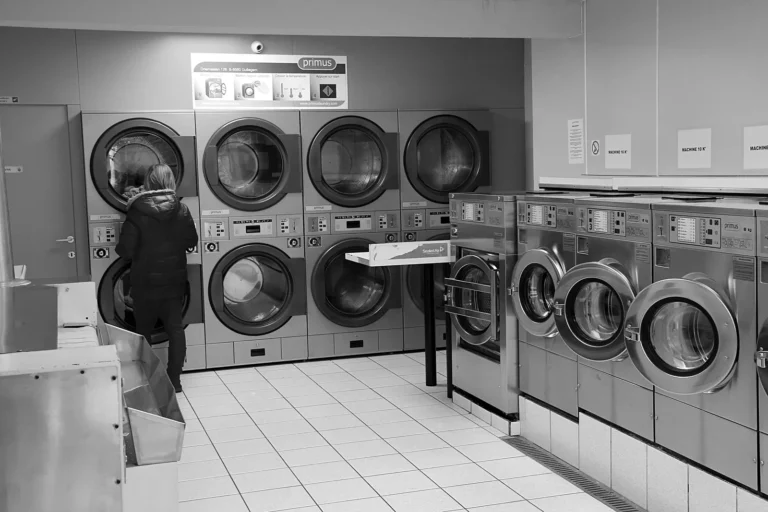
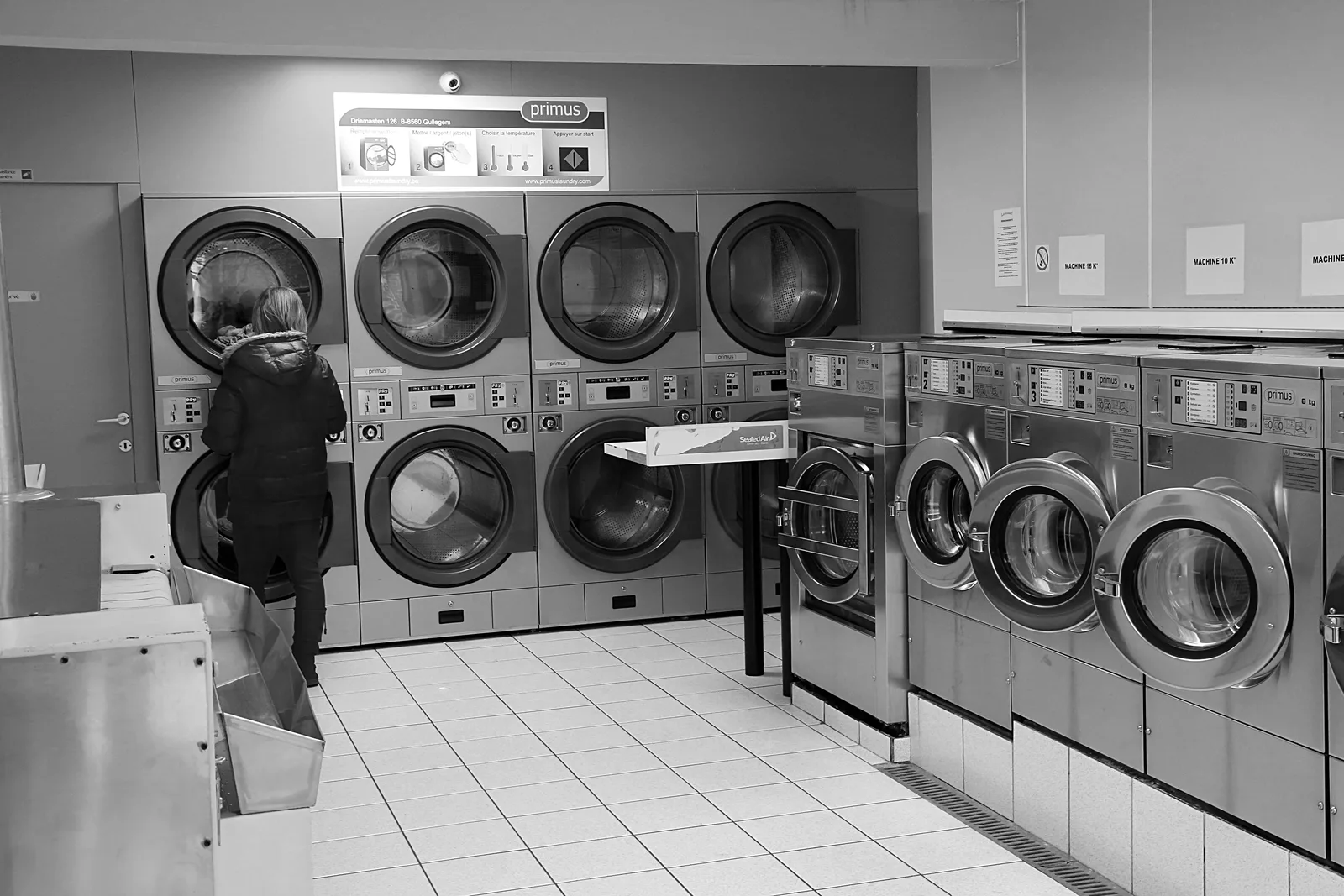
Illustrative laundry setting in Mouscron, Belgium, photographed by Jamain in March 2019. This archival image does not depict Taku or a Dyna facility. Resized and converted to WebP. The image and derivative use Creative Commons Attribution ShareAlike 4.0.