WAIC 2026 opens in Shanghai with an AI governance agenda

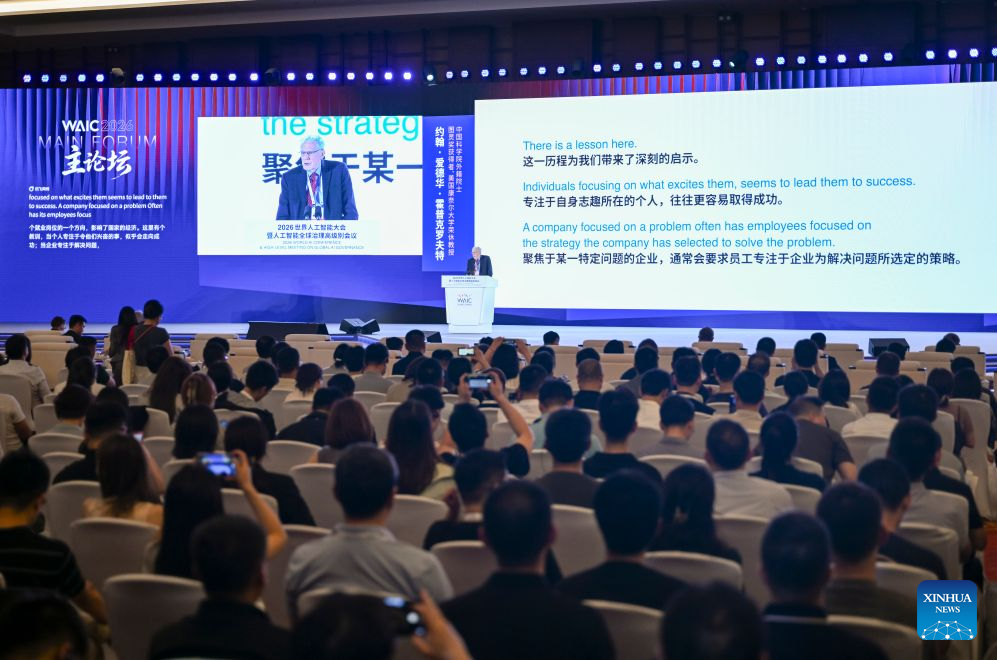
Shanghai opened the year’s biggest state-backed AI stage with a record floor and a governance agenda running in the same week. On July 17, the 2026 World AI Conference (WAIC) and the High-Level Meeting on Global AI Governance kicked off under the theme “AI Partnership for a Brighter Future.”
The show is hardware and demos. The meeting is Beijing’s bid to set terms for how countries talk about AI rules.
What opened on the exhibition floor
Per Xinhua’s opening coverage, the exhibition area exceeds 100,000 square meters for the first time, with more than 1,100 enterprises on site. Organizers say exhibitors are showing 3,000+ products and technologies, including 300+ global debuts, across venues anchored by the Shanghai World Expo Exhibition and Convention Center.
The program splits into six sections: Conferences & Forums, Exhibitions & Showcases, Awards & Competitions, Application Experiences, Innovation Incubation, and Talent Attraction. Floor color from the photo wire: robots, AI glasses, unmanned logistics vehicles, agent phones, TCM diagnosis bots, and Huawei’s pretraining booths — the usual WAIC mix of consumer gadgetry and industrial stack. The Expo Center is the main stage; West Bund is carrying overflow demos.
Governance meetings running in parallel
WAIC is paired with the High-Level Meeting on Global AI Governance, not treated as a side panel. At the opening ceremony, President Xi Jinping announced that the World Artificial Intelligence Cooperation Organization (WAICO) has come into being in Shanghai — per China’s Foreign Ministry readout, an intergovernmental body China is pitching as a milestone for Global South-centered AI cooperation.
The Chair’s Statement from the same day puts WAICO’s headquarters in Shanghai and frames it as the first intergovernmental AI organization of its kind. Xi called for people-centered development, security that stays “controllable,” UN-centered coordination on strategies and standards, and opposition to “overstretching the national security concept” in AI. He also pledged 5,000 AI training and seminar slots for developing countries over five years, plus regional application cooperation centers with ASEAN, the Arab League, the African Union, CELAC, the SCO, and BRICS.
Who showed up from governments and labs
Opening speakers named by MFA and Xinhua include Kazakh President Kassym-Jomart Tokayev, Cambodian Prime Minister Hun Manet, Thai Prime Minister Anutin Charnvirakul, and UN Secretary-General António Guterres. They framed AI opportunities and risks as borderless and backed WAICO as a venue that could matter.
The guest list skews toward governments and international organizations more than a Silicon Valley keynote circuit. MFA puts attendees from more than 100 countries and organizations in the room. That is the point of the dual format: state capacity on stage, vendors on the floor.
Signals that matter beyond the keynotes
Analysis: WAIC 2026’s real story is the parallel architecture. A 100,000 m² expo with 1,100+ exhibitors is China’s annual proof of industrial depth. WAICO, headquartered in Shanghai per the Chair’s Statement, is an attempt to institutionalize a governance lane outside Western-led forums.
Watch whether founding members turn into working groups with budgets and standards, or whether the org stays a speech venue while export controls and domestic rules do the real steering. The floor will generate model launches and booth photos either way. The governance track only counts if WAICO becomes a place companies and regulators actually file to.