Schaeffler turns to Wandelbots NOVA for factory robot skills

Schaeffler and Wandelbots announced a technology partnership on October 22 to make robot applications easier to develop, test and transfer between factories. They plan to use Wandelbots NOVA as a common software foundation across Schaeffler’s manufacturing network, with NVIDIA Omniverse and Isaac Sim supporting virtual testing.
The partners target a reduction of up to 40 percent in automation costs over a system’s lifecycle. That is a goal, not a measured saving across Schaeffler’s plants. The announcement does not give a timetable for making the platform available at every location.
From a packaging cell to reusable skills
Wandelbots describes an earlier packaging cell project that shortened development by about two weeks per application. It says teams tested processes, cycle times and inspection in a digital twin before running the same application logic on the physical system. That is a partner reported example, not a benchmark for the entire network.
The published case study overview identifies MHP and NVIDIA Omniverse alongside Wandelbots in the shared development environment. It describes checking robot movements, layouts and inspection processes before physical commissioning, when changes would be more expensive. The practical aim is to find integration problems before they require physical rework.
The partnership would add a centrally managed library of robot skills spanning simulation, training and deployment. That is the proposed operating model, not evidence of arbitrary tasks transferring unchanged between robot bodies.
Shared software does not make motion identical
NOVA’s current controller documentation explains what this software reuse means. The same API addresses virtual controllers and connected physical controllers. An application can switch between them by changing its controller identifier. The software interface therefore stays consistent while the target hardware changes.
The documentation also names the limit. Virtual controllers use idealized movement, while physical behavior depends on controller timing, mechanical inertia and safety systems. NOVA distinguishes this internal virtual representation from the more detailed external simulation associated with Isaac Sim. A program using the same interface still needs evaluation against the real cell.
The collision environment documentation shows another part of that preparation. Teams can transfer collision geometry between Isaac Sim and NOVA, with reference coordinates and the selected robot motion group defining the setup. Tool geometry is handled separately so it follows the robot flange and its offset. Reusing software does not remove the need to represent the actual installation accurately.
Compatibility and safety still need local work
The NOVA intended use documentation lists supported controller and robot combinations. It also says NOVA must not replace the original robot controller and requires the safety controller to be configured. These conditions make the distinction between a common programming layer and unrestricted hardware compatibility important.
The separate robot connection guide covers model selection, controller requirements, the connection to an industrial PC and communication configuration. Support for a manufacturer’s brand is not equivalent to support for every machine it makes. A rollout team still needs to check the exact controller, arm and cell configuration.
ByteForward’s reporting on SafeWorld and the limits of simulated robot safety testing explores the related distinction between finding problems in a virtual environment and establishing that a physical system is safe. SafeWorld is separate from this partnership.
What would establish wider value
The next useful evidence would be results from repeating the process across additional cells and plants. How much application logic transfers, how much configuration changes, and how much commissioning rework remains would show whether the packaging example scales. The 40 percent cost target needs its own measurement rather than being inferred from a shorter development schedule.
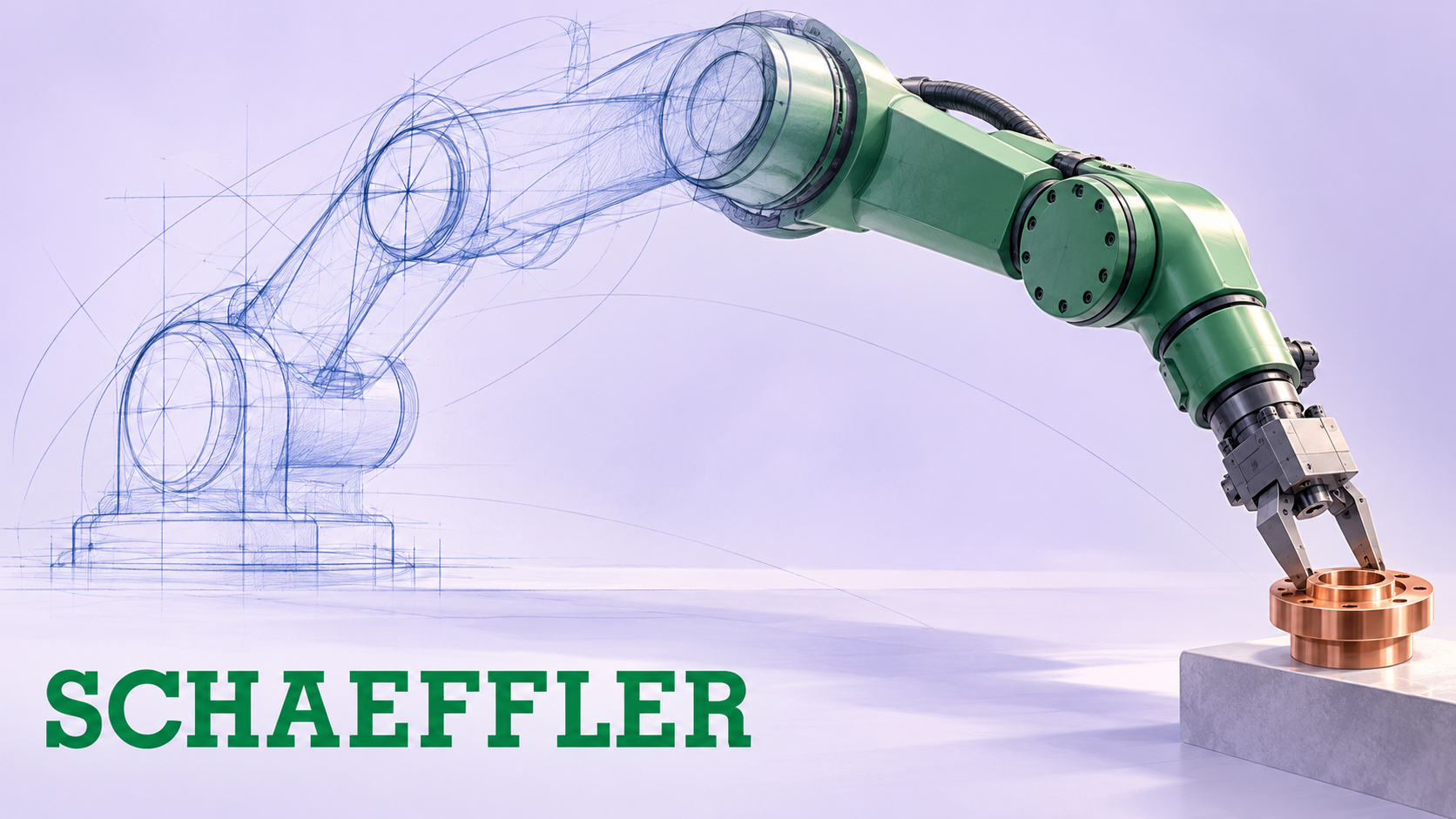
AI generated editorial illustration using Schaeffler branding. The conceptual robot is not a photograph or product specification.