Formic raises $50 million to expand factory robotics

Formic announced $50 million in growth financing on October 22 to expand its factory robotics business. The package combines a Series B led by Mercato Partners with debt from S2G Investments. The announcement does not break out those amounts, so the total should not be described as a $50 million equity round.
The company reports more than 750,000 production hours across over 100 facilities in more than 30 states. It says the funding will support a move from robots dedicated to particular jobs toward systems handling a broader range of manufacturing tasks. That expansion remains a plan, not proof of general robotic autonomy.
An operating service rather than a robot sale
Formic’s Full Service Automation offering bundles the equipment with installation, maintenance, software and ongoing support for a recurring payment. It names KUKA, ABB, FANUC and Doosan among the robot brands used in its systems. Customers are buying an operated production capability rather than simply taking delivery of an arm.
The company describes regional field engineers, support around the clock, managed spare parts and performance commitments in its service agreements. It also provides throughput and cycle time reporting. For a manufacturer, those arrangements shift attention from the purchase price to the ongoing agreement, the measured output and the responsibilities when a line stops.
Its platform description separates Core, the software and control layer at the robot, from Cortex, which handles fleet telemetry, diagnostics and updates. Formic says physical safeguards such as stops, light curtains and area scanners remain outside the AI’s authority to override. Those are company descriptions, not an independent safety assessment of a customer installation.
Humanoids are still a pilot offering
The current humanoid service page makes a narrower promise than the general robotics ambition. Formic describes selected customer pilots across 2026 and 2027, initially limited to one task, one production cell and one shift. Expansion depends on the economics demonstrated during the pilot.
The offering includes data collection, model training, maintenance and monitoring, with remote human intervention when necessary. Formic gives an indicative 60 to 90 days from scoping to initial production cycles, followed by further buildout and training if the pilot succeeds. Those are vendor estimates, not a guaranteed deployment schedule.
Where Physical Intelligence fits
Formic also says it is working with Physical Intelligence to adapt robotic foundation models using its production data and manufacturing experience.
Physical Intelligence’s October 13 Pi API beta announcement includes Formic among its early collaborators. The described workflow lets developers upload demonstrations, adapt models on managed infrastructure and obtain predictions through hosted inference. Teams then test on the robot and collect further data around failures.
That service can reduce the infrastructure work needed to try a robot policy, but it does not supply the whole factory deployment. Physical Intelligence says some early applications encountered connectivity problems. Its account reinforces why model access, operating support and integration are separate parts of the commercial proposition.
ByteForward’s guide to the Pi API beta explains the access process and the questions developers should resolve about robot configuration and hosted inference. The beta predates this funding announcement and should not be presented as a new release.
What would demonstrate progress
For the broader robotics offering, the useful next evidence would be sustained production results from those limited pilots. Task success, acceptable throughput, rejected output and human assistance should be reported together. A low monthly equipment payment would tell only part of the story if recovery work repeatedly interrupted production.
The immediate development is financing for a company with an existing deployment operation. The harder test is whether the service infrastructure that supports established factory tasks can make more adaptable robots economical without hiding the work still done by people.
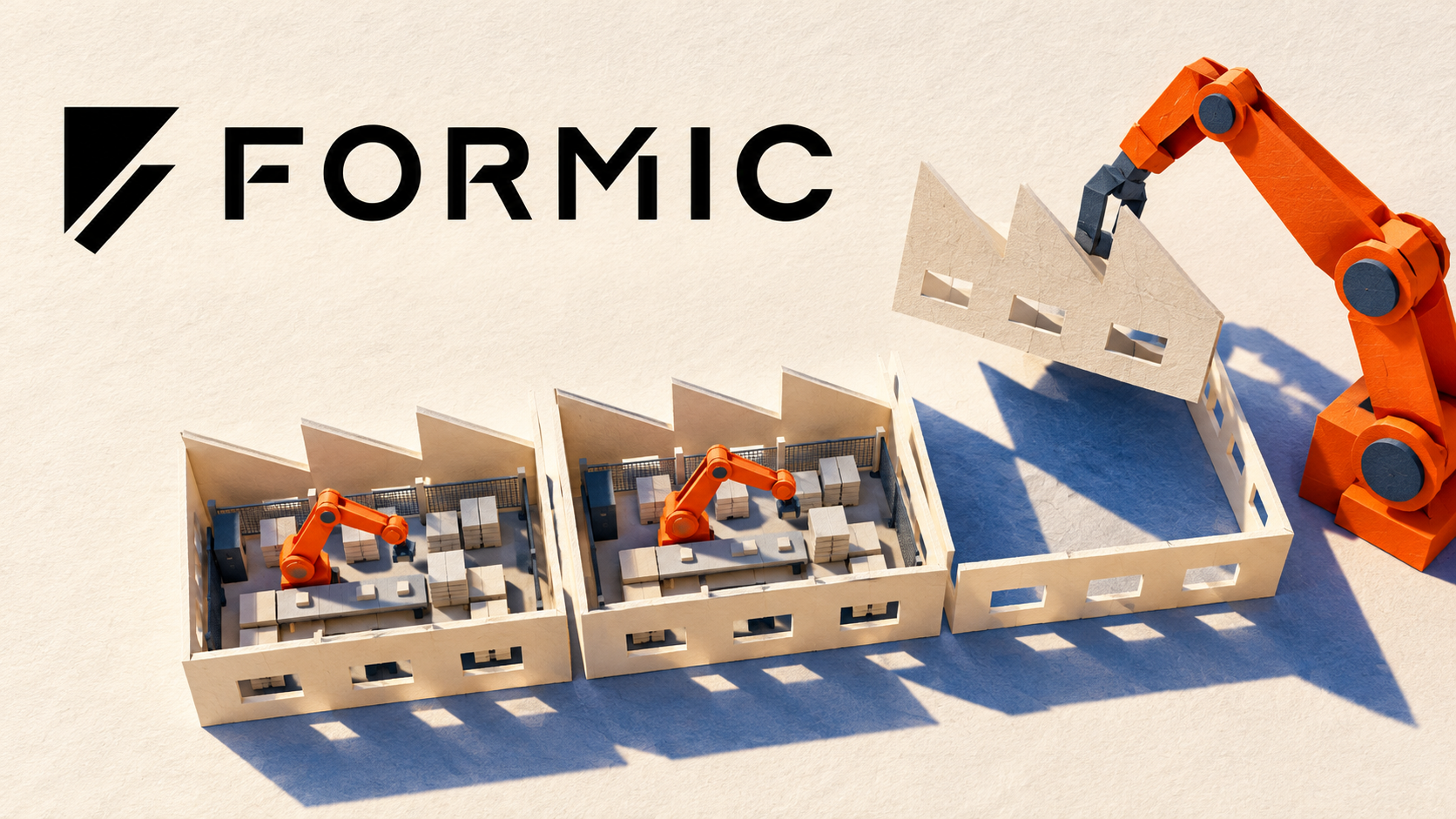
AI generated editorial illustration of Formic factory automation expansion using Formic branding. Not a photograph of a deployment.