Runway releases Praxis-1 robot policy with open weights

Runway released the Praxis-1 robot policy on November 11, 2026, with open weights and code under Apache 2.0. The publisher’s Hugging Face repositories for the single-arm DROID checkpoint and dual-arm YAM checkpoint list the weight files, but Hugging Face requires signing in and accepting the repository conditions before downloading them.
That public release followed Runway’s September 30 partner preview with Noble Machines, Standard Bots and Ultra. Runway uses ordinary video to pretrain a policy that predicts both what a camera will see and how a robot arm should move. The September announcement described partner testing, not public access at that time.
Runway’s demonstrations include a mobile robot retrieving a book and a policy moved between a studio and kitchen without retraining. These are company demonstrations.
Praxis-1 checkpoints and hardware requirements
The official repository documents a default BF16 DROID simulation path using Python 3.12, a CUDA 13.0 driver and one CUDA GPU with at least 80 GB of memory. Those are requirements for that path, not for every separately documented quantized configuration. The code license is Apache 2.0. Runway lists the dependencies from Wan and Qwen separately under their own terms.
Hugging Face’s LeRobot integration guide documents converted single-arm and dual-arm checkpoints. Its converted DROID weights are about 54 GB in BF16, and the guide specifies an 80 GB GPU for inference. A converted checkpoint makes the model easier to load in LeRobot, but does not establish support for arbitrary hardware. ByteForward reviewed the release documentation and did not run the model.
What the evidence actually measures
Runway’s placement comparison reports 16.1 cm error with web video pretraining and 16.0 cm with teleoperated robot video, after finetuning. Error bars represent one standard error of the mean across 93 evaluation pairs. The page does not specify the task set. The chart cannot establish performance across all hardware.
A separate February 27 study reported a 0.95 correlation in policy evaluation. Runway simulated eight existing robot policies and compared their scores with physical trials. All used a Franka Panda arm on tabletop manipulation tasks from RoboArena. This was an evaluation of a simulator, not a test of Praxis1.
Human graders assessed 1,450 simulated rollouts, producing more than 16,000 ratings. The reported correlation describes agreement in relative policy performance. Runway explicitly says that study tested policy ranking rather than prediction of absolute success rates. It leaves broader robot types and more accurate success estimates for further work.
Hardware integration remains a separate responsibility
Standard Bots’ RO1 safety documentation makes the deployment boundary concrete. It says the application and risk assessment determine how safety features are implemented, while the integrator must calculate the system’s final performance level. It also calls for a full safety assessment before production and notes that payload and attached tools affect safe operation.
Start evaluation in simulation and keep evidence from simulation separate from evidence on the target equipment. Count interventions and record failures rather than relying on a placement score to estimate how much supervision a whole workflow will need.
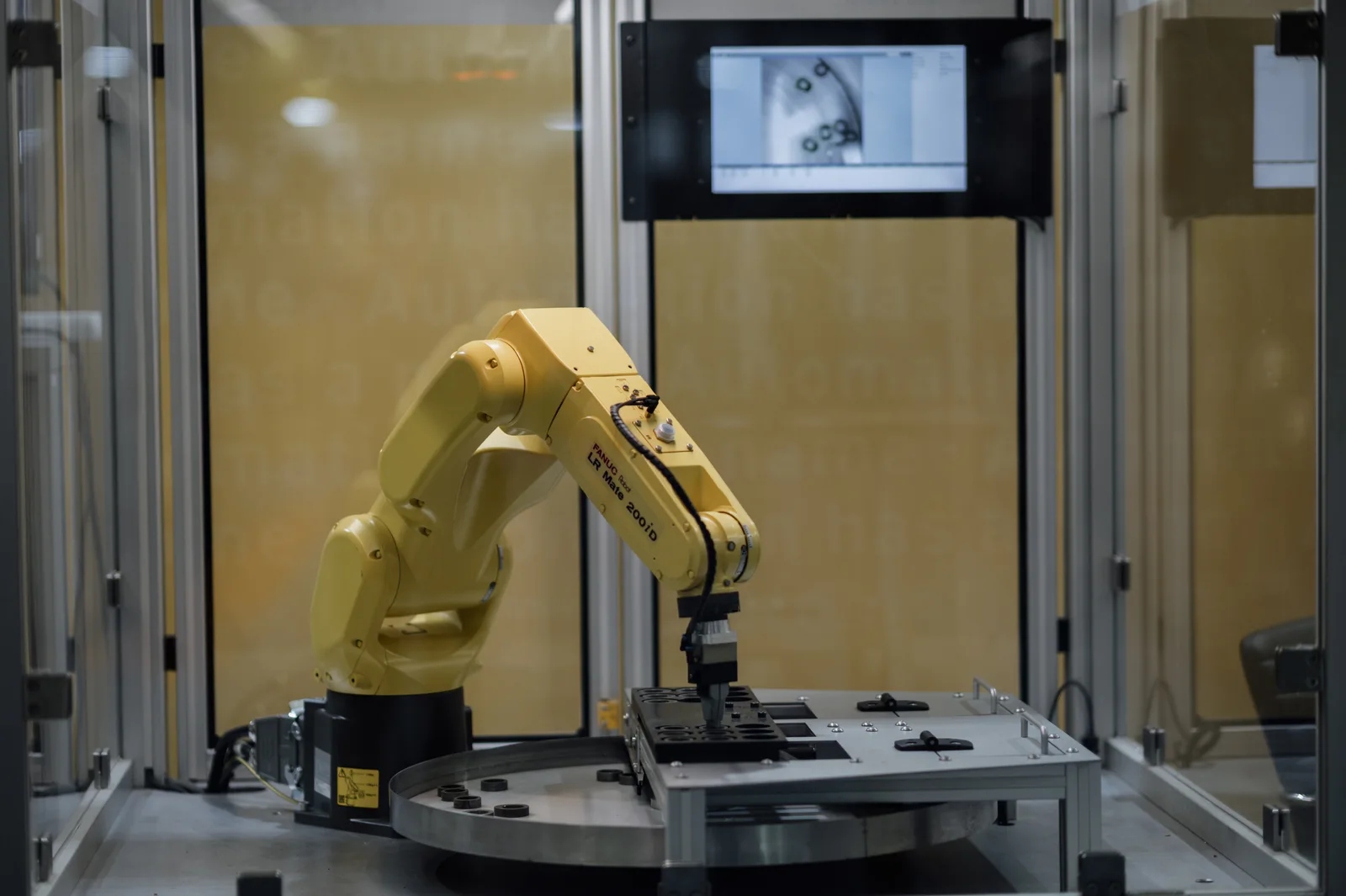
Illustrative photograph Robot arm works on a small component in a lab setting by Nenad Stojković, also known as Shixart1985, under Creative Commons Attribution 2.0. Photographed in May 2026. Resized and converted to WebP. This is unrelated hardware, not a Praxis1 demonstration.