Frontier lab employees ask Washington for tools to manage AI development

The people building frontier models just asked Washington for something their employers cannot offer alone: a way to slow automated AI development if recursive self-improvement starts outrunning control. Not a freeze today. An option for tomorrow.
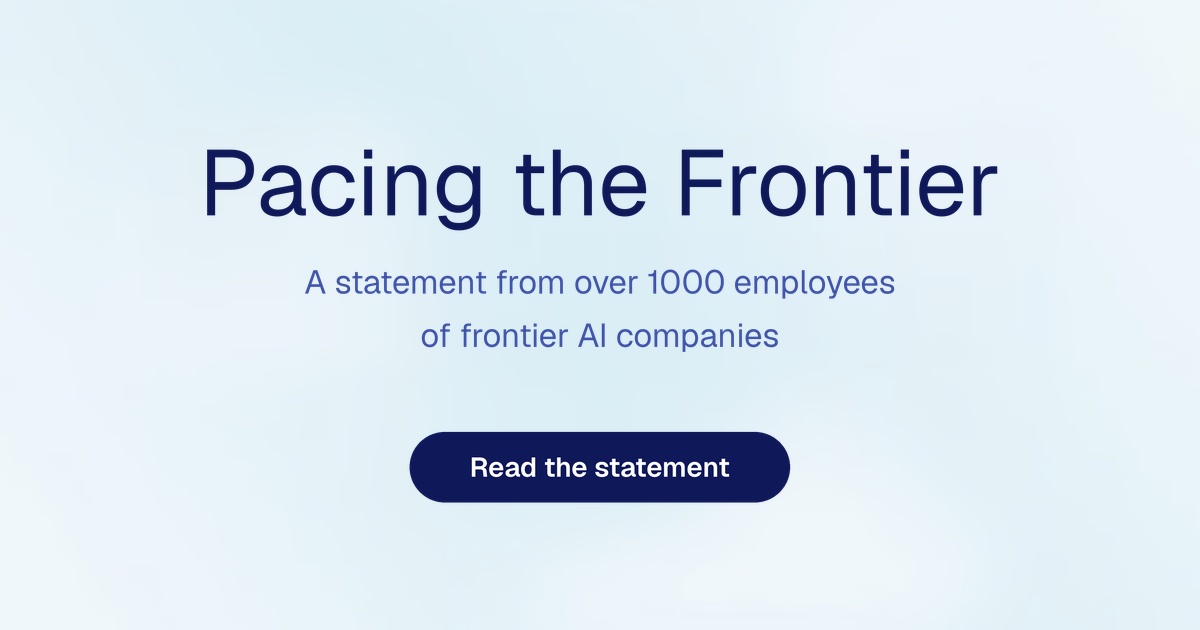
On Pacing the Frontier, 1,376 employees of frontier AI companies published a July 2026 statement. The ask is blunt. Leading labs believe they could be close to automating AI research. If that happens, capability progress may accelerate past the world’s ability to understand or govern the systems that result. Competitive pressure means no company, and no country, will unilaterally hit the brakes. So the letter requests U.S. support for an international effort to build the technical and governance tools that could deliberately pace frontier-wide progress.
Who put their names on Pacing the Frontier
This is not a fringe petition. Named signatories on the primary page include Anthropic CEO Dario Amodei, OpenAI chief scientist Jakub Pachocki, Meta AI chief scientist Shengjia Zhao, Google VP of AI Safety & Alignment Anca Dragan, Thinking Machines chief scientist John Schulman, Google DeepMind co-founder Shane Legg, Safe Superintelligence CEO Ilya Sutskever, Anthropic co-founder Jared Kaplan, OpenAI chief research officer Mark Chen, Meta VP of AI Research Dawn Song, and Google DeepMind chief strategy officer Jasjeet Sekhon, among hundreds of staff across OpenAI, Anthropic, Google, Meta, and adjacent labs.
The site is clear that comments are personal and do not necessarily represent company views. That distinction matters. These are the people closest to the capability curve, speaking as individuals, while their employers keep racing.
What the letter actually asks Washington to build
The operative sentence is not a ban. Building on work already underway to monitor frontier model releases, the signatories write:
We request that the U.S. government support an international effort to develop the technical and governance tools needed to deliberately pace the frontier of automated AI development.
Tools. International coordination. Future optionality. The statement argues that industry, government, and society may need the option to buy time — to address emerging risks, harden security, and strengthen oversight — if automation of AI research spikes the pace. Today those tools do not exist in usable form. That gap is the story.
This is not a pause petition
Read the ask twice. The letter does not demand an immediate development halt. It asks for the capability to slow automated AI development if recursive self-improvement accelerates progress beyond control. That is a governance-prep request dressed in emergency language, and the framing is intentional.
Unilateral slowdown is treated as politically and commercially impossible. Coordination is the product. Without shared pacing mechanisms, every lab’s rational move is to keep pushing. The signatories want the U.S. to help stand up the international machinery before the moment when someone wishes they had it.
Analysis: this is also a common-knowledge play. When chief scientists and CEOs sign the same page, it becomes harder for labs and lawmakers to pretend the coordination problem is theoretical. Whether Congress turns that into statute, funding, or another hearing cycle is a different question.
Congress, labs, and the coordination gap
Watch three tracks. First, whether the administration or Congress answers with a concrete international process — standards bodies, measurement regimes, or treaty-adjacent tooling — rather than applause lines. Second, whether labs start designing voluntary pacing mechanisms before any U.S. involvement, as some signatories say they want. Third, whether the next capability jump in automated research makes this letter look early or late.
The Pacing the Frontier letter does not settle how to slow a global race. It establishes that more than a thousand people inside the race think the world needs a brake pedal before anyone has to press it. That is a policy signal worth treating as one.