Nuix details Neo AI governance framework with agent access for early adopters

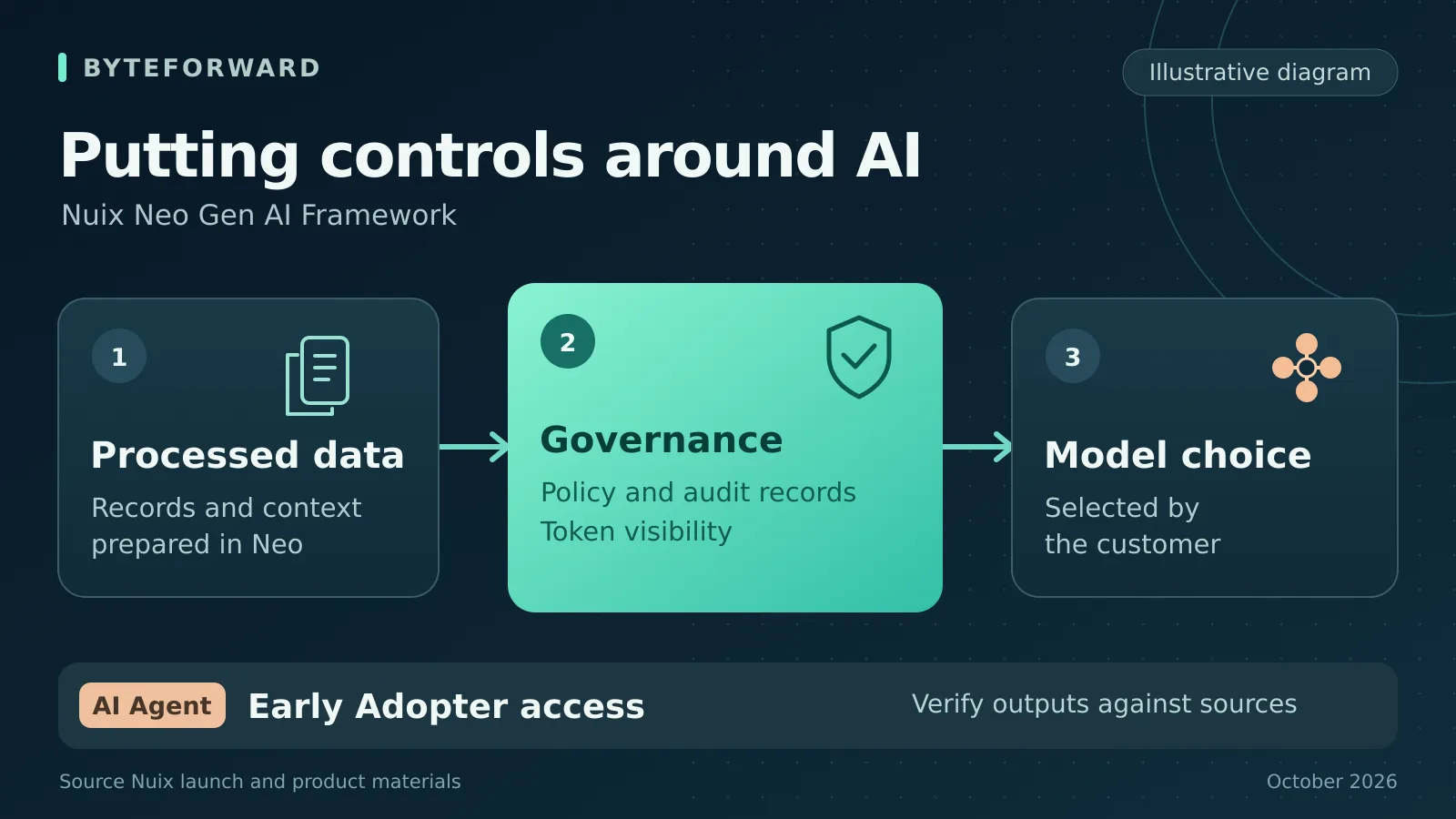
Nuix announced a Gen AI Framework for connecting selected models to data processed in Neo. Its newsroom dates the announcement October 8 in Sydney. PR Newswire distributed the news on October 7 in US Eastern time.
The Nuix Neo AI Agent is available through an Early Adopter program. General availability is not established.
What the framework adds
The framework combines policy controls, audit records, token monitoring and context management. Nuix says BYO AI produces source linked reports across a dataset.
The agent investigates text, metadata and images. Nuix warns that outputs remain probabilistic and require source verification.
That warning matters. A system can document how an answer was produced while still producing an incorrect answer. For an investigation team, the useful test is whether a reviewer can move efficiently from a claim to the relevant record and determine whether the claim actually follows.
Existing capabilities provide context
The wider Neo platform already separates its AI into different categories. Nuix’s product page distinguishes its own deterministic AI from integrated features such as semantic search and transcription, and from connected models accessed through its generative framework. The company also says it records an audit trail during processing.
These distinctions help set expectations. Repeatable processing does not make every connected model deterministic. A buyer should establish which parts of a workflow can be reproduced exactly and which depend on a model whose answers can vary.
Nuix’s existing product update page lists BYO AI and local deployment among its capabilities. That supports reading this announcement as a description of the framework and its applications, rather than assuming that every named capability first became available this week.
Model choice creates operational choices
In a separate governance post, Nuix says its BYO AI framework can connect to OpenAI, Anthropic Claude, Google Gemini, AWS Bedrock and Azure AI Services. It says interaction logs include the model name, time, prompt and response.
The same post describes local deployment through Ollama or vLLM, including configurations isolated from external networks, and says that capability is shipping. That gives organizations a materially different deployment path from sending requests to an external model provider.
The practical question is which configuration a particular customer will use. Teams should confirm where prompts and retrieved records travel, who can access the logs, and what happens when a provider changes a model. Nuix’s list of supported connections does not answer those questions for every deployment.
The customer example has limits
Nuix points to the Los Angeles County District Attorney’s Office as an example of applying selected AI models within Neo workflows. Its case study describes document summaries, structured extraction from reports and warrants, and identifying handwritten material for review. It also discusses token estimates and identifying generated content.
This is an existing customer account. The PDF carries a 2025 copyright notice, and Nuix lists the case study under February 2026. It should not be presented as evidence that the newly announced agent has already completed a broad production rollout.
The case study offers useful examples of tasks the software can support. It does not provide a controlled evaluation, error rates or a measured accuracy improvement that would justify generalizing its results to other organizations.
What buyers should test
For teams evaluating the framework, a focused trial would be more informative than a polished demonstration. Use a representative set of records with known answers. Check whether generated claims point to the right evidence, whether important contrary material is surfaced, and how the system handles incomplete or unreadable inputs.
Cost controls deserve similar scrutiny. Processing every item can create a different workload from retrieving a small subset. Buyers should measure actual token consumption, repeat runs and human review effort before treating predictable spending as an established result.
Nuix is addressing a concrete deployment problem. Organizations want access to changing AI capabilities without losing track of their data and investigative process. The value of this framework will depend on how well its controls work in practice, while qualified people retain responsibility for checking the conclusions.