Mulligan targets robot failures to improve training
Stanford researchers test more selective robot practice with human supervision.

Stanford researchers describe Mulligan, a method for choosing robot practice, in an October 5 preprint. It revisits failed starting positions while also exploring less familiar setups.
A human places objects and corrects mistakes, with retraining between rounds. Collection budgets were matched.
Results from three physical tasks
The authors report that Mulligan, combined with value based action selection, raised final success by 10 to 34 percentage points over an imitation baseline using uniform sampling. A Franka Panda arm performed pen insertion, nut placement and cable routing. The study reports 2,550 physical evaluation episodes without human intervention.
The final pen comparison was statistically significant under the authors’ paired test. The other two were not.
Where the evidence stops
Each physical strategy had one collection campaign. The approach requires an operator who can reset objects. Transfer to other physical tasks was not tested. ByteForward has not reproduced the experiments.
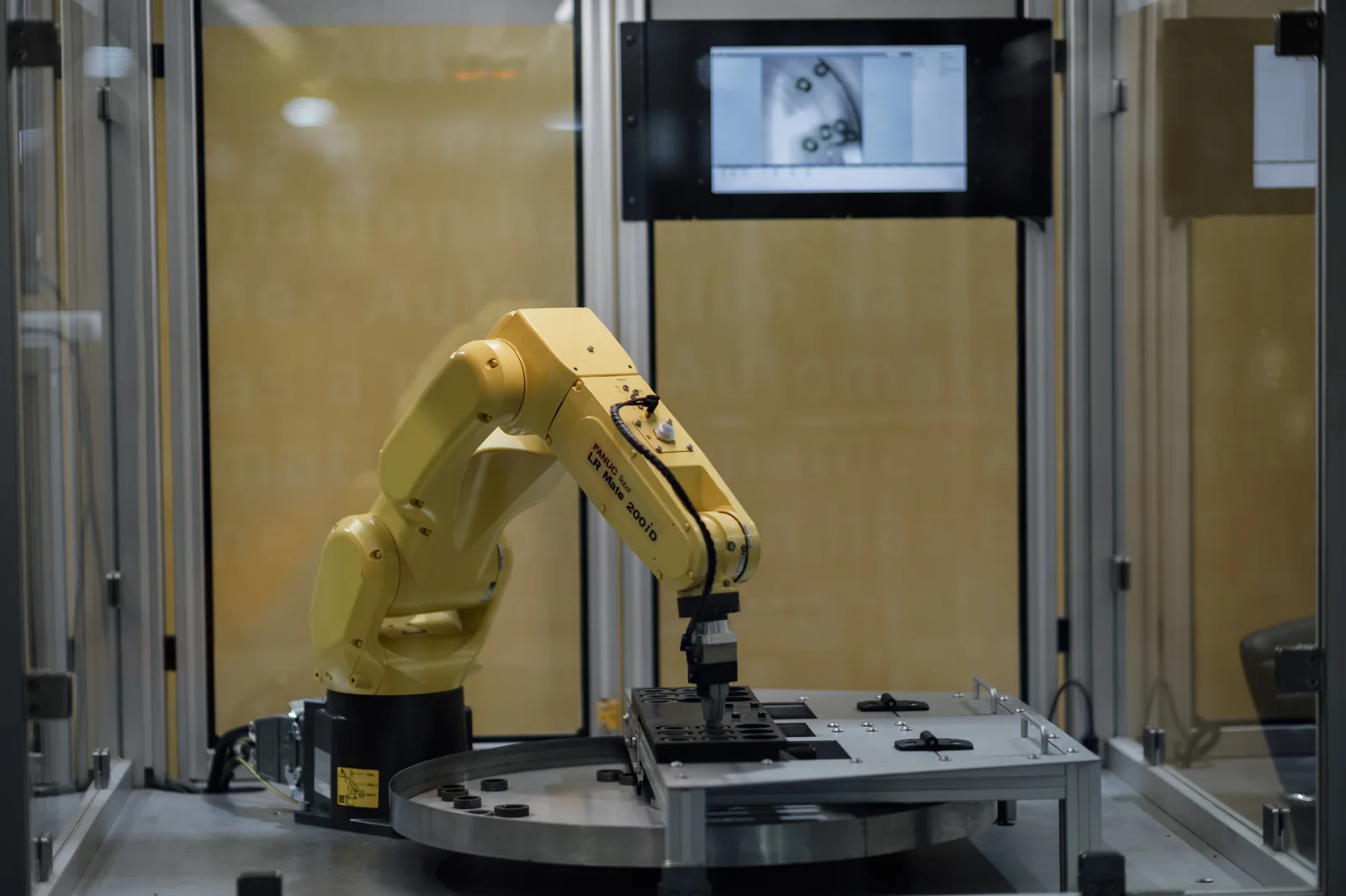
Illustrative archival photograph titled Robot arm works on a small component in a lab setting by Nenad Stojković under Creative Commons Attribution 2.0. Resized and converted to WebP. The photograph shows different equipment from the study.