Oracle adds Vera Rubin to OCI and plans Google TPUs for 2027


Oracle’s October 27 AI infrastructure news has two different timelines. NVIDIA says Vera Rubin NVL72 systems and Vera CPUs are now generally available on Oracle Cloud Infrastructure. The companies also plan a larger, multi-gigawatt deployment and an eight-GPU HGX Rubin NVL8 option.
Google TPUs are further out. Oracle and Google announced that TPU capacity will arrive on OCI in calendar year 2027 and expand over multiple years. They describe OCI as the first hyperscaler outside Google to offer the chips. That is a future deployment, not an instance customers can select today.
What is available, and what is still planned?
| OCI offering | Status announced October 27 |
|---|---|
| NVIDIA Vera Rubin NVL72 | Generally available |
| NVIDIA Vera CPU | Generally available |
| Larger, multi-gigawatt Vera Rubin deployment | Planned expansion |
| NVIDIA HGX Rubin NVL8 | Planned introduction |
| Google TPUs | Starting in calendar year 2027 |
The CPU work between model calls
The Vera CPU announcement targets the work agents do after a model responds, including running tools, executing code and retrieving information. NVIDIA says OCI Kubernetes Engine lets customers scale CPU and GPU resources separately. OpenAI says it is bringing Vera CPUs into production on OCI for agentic sandbox workloads.
That is a different problem from making the model itself generate tokens faster. If an agent spends its next turn waiting for a code test, a faster GPU does not remove that wait. The CPU and GPU stages need capacity for different kinds of work.
Google TPUs would sit closer to Oracle data
The joint Google Cloud engineering post distinguishes two networking jobs. Google’s Inter-Chip Interconnect and Optical Circuit Switching handle traffic within TPU systems. Oracle Acceleron connects that capacity to OCI databases, storage and other infrastructure. The companies propose fine-tuning and serving models near existing enterprise data, rather than moving that work across clouds.
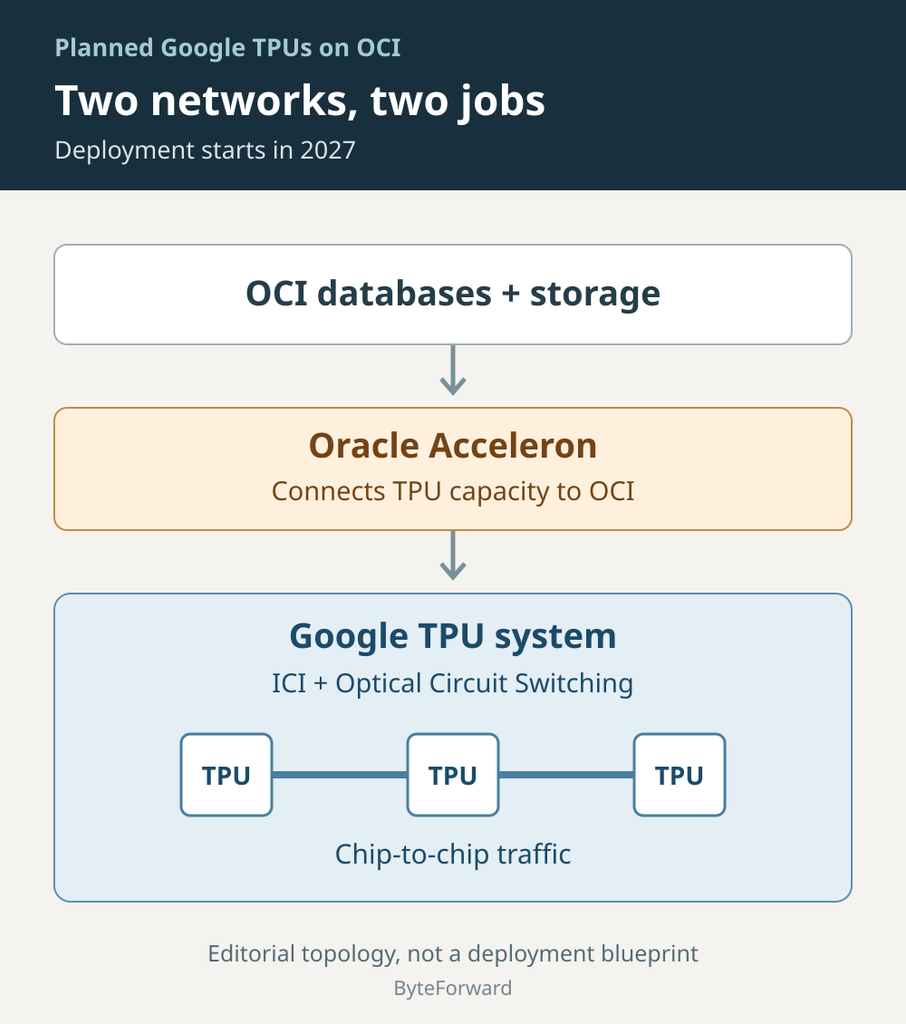
The planned deployment therefore adds a location choice as well as a chip choice. It does not establish that every existing Oracle workload will become cheaper or that all data movement disappears.
Training and serving do not stress hardware equally
For background, Google’s earlier eighth-generation TPU description separates TPU 8t, optimized for large training runs, from TPU 8i, optimized for latency-sensitive inference. Google specifies up to 9,600 chips and two petabytes of shared high-bandwidth memory for an 8t superpod. It describes 8i as pairing 288 GB of high-bandwidth memory with 384 MB of on-chip SRAM.
Those are Google’s architecture specifications, not confirmed OCI launch-instance sizes. The distinction explains the product strategy. Training prioritizes sustained computation across a large system, while serving must also deliver individual responses promptly. Both chip designs can run more than one workload type.
The software route already exists
Google open-sourced TorchTPU on October 20, before this OCI announcement. It brings native PyTorch support to TPUs, including eager-mode debugging and a path to optimization through torch.compile. Google also describes integrations for vLLM serving and TorchTitan training. This is existing TPU software groundwork, not evidence that the future Oracle service is already running.
The TorchTPU repository includes model examples such as Llama, Qwen and ResNet, distributed-training support and interactive notebooks. Its getting-started guidance points to a TPU virtual machine, with a Google Cloud v6e instance suggested as the easiest starting point.
For OCI buyers, the immediate distinction is availability. The announcements do not provide a TPU region list, price sheet or specific 2027 launch date. Existing GPU and CPU offerings, planned capacity expansion and a future TPU service are three different commitments. They should not be treated as one simultaneous rollout.