
Humanoid raises $152 million in Series A funding

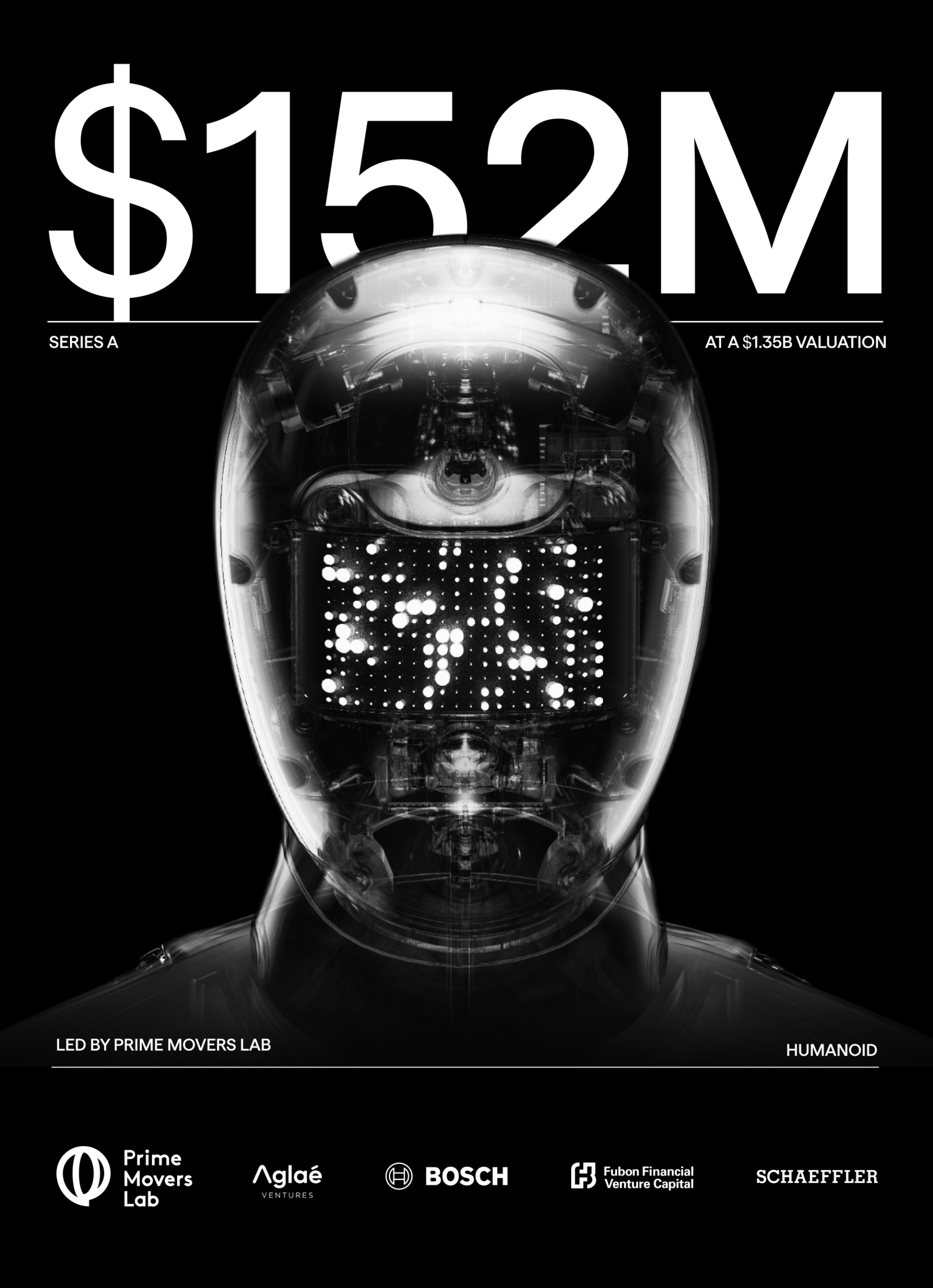
Europe just minted a humanoid unicorn that builds for factory floors, not demo stages. London-based Humanoid closed a $152 million Series A at a $1.35 billion post-money valuation, per a Business Wire release on Morningstar. Two years after founding, it claims Europe’s first pure-play humanoid robotics unicorn — and $270 million raised to date.
Series A terms and who led the round
Prime Movers Lab led. Participants include Schaeffler, Bosch, Fubon Financial Holding Venture Capital, and Aglaé Ventures. Humanoid calls it the largest Series A ever for a humanoid-first robotics firm in Europe.
Strategic money matters more than the vanity mark. Schaeffler is both investor and commercial partner after what Humanoid describes as the industry’s largest publicly announced deal to deploy thousands of humanoid robots in manufacturing. Bosch, through Robert Bosch Robotics, is the contract manufacturing partner and a source of hardware, production, and supply-chain expertise. Named partners elsewhere include SAP, NVIDIA, and Siemens. That is industrial distribution, not a keynote photo.
Founder and CEO Artem Sokolov framed the round as compressing a decade of robotics progress into two years. Prime Movers Lab’s Zia Huque cast Humanoid as one of a small set of category leaders across Europe and beyond. Take the consolidation thesis as investor narrative; the cap table is the harder signal.
Why Europe’s first pure-play humanoid unicorn matters
Physical AI capital has clustered in the United States and China. A UK company clearing unicorn status on industrial humanoids is Europe arguing it can own a slice of that stack instead of importing it. “Pure-play” does work in the claim: not a diversified industrial with a robotics side project, but a humanoid-first company priced like a platform bet.
Labor shortages in manufacturing, logistics, and retail are the demand story. Humanoid’s answer is wheeled industrial robots meant to work beside people, not bipedal moonshots for the stage. Whether that becomes category leadership depends on deployments that stick. Still, a $1.35B mark with Schaeffler and Bosch on the same ticket forces U.S. and Chinese peers to treat Europe as a competitive theater, not a talent farm.
Q4 2026 beta and wheel-based manufacturing plans
Cash funds the next-generation robotics platform, commercial deployments across logistics, manufacturing, and retail, and mass manufacturing for wheel-based humanoids. Beta robots are scheduled for Q4 2026 at customer facilities. That date is the near-term proof point. Unicorn math is easy; thousands of robots that survive a shift are not.
Bosch’s manufacturing role is the quiet enabler. Humanoid can sell the AI and form factor while a Tier-1 industrial partner owns scale production. Offices in London, Boston, Vancouver, and San Diego, plus a claim of more than 250 engineers and researchers, show a company already acting multinational before the beta lands.
What KinetIQ is supposed to ship
All Humanoid robots run on KinetIQ, described as a proprietary four-layer AI framework for real industrial tasks: understand, reason, and execute in messy environments. The Series A is meant to accelerate that “AI brain” toward a general-purpose industrial robot, not just a teleoperated shell.
Analysis: the round buys time to turn Schaeffler’s thousand-unit ambition and Bosch’s factory muscle into shipped betas before the late-2026 window. If KinetIQ holds up on real lines, Europe has a credible industrial humanoid champion with suppliers already inside the building. If betas slip or the wheeled bet looks like a halfway house customers abandon, the unicorn label becomes a fundraising costume. For now, Physical AI’s European chapter has a price tag and a ship date.