Liquid AI launches d1 Ultra for visual decisions

Liquid AI released d1 Ultra on October 15 for structured decisions involving text and images. Liquid targets harder tasks such as visual inspection. Liquid AI announcement
What changed since d1
The earlier d1 release added vision on October 5. It already returned probabilities for predefined answers and supported image inspection. Ultra therefore extends an existing product family rather than introducing image decisions for the first time. Earlier d1 announcement
The output remains a structured choice or score. Developers can ask a yes or no question, select among named categories, or rate an input against an ordered scale. Liquid’s documentation recommends this approach for routing, classification and scoring. Applications that need conversation, explanations or generated code still need a language model for that work. Decision model documentation
Where developers can use it
Liquid’s launch post initially described Vercel and OpenRouter access as coming soon. Vercel’s own October 15 announcement now confirms availability through AI Gateway, including text and image inputs. It lists a context window of 32,768 tokens and says decision requests appear in usage logs and count toward budgets. Vercel availability update
OpenRouter also lists d1 Ultra as available, with the same context window and support for text and images. Its listing describes a decision endpoint that returns probabilities directly from the model, without generated prose. These listing details do not establish performance on a reader’s workload. OpenRouter model listing
How the bill grows
Liquid lists d1 Ultra at $0.042 per million input tokens, compared with $0.02 for d1. Both have zero output token charges. Ultra’s listed input rate is therefore 2.1 times the current d1 rate. The relevant comparison is whether its decisions improve enough to justify that difference for a particular workload. Current Liquid pricing
Question count matters. Liquid bills every question as a separate prompt, including its text and all supplied images. A 1024 by 1024 pixel image counts as 1,536 input tokens. Sending several questions together does not make the repeated image input free. Image billing details
For illustration, 100,000 images of that size would cost about $6.45 for one question each, before text tokens. Five questions per image would raise the image portion to about $32.26. These are calculations from Liquid’s stated token rule and price, not measured application bills.
How to read the performance claims
Liquid reports comparing Ultra with d1 and Jev 1.14 across 112 evaluations. It says the new model improves accuracy and probability calibration. Those are vendor findings, and the launch post does not establish results for a reader’s own production data.
Artificial Analysis includes d1 Ultra in its Decision Index. The index combines knowledge and hallucination checks, multiple choice reasoning, tool calling and safety classification, with each evaluation contributing a quarter of the score. That mix is useful context for broad decision capability, but it does not directly establish accuracy on a company’s defect photographs. Independent index methodology
A useful pilot would compare d1 and Ultra on the same labelled examples, record mistakes and costs, and set a review threshold for uncertain cases. Teams should test the difficult boundary cases that make a wrong decision expensive, rather than choosing a model from its confidence score alone.
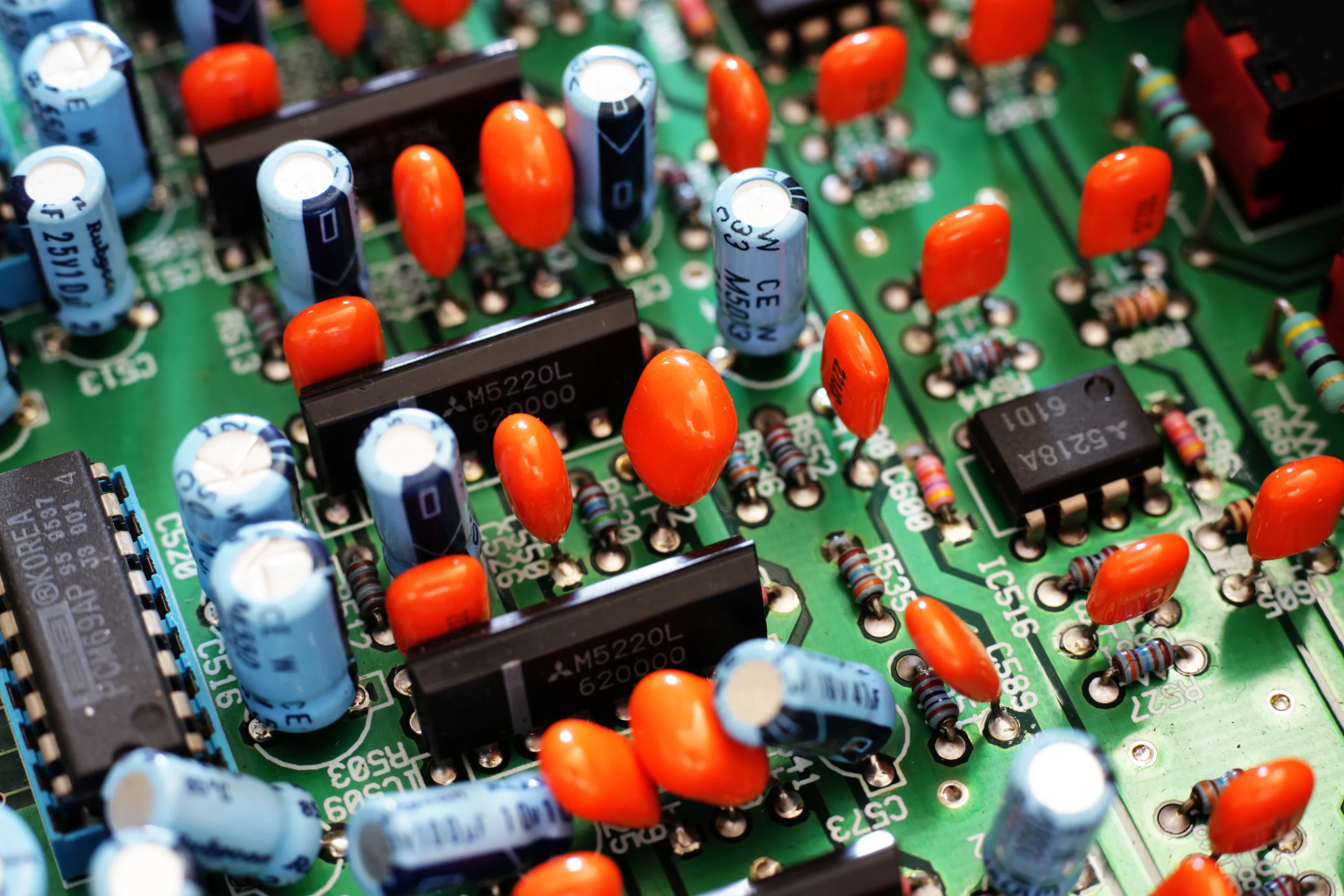
Illustrative circuit board photograph by Ashley Pomeroy, taken in 2023 and shared on Wikimedia Commons under CC BY 4.0. It shows part of an Akai sampler and is not a Liquid AI deployment. No local edits were made. WordPress converted the uploaded image to WebP for display.