Gemini Decision 1 launches for fast AI routing and scoring

Google’s Gemini Decisions API is for applications that need to choose an answer from a defined set. Announced on November 11, 2026, it uses Gemini Decision 1 to return probabilities rather than generate a written response. Developers can start in Google AI Studio now. Google Cloud support is still forthcoming.
The practical question is whether your application needs a decision or an explanation. Sorting a photo into an album is a bounded task. Describing everything happening in that photo is a different job. Start with the required result before choosing the model.
Three question types, with limits worth checking
The developer documentation specifies gemini-decision-1 on the Gemini Developer API’s v1beta endpoint. Shared input can contain text, images, audio, video and PDFs. A request accepts 1 to 1,000 independent questions within 262,144 tokens across the input and questions together. Choice questions allow 2 to 255 options.
| Type | Example to try | Useful result |
|---|---|---|
| noul: yes or no | Does this garden photo contain a flower? | Probability that the answer is yes |
| choice: fixed options | Sort a clip into cooking, gardening, crafts or other. | Selected category and option probabilities |
| score: ordered rubric | Rate a tutorial from unclear through partly clear to clear. | Weighted score across the defined levels |
Questions cannot read one another’s answers. Choice probabilities are distributed among your options even if none fits. Ordered scores can fall between rubric levels, so inspect the probabilities rather than treating every score as a discrete category.
For the clip sorter above, include examples where sound and picture disagree. A gardening video with background music should not quietly become a music category. Decide which evidence matters, document that rule, and check whether another reviewer can apply it consistently.
What $0.10 per million tokens actually buys
Google’s pricing page lists $0.10 per million input tokens across supported modalities, with zero output tokens. Shared input is billed once per request, while each question adds instruction, criteria and formatting tokens. Batch API and context caching are unavailable.
At that rate, 100,000 total billed input tokens cost $0.01. That is arithmetic, not a measured workload price. Count the complete request rather than only the uploaded document, and include retries when estimating a production budget.
The free tier lists data as used to improve Google’s products. The paid tier lists no such use. That distinction is not a blanket privacy guarantee. Review the applicable terms before sending confidential material.
The speed claim has a narrower test window
Google reports 150 to 250 milliseconds of total latency for contexts up to 16K tokens, with performance remaining nearly flat from 1 to 100 questions. Those are vendor measurements, not evidence that maximum context and 1,000 questions finish in the same time. ByteForward has not independently benchmarked the API.
Measure the slowest routine cases as well as the median. Keep image resolution, question count and input length visible in results. A quick average can conceal the requests that leave a user waiting. Compare against your existing implementation using the same inputs and acceptance criteria.
Google links to a Decisions Playground for trying the question types and exporting code. ByteForward has not run a model test.
Choose the deployment around the task
For broader generation and coding, our Gemini 4 Carbon access and pricing guide covers a different model role. If running locally matters, the Liquid AI LFM3 family includes models for structured decisions. These are deployment alternatives to investigate, not an accuracy ranking.
Start with a reversible feature, such as suggested album labels, and retain manual correction. Record which suggestions users change. The useful outcome is less sorting work without a growing correction queue, not merely a fast API response.
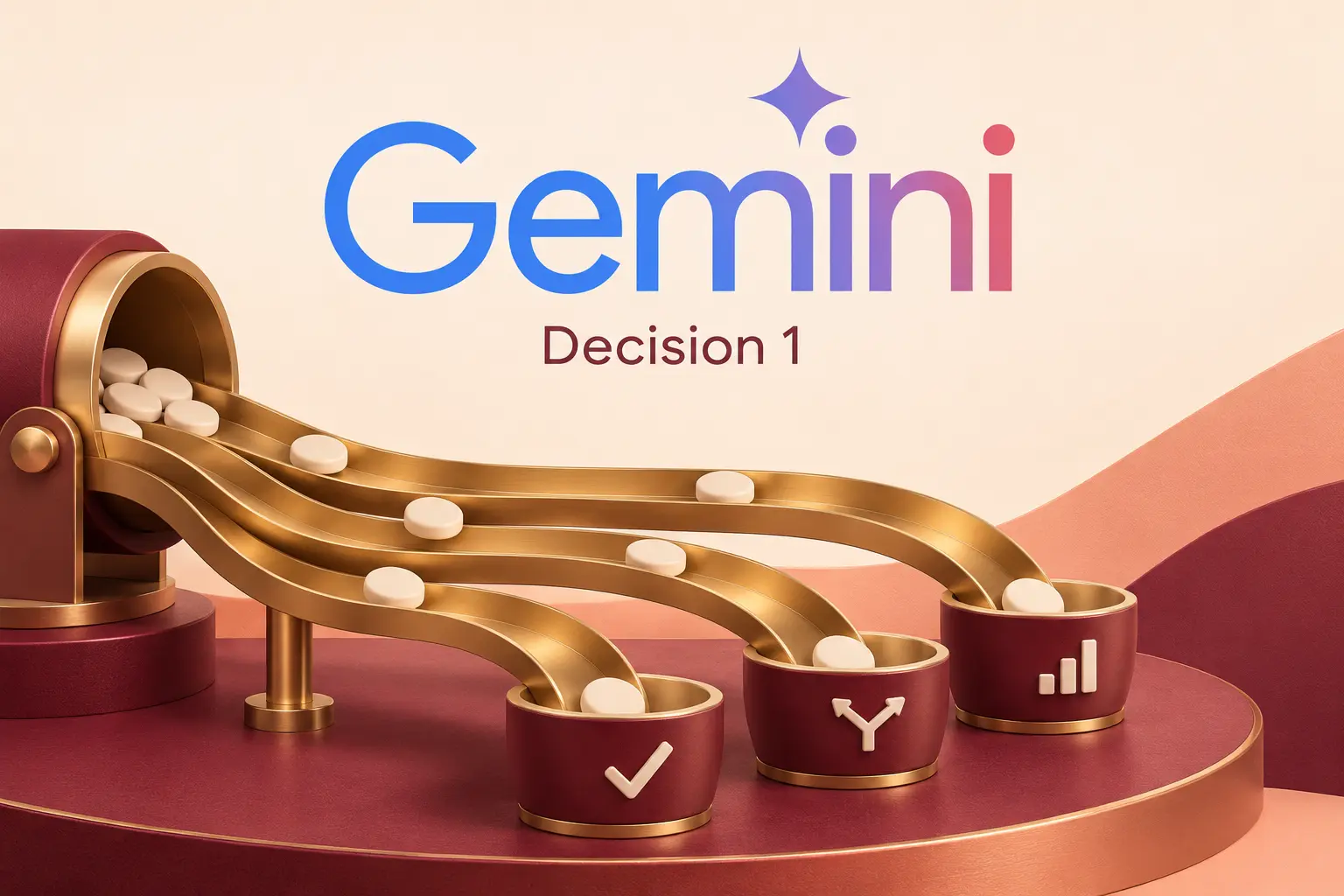
Featured image: AI generated editorial illustration by ByteForward, not a Google product or interface. Gemini and the Gemini logo are trademarks of Google LLC. ByteForward is not affiliated with or endorsed by Google.