Google announces Gemini 4 Carbon, but public access comes later


Google announced Gemini 4 Carbon on October 28, but most users cannot switch to it yet. Access starts this week with selected cyber defenders, followed by additional trusted partners through Fairwind. Google says developers, businesses and consumers will get access later, without giving a public release date.
What the independent evaluations show
Artificial Analysis lists Carbon in its High configuration at 59 on Intelligence Index v5, ranked first in its displayed comparison. The page reports no public API and no output-speed measurement. Its estimated evaluation cost is $7.76 per index task, using $4 input and $20 output pricing per million tokens. That is not a universal cost per user request.
| Evaluation | Carbon High snapshot | Qualification |
|---|---|---|
| Text Arena | First, 1528 ±9 | Preliminary, rank spread 1 to 2 |
| Agent Arena | Second, 21,922 sessions | Preliminary, distinct agent-session signals |
| WebDev Arena | Fourth, 1768 ±15 | Preliminary, rank spread 2 to 6 |
These are different evaluations, not three interchangeable measures of intelligence. Text Arena covers text responses, while Agent Arena incorporates signals including success, satisfaction and steerability. Its second-place ranking is not a second-place claim for every coding task.
The Arena pages displayed an October 27 date when checked on October 28. Google’s WebDev score changed from 1769 to 1768 that day. The table uses the observed leaderboard snapshot. Preliminary ranks and overlapping uncertainty ranges are reasons to avoid declaring an uncontested winner.
HLE-Diamond adds a no-tools comparison
Updated October 30, 2026 (UTC): Artificial Analysis’s October 29 leaderboard announcement adds a narrower comparison than its composite Index score. The HLE-Diamond results list:
| Model configuration | Overall | Reasoning | Knowledge |
|---|---|---|---|
| Gemini 4 Carbon (High) | 69.1% | 79.6% | 58.6% |
| Claude Opus 5.5 (Max, DefaultFallback) | 67.9% | 78.0% | 57.8% |
AA tests 1,000 questions: 500 reasoning and 500 knowledge, with images in 272. Each model answers once without tools. GPT-5.6 Luna at medium effort grades responses against reference answers using the official HLE judge prompt. These are AA’s results, not tests conducted by ByteForward.
The 1.2-percentage-point overall gap does not by itself establish a statistically meaningful advantage. HLE-Diamond differs from AA’s earlier text-only HLE evaluation, so the percentages are not a like-for-like improvement measure. This benchmark update does not change Carbon’s restricted-access status.
Introductory pricing is not the permanent rate
Google announces introductory pricing of $2 per million input tokens and $10 per million output tokens, with a 95% cached-input discount. Its footnote gives subsequent rates of $4 and $20. Google gives no end date.
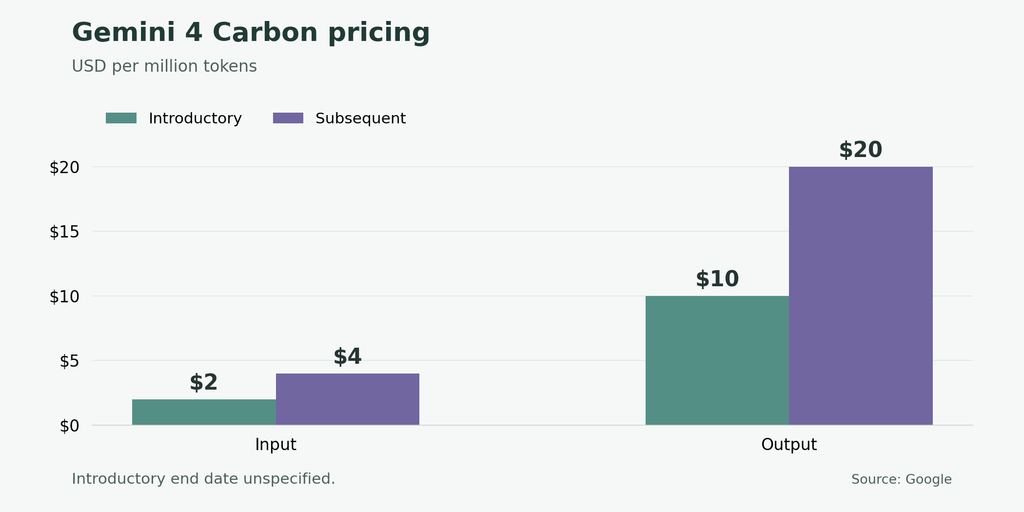
That explains why the launch price and Artificial Analysis’s listed price differ. Compare costs at the same rate schedule and reasoning setting, then measure how many tokens a complete task consumes. A cheap output token does not necessarily mean a cheap completed job.
Fairwind is an application route, not open access
The Fairwind program page prioritizes governments, critical infrastructure operators and core technology platforms. Applications are vetted, access is controlled and partners cannot redistribute or sell it. The page still describes Argon in several technical sections. Those existing details do not independently establish Carbon’s retention settings, integration support or availability to every current partner.
What to test when access reaches your workflow
For a practical comparison, use a small repository with a known failing test and a written acceptance checklist. Ask each model to diagnose the failure, propose the smallest change and identify what it could not verify. Keep tools, permissions and time limits consistent. Record successful completion, total tokens, elapsed time and reviewer corrections rather than judging the first patch alone.
This is an illustrative evaluation plan, not a test ByteForward performed. Until wider access arrives, the useful distinction is between promising benchmark results and a model you can deploy. Our Intelligence Index v5 explainer covers why the new score scale should not be compared directly with the previous version.
AI-generated editorial illustration by ByteForward. Gemini logo reference from the official Gemini website. Gemini is a trademark of Google LLC. ByteForward is not endorsed by or affiliated with Google.