California adds AI layoff disclosures and workplace surveillance limits
SB 951 adds technology details to covered layoff notices while AB 1883 limits AI emotion and neural monitoring, with exceptions

California Governor Gavin Newsom signed SB 951 and AB 1883 on September 30 as part of a wider workplace AI package. The two laws address employer obligations around technological displacement and employee surveillance.
Applying California’s standard effective date rule, both laws take effect on January 1 2027. Neither chaptered text contains an urgency clause or later operative date. Employers have a preparation period before the new duties begin.
More detail in existing layoff notices
SB 951 adds technology details to notices already required under California’s WARN law. It applies when AI or other automation causes a covered mass layoff, relocation or operational closure wholly or substantially.
Covered establishments employ, or employed within the previous 12 months, at least 75 people. A mass layoff means at least 50 employees within 30 days. The existing 60 day notice period remains.
Notices must detail layoff counts, occupations, work locations, automated functions and technology types. Notices need a technology displacement label. The Employment Development Department must publish notice summaries and quarterly statewide summaries.
An agency report due January 1 2028 will examine AI’s hiring effects and may recommend future notice requirements for permanent hiring cessation. SB 951 does not itself require notice whenever a business stops hiring.
Limits on emotion and neural monitoring
AB 1883 restricts AI surveillance used on employees to recognize, infer or predict emotions, or collect neural data. Neural data means measurements of central or peripheral nervous system activity, excluding inferences from nonneural information.
The law permits surveillance to ensure safety. A separate exception covers certain aircraft, national security, military, space and defense operations, only where tool use is reasonably necessary to meet a federal statute, regulation or binding contract.
Public employers are included. The Labor Commissioner and public prosecutors may enforce the rules, with penalties of up to $500 per violation. The restriction concerns these uses of AI surveillance, rather than every workplace monitoring system.
Definitions remain an issue
Newsom’s signing letter nevertheless asks lawmakers to refine AB 1883 because missing definitions could create uncertainty about covered tools. He supports limits on harmful surveillance while warning that unclear scope could affect beneficial security uses. The letter accompanies his signature and requests further legislative work. It does not suspend the enacted restrictions.
AB 1331 separately restricts bathroom monitoring, with court order and other exceptions. It allows checks for a single entry and exit. Certain required identification, safety or access devices remain permitted only if they neither detect nor record audio or video and have no physically embedded or attached AI.
The package also contains the separate SB 947 human review rules for disciplinary decisions, which ByteForward covered previously.
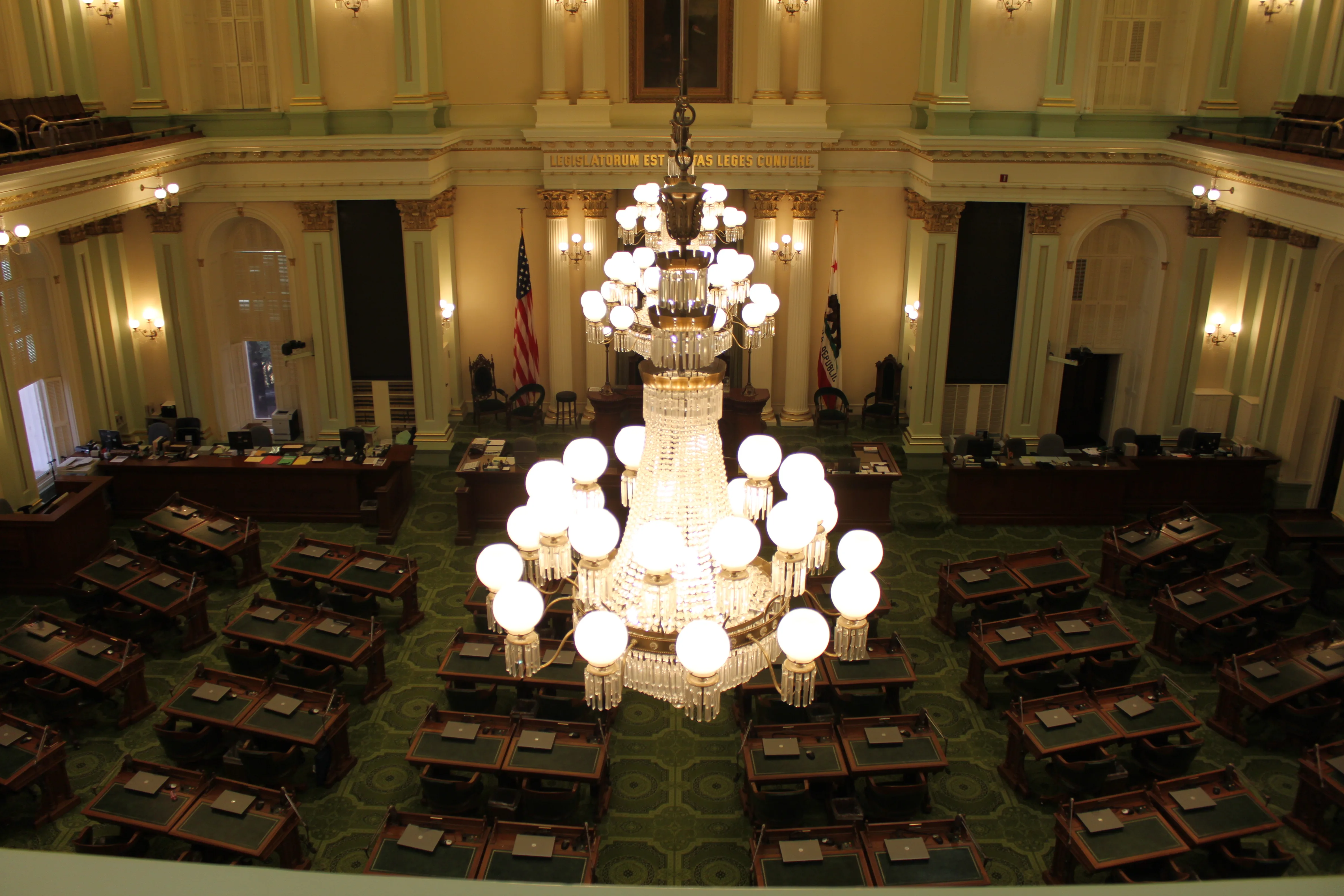
Archival photograph Assembly Chamber at the California State Capitol by BenFranske, taken on July 13 2013. Licensed under Creative Commons Attribution ShareAlike 3.0. Converted to WebP for site delivery.