Blacksmith backs CI capacity as coding agents increase testing demand

Blacksmith announced a Series C led by Sequoia Capital on October 21, 2026, valuing the company at $1 billion. The funding backs infrastructure for building and testing software as coding agents increase the volume of changes that engineering teams need to check. Its announcement puts total funding at $125 million.
The company says weekly jobs rose from 5 million in January to more than 90 million, while annual recurring revenue grew 17 times. Those are company reported figures, not independent measurements. It plans to expand a compute footprint of just under 10 megawatts across the United States and Europe fivefold in 2027.
Why this is an AI infrastructure story
An agent can propose a patch without proving that the patch works. Continuous integration, or CI, runs builds and tests against changes. More code can therefore create more demand for computing even when the model generating it becomes faster.
Anthropic documented this pressure in a September engineering account. Its CI job volume grew 25 times over six months. That report describes one organization, not an industry average.
This distinction matters when evaluating infrastructure claims. Running more jobs and deciding which jobs should run are separate problems. Buying execution capacity does not by itself establish that a test suite covers the failure a coding agent introduced.
What teams can use now
Blacksmith’s setup guide describes a GitHub integration and a migration wizard that updates workflow files. The documented alternative is changing the runner selection for each relevant job. The service is restricted to GitHub organizations rather than personal repositories.
Organizations with IP allowlists or network restrictions may also need to permit the control plane to communicate with GitHub. Integration permissions, workflow coverage and network requirements belong in a deployment review, even if the runner change itself is small.
The documentation also covers caching dependencies and Docker layers, plus logs, run history and test analytics. These are practical areas to measure during an evaluation. Compare waiting time, execution time and repeated build behavior on your own workloads instead of assuming a vendor’s headline speed claim applies to every repository.
A separate beta for evidence about changes
Blacksmith’s Proof documentation describes a private beta that executes a proposed change and records results alongside the pull request. It compares the main branch and proposed branch under the same interaction or test.
Examples include recordings for interface changes, matching load tests for performance changes and command output for command line work. This is a narrower claim than proving a program correct. A reviewer still needs to decide whether the recorded scenario tests the intended behavior and whether important failure cases are missing.
The funding announcement does not turn that private beta into general availability. Teams interested in it must distinguish access to ordinary CI runners from access to this additional review product.
Capacity is not the only constraint
A September technical report explains why bursty CI workloads are difficult to place. A large job may need an almost empty host, while smaller jobs leave capacity scattered across machines. Blacksmith describes replacing independent host polling with centralized assignment to improve scheduling across its fleet.
That engineering context helps explain what the new investment is intended to scale. It does not independently verify performance or guarantee that queues disappear during peak demand. ByteForward has not tested the service.
The broader investment in agent infrastructure also includes Daytona’s execution cloud. Its environments and persistence rules address a different deployment question. Teams should compare the actual workload and access boundaries rather than treat all agent infrastructure as interchangeable.
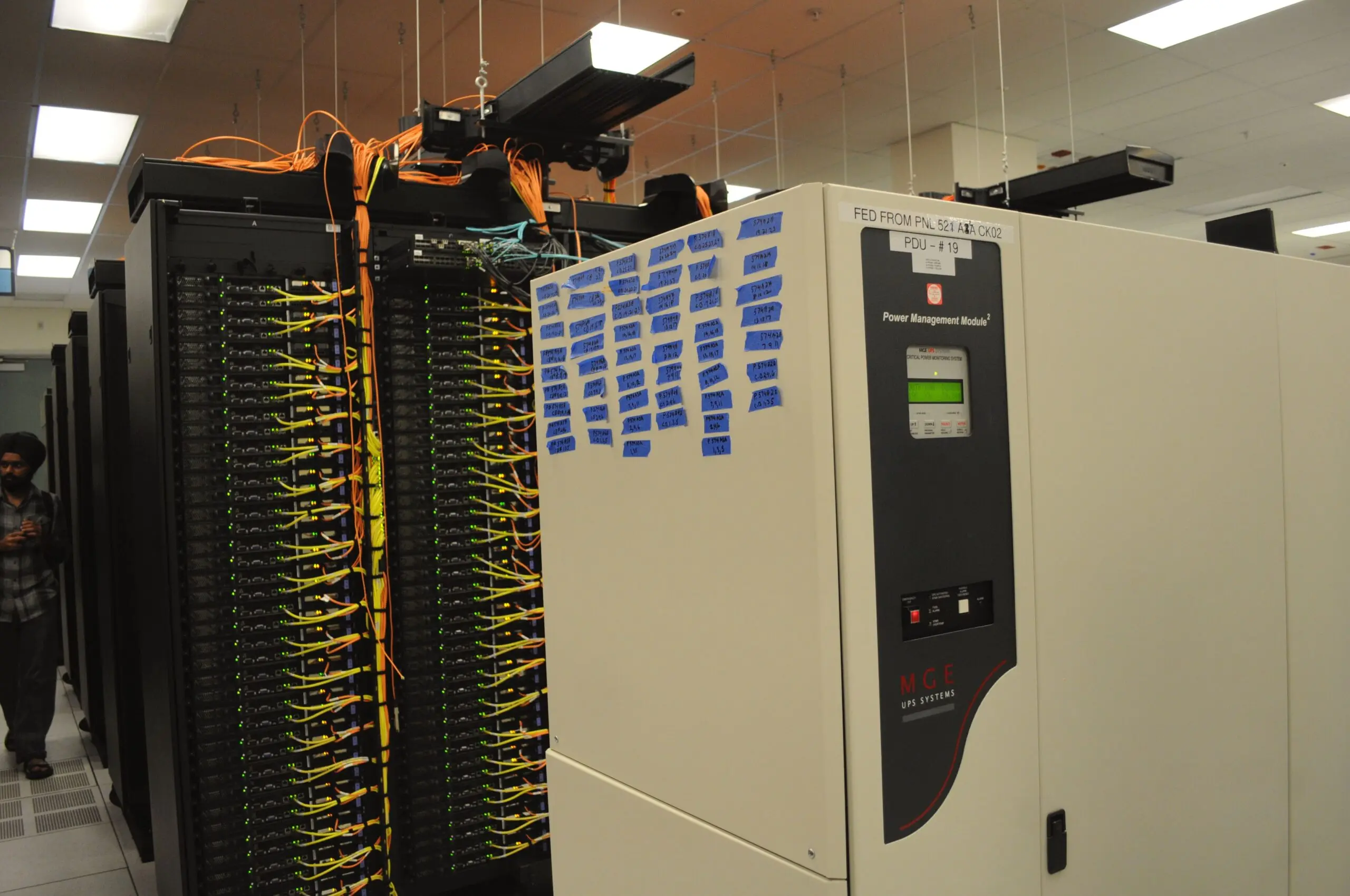
Illustrative archival photograph of server infrastructure at NERSC in 2011. Photo by Chiara Coetzee via Wikimedia Commons, released under CC0 1.0. The image does not depict Blacksmith facilities.