Flapping Airplanes raises $1 billion for more efficient AI

Index Ventures identifies Flapping Airplanes’ financing as a $1 billion Series A in its October 21 announcement and says partner Mark Xu is joining the board. This is an investment announcement, not evidence of a customer model release.
What the investor says the team is building
Index describes a small San Francisco team working across GPU kernels, model training and inference. Its central technical claim concerns megakernels that execute a program within one GPU kernel, reducing time lost between steps. Those descriptions come from an investor in the company, not an independent performance evaluation.
The useful distinction is between a research direction and a measured result. The announcement does not supply a reproducible benchmark suite, deployment instructions or a price list. It cannot tell a buyer how much a particular workload would save.
Why time between GPU operations matters
NVIDIA explained the underlying scheduling problem in its 2019 introduction to CUDA Graphs. A short GPU operation can finish so quickly that the overhead of submitting work becomes a meaningful part of total runtime. Repeating many such operations can compound that cost.
CUDA Graphs address this by representing several operations as a graph that can be launched through one CPU operation. That is useful context, but it is not the same claim as running an entire program in one GPU kernel. Nor do NVIDIA’s examples establish the performance of Flapping Airplanes technology.
For an evaluator, the first question is therefore where time is going. Reducing submission overhead matters most when that overhead is a material bottleneck. It should not be assumed to deliver the same benefit for every model, input size or hardware configuration.
What developers can examine today
A separate public reference is ThunderKittens, a framework for writing CUDA kernels around small data tiles. Its documentation describes techniques involving tensor cores, asynchronous transfers and overlapping computation with input and output work. It is maintained by Stanford Hazy Research graduate students and is available under the MIT license.
That repository is inspectable software, not a substitute for Flapping Airplanes benchmarks. Its current instructions also make deployment constraints concrete. Individual kernels must be compiled separately, and the maintainers say they no longer actively support Ampere GPUs. Hardware support is a real selection criterion, not a footnote to a speed claim.
What would make the efficiency case convincing
A useful evaluation would compare the same task, output quality and hardware while reporting latency, throughput and resource use. Training and serving should be assessed separately rather than collapsed into one efficiency number. Engineering effort and compatibility matter alongside raw speed.
The distinction also applies to retrieval and document processing models. Choosing a capable model and executing its workload efficiently are related decisions, but one does not prove the other.
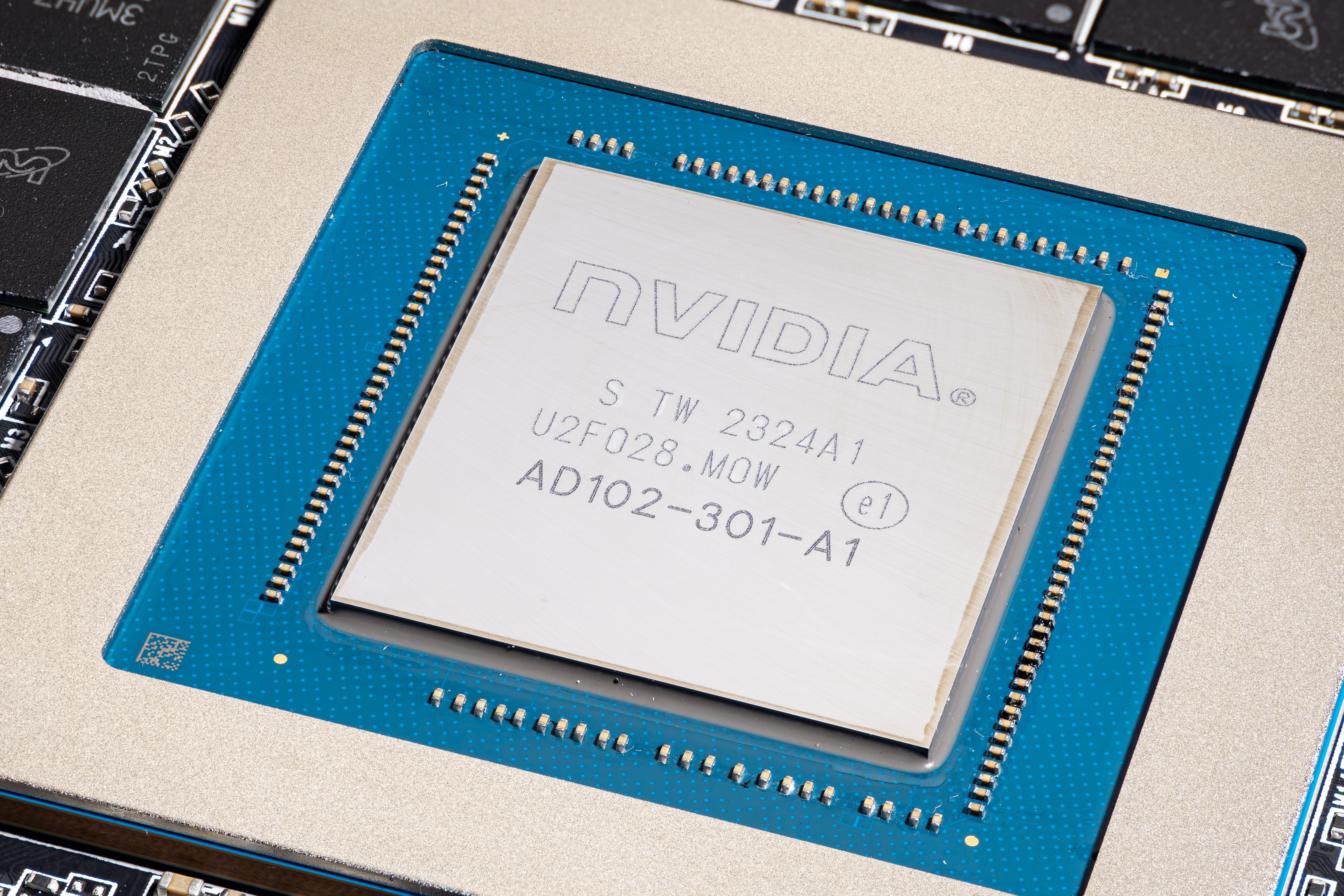
Illustrative NVIDIA GeForce RTX 4090 chip photograph by Fritzchens Fritz. Public domain under CC0. This is not a photograph of Flapping Airplanes equipment.