Intel Inference Microservices brings tuned LLM serving to Xeon

Intel has announced Intel Inference Microservices, a set of containers that package language models with serving settings tuned for supported Xeon processors. Each container detects its host and selects a configuration behind an OpenAI compatible API. The practical pitch is to reduce the work of putting existing server capacity to use for AI inference. Intel’s announcement says the current release uses vLLM, with GPU support and additional engines still planned.
Intel’s newsroom dates the announcement October 14. The documentation carries a September 24 update date, so the announcement should not be read as proof that the software first became available this week.
Which servers and models qualify
The supported hardware list covers fourth and fifth generation Xeon processors, plus both performance core and efficient core Xeon 6 families. Those are Sapphire Rapids, Emerald Rapids, Granite Rapids and Sierra Forest. The runtime checks the processor’s capabilities and the cores available to the container, rather than relying only on its product name. A container assigned a fraction of a server’s cores gets a configuration for that allocation.
Memory remains a real constraint. Intel suggests 32GB for smaller models, 48GB around 14 billion parameters, 64GB around 20 billion and 96GB around 30 billion. Those are starting points for modest context and low concurrency. Longer prompts and more simultaneous requests increase memory use. For a mixture of experts model, memory sizing must account for all parameters, including experts that are inactive for a particular token.
The setup requirements include Linux, Docker 20.10 or later and at least 50GB of free model cache storage. Intel recommends Ubuntu 22.04 LTS or later. The serving engine and its dependencies are included in the image, so a separate vLLM or Python environment is unnecessary.
Intel’s documented catalog lists 11 model images at version 0.1.0. They span Qwen3, Llama 3.1 and 3.2, Granite, Phi, Mistral, Gemma and OpenAI’s gpt-oss-20b. The example used in the quickstart is Qwen3-4B. This is a menu of specific model versions, so teams should copy the exact image from the listing rather than assume a newer release from the same family has a tuned container.
The model licenses still apply. Qwen3-4B uses Apache 2.0, while Llama 3.1 uses Meta’s community license and requires access approval on Hugging Face. A common deployment interface does not make those terms interchangeable. Review the particular model’s license and access requirements before choosing it for a commercial service.
The tuned path has a deliberate stopping point
The model image and base image serve different purposes. A catalog image brings the configuration Intel tested for that model. The base image accepts a Hugging Face model identifier and uses the same serving runtime. This lets a team try a model beyond the catalog, but it should not be described as Intel validation of every model that can load.
The fallback behavior is important on a mixed server fleet. A model specific image stops when no compatible profile matches. The base image can instead select a general hardware configuration, without model specific tuning. A successful startup therefore does not, by itself, establish that the intended optimized profile is active.
Intel provides inspection commands for that check. Use detect-hardware to see the processor and resources visible inside the container, list-profiles to inspect compatible configurations, and dry-run to see the resolved engine command. These inspection commands do not load model weights or open the serving port, making them useful before a rollout.
Production needs more than a running container
The most consequential limitation is in the security documentation. The container’s endpoint provides neither authentication nor TLS. Anyone who can reach its port can send requests and read exposed model information or metrics. Intel says to treat it as an internal service and put an ingress or API gateway in front for encryption and access control. Keeping inference on company hardware still leaves the team responsible for protecting the endpoint.
Model downloads also affect startup. Persistent caching allows weights to be downloaded once and reused, instead of fetched again after each fresh container run. On Kubernetes, an init container can populate a persistent volume before the serving container starts. That avoids tying every restart to another large download and helps separate the download step from serving traffic.
The Kubernetes guide uses a Deployment and Service around the same image. Teams need to pin workloads to compatible Intel nodes, size their resource requests and preserve readiness checks so requests reach only a loaded model. A startup probe allows time for loading before ordinary health checks begin. The supplied manifest is a starting point, with production requirements that include model caching and appropriate network access for downloads.
API compatibility has limits
The validated feature list includes chat and text completions, streaming, health checks and Prometheus metrics. The published images use BF16 precision. Tool calling, structured output, reasoning parsers and other vLLM options can be configured through engine arguments, but Intel classifies these as capabilities passed through to vLLM rather than validated model configurations. Their parsers and backends still need to match the selected model and be tested.
One container serves one model. For a broader shared service, Intel points to its separate AI for Enterprise Inference project on GitHub. That project adds Kubernetes serving infrastructure, routing and gateway services, and can use vLLM or OpenVINO Model Server. Its repository explicitly depends on the larger Intel AI for Enterprise Solutions platform. Those capabilities belong to a wider stack, not automatically to every microservice container.
What a useful evaluation should establish
ByteForward has not benchmarked these containers. Intel’s announcement does not provide a reproducible comparison that establishes a universal speedup or a lower cost than GPU serving. The strongest immediate use case is a team with suitable Xeon capacity and a model that fits its memory budget. For that team, a prepared configuration offers a concrete starting point for evaluation.
Measure the actual workload before moving production traffic. The API reference exposes queue depth, time to first token, complete request latency and token counts through Prometheus metrics. Test realistic prompt lengths and concurrent users, confirm the selected profile, and include infrastructure and operating effort in the cost comparison. The useful result is a service that meets the application’s latency and reliability needs on the hardware available.
For related hardware coverage, see ByteForward’s report on Intel D270 and Crescent Island sampling.
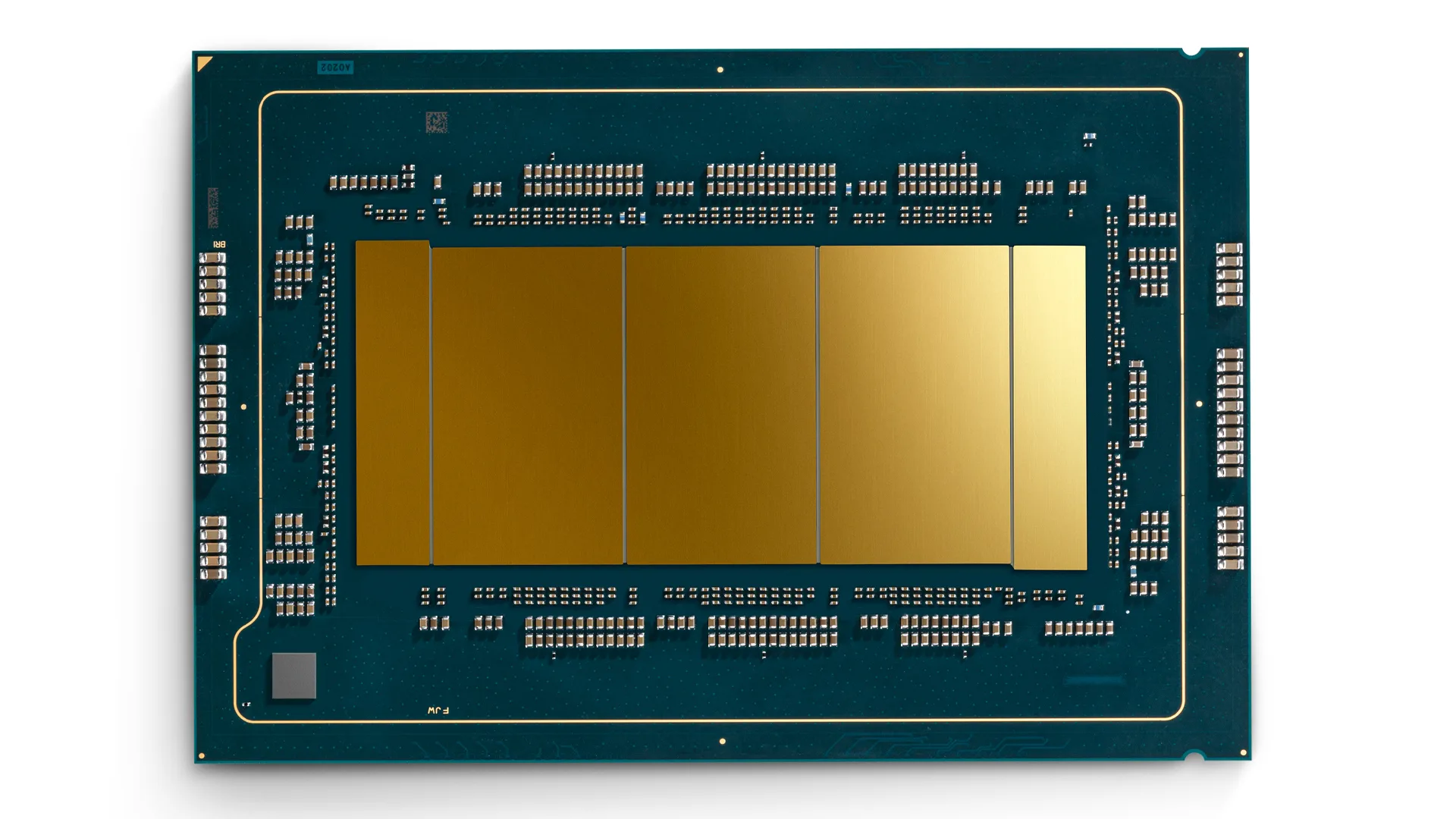
An Intel Xeon 6 processor with P cores, shown in a September 2024 product photograph. Credit Intel Corporation. Used under Intel’s editorial reuse terms.