

Google SynthID Bio brings AI watermarking to proteins
Google DeepMind’s SynthID Bio marks AI designed proteins while preserving function in lab tests. Here is what the study establishes and what still needs work.

Google DeepMind has introduced SynthID Bio, a way to mark proteins designed by AI so their origin can be checked later. Announced on September 30, the research extends watermarking into biological sequences and predicted molecular structures. Google says its laboratory tests preserved the function of the protein binders it tested.
The important development is the link between digital design and physical biology. A provenance signal can travel with the protein itself. The announcement describes a proof of concept, with substantial work remaining before it becomes a dependable screening system.
What SynthID Bio actually does
SynthID Bio has two branches. The sequence version works with ProteinMPNN, a model used to design protein sequences. It steers generation toward amino acid choices that carry a detectable pattern. The structure version uses a modified AlphaFold 3 model to embed a signal in predicted three dimensional molecular coordinates.
Google’s public research repository makes that distinction explicit. One approach marks the sequence a design tool produces. The other marks a structural prediction. A result from one branch should not be treated as evidence that every kind of biological object can be marked equally well.
What the experiments established
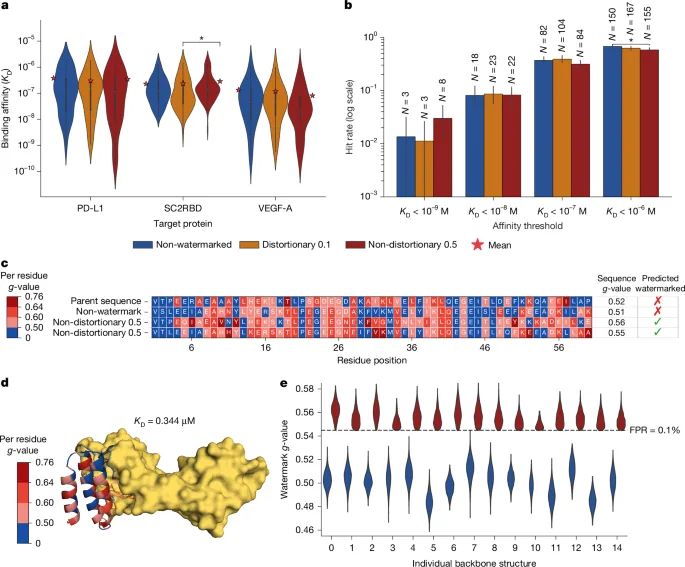
The Nature paper tested protein binders against three targets. Researchers began with backbones from known binders, then generated new sequences with and without watermarking. That is a meaningful laboratory test, but its scope matters when interpreting the result.
| Research branch | Reported result | Important boundary |
|---|---|---|
| Protein sequences | Broadly comparable binding performance across three targets | Tests used selected backbones from known binders |
| Predicted structures | Detection exceeded 99.8% at a 0.1% false positive rate | This measures a benchmark under specified settings |
The detection percentage is easiest to misuse. It describes how often the tested detector found the watermark at a chosen error threshold. It does not establish that an unfamiliar protein is harmless or that all AI designs can be identified.
Why this goes beyond watermarking AI images
Google’s existing SynthID system embeds signals in generated images, video, audio and text. Those marks are designed to be invisible or inaudible while remaining detectable by software. In text, for example, watermarking adjusts the probability of token choices during generation.
That makes biological watermarking a natural extension of provenance research, although biology adds a demanding requirement. A marked design still has to perform its intended function. A signal that makes a protein easier to identify but undermines its usefulness would offer researchers a poor trade.
Readers following this issue can also see our coverage of Claude watermarking. The common question is what a detectable mark actually tells the person relying on it.
Where the practical value could emerge
DeepMind identifies two possible uses. DNA synthesis providers could use provenance as an additional signal when reviewing orders. Scientific databases could flag synthetic entries for closer review, reducing the risk of generated data being mistaken for other kinds of evidence.
Google also describes early work with Stanford and Arc Institute on watermarking an AI designed bacteriophage. Further technical details are still to come. That effort should be read as an extension under investigation, separate from the published protein results.
The limits that matter before deployment
The Nature authors call the operational applications hypothetical. Their tests also found that deliberate modifications could remove watermarks. They recommend layered screening rather than treating a detected mark as a reason to abandon other checks.
For a synthesis provider, the useful question is therefore whether provenance improves an existing review process. It would need to help staff make better decisions without creating misplaced confidence in a design. Adoption, verification procedures and error handling deserve as much attention as a strong laboratory detection score.
The code is available in the research repository, which separately lists terms for model weights. For now, SynthID Bio gives researchers a concrete system to evaluate. Its significance will grow if that technical result translates into trustworthy decisions outside the original experiments.
Featured image reproduced from Figure 2 by Stutz and colleagues, Nature, 2026, under CC BY 4.0. No editorial alterations were made. The site converted the file to WebP and may crop its display to fit the article cover.



[…] coverage of Google’s SynthID Bio research illustrates the distinction between a promising technical result and an operational system. A […]