NVIDIA releases NeMo Switchyard to route agents across AI models

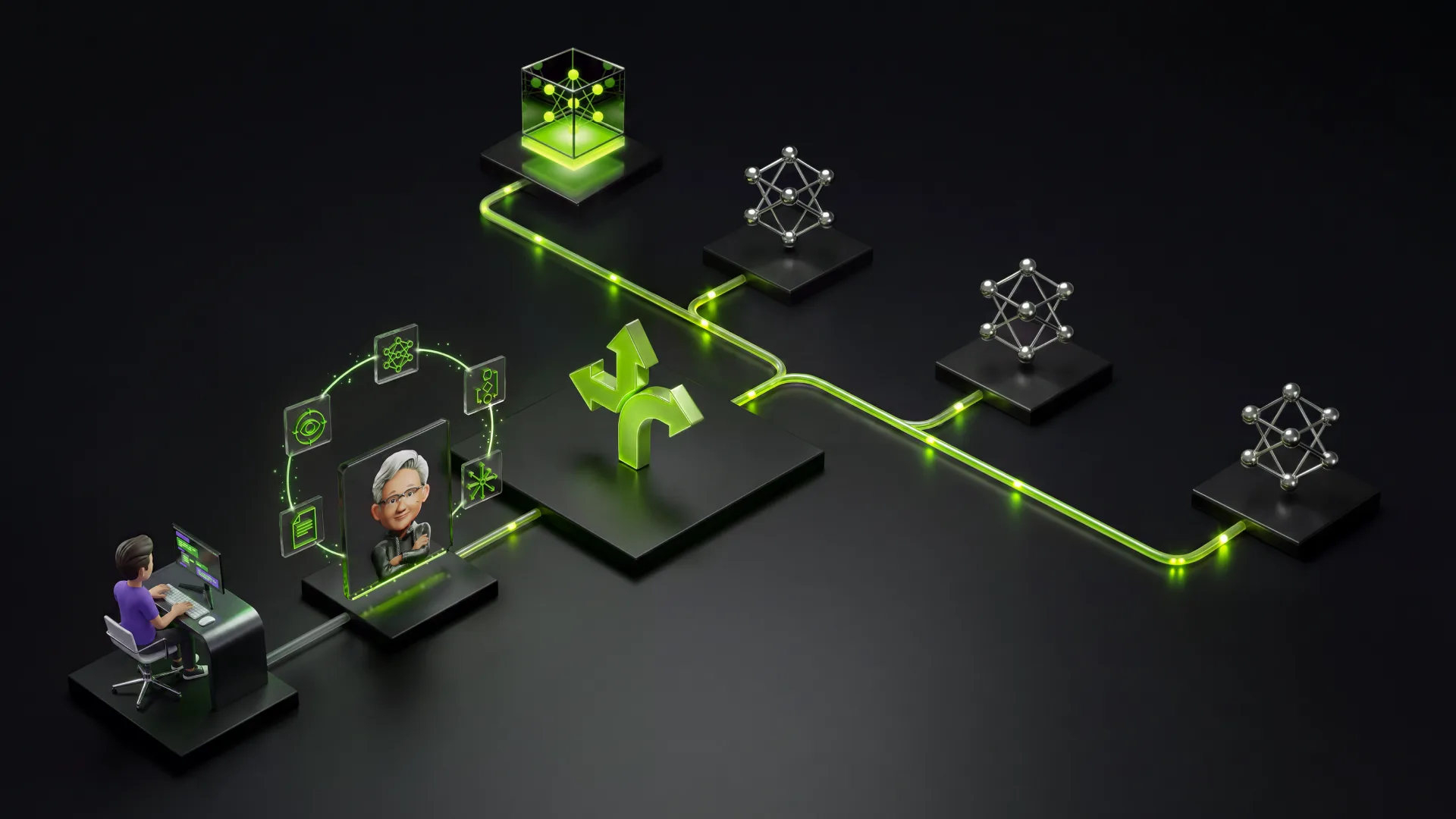
NVIDIA’s NeMo Switchyard is an open source routing library for agents that use more than one model. Instead of sending every step to the same model, developers can choose routing policies for different quality, latency and cost requirements.
NVIDIA announced Switchyard on August 11, 2026, alongside Nemotron 3.5 Lightning. They serve different purposes: Lightning is a model, while Switchyard selects among models. The November update below concerns an Amazon Bedrock walkthrough, not a new model release.
Launch results are workload specific
NVIDIA’s launch post reported that LangChain reduced cost by 74% across 145 multi-turn Deep Agents tasks, sending 7% of calls to a frontier model with a 6% accuracy tradeoff. Those are reported evaluation results, not a guarantee for another agent. A routing policy needs comparison against a fixed model on the same tasks, including unsuccessful attempts.
November 13 update: testing Switchyard on Amazon Bedrock
An AWS walkthrough published November 13 shows a coding agent using Switchyard through LiteLLM and Amazon Bedrock. It combines Claude Opus 5.5 with NVIDIA Nemotron 3 Super 120B. This is a sample for evaluation, not a production deployment recommendation.
The AWS sample repository says the model pair was tested in us-east-1. Developers still need the appropriate Bedrock model access and must verify region and tool-calling support. Its Opus configuration uses a global cross-region inference profile, so processing is not restricted to the originating region. The Nemotron configuration uses in-region inference. Running the gateway locally does not remove Bedrock inference charges.
Two routing policies, no judge model
The pinned NVIDIA LiteLLM integration is experimental and targets LiteLLM 1.102.0. Stage routing requires exactly two distinct candidates, with the capable model declared first and the efficient model second. It uses conversation and tool history. Random routing supports weighted selection among two or more candidates.
Neither policy makes an extra judge-model call in this integration. Task or Composite policies that need intermediate model calls are not supported here. The adapter accepts text and function-tool exchanges, not arbitrary media or legacy function messages. Clients must supply the supported conversation history rather than assuming a continuation identifier contains the context the router needs.
A separate caveat concerns switchyard-server 0.3.0 used in the AWS walkthrough. NVIDIA’s main repository labels the standalone server a demo, not a supported production path. The library, server and experimental LiteLLM plugin should not be treated as having identical maturity or deployment guarantees.
Measure completed work, not cheaper tokens
AWS recommends evaluating cost per solved task: include the cost of failed attempts in total spend, then divide by the number of solved tasks. Missing usage or pricing evidence should remain unpriced rather than silently becoming zero. A few demonstration runs cannot establish reliable savings or quality differences.
For teams evaluating a router, the practical question is whether it completes their workload at an acceptable quality and total cost. Lower token prices alone do not answer that question. ByteForward has not independently benchmarked this sample.