NVIDIA joins European science pledge with open courses and compute access routes

The European Commission launched its AI in Science Enablers initiative in Dublin on October 15, bringing private companies and philanthropic organisations into a shared effort to support European researchers. The first pledges span computing access, research software, data and training. They are commitments from individual providers rather than one uniform benefit that every researcher can claim.
NVIDIA’s contribution combines scientific AI tools, open course materials and routes into European computing infrastructure. For a small laboratory or startup, the practical question is which parts can be used immediately and which still depend on membership, local programmes or a research allocation.
What the European initiative adds
RAISE stands for Resource for AI Science in Europe. The Commission describes it as a virtual institute bringing together computing, data, talent and research funding. Its pilot launched in November 2025. Today’s pledging initiative extends that framework through outside contributions. It does not mean RAISE itself is launching for the first time.
The participants offer different things. Google lists $3 million in cloud credits and tokens for European researchers. Mistral pledges model access, Vibe seats and API credits. The Novo Nordisk Foundation intends to provide access to the Gefion supercomputer. These are provider commitments, and the Commission’s overview does not establish a single application process or a guaranteed allocation for every applicant.
Course materials are available without enrolment
NVIDIA’s open courseware hub is the most direct starting point for learning. Its materials can be downloaded without registration or enrolment, and educators can adapt them within the applicable licence terms. The catalogue includes Fundamentals of Deep Learning and Securing Agents With NemoClaw and OpenShell.
Free materials do not make every lab environment free. NVIDIA explicitly warns that computing instances may cost money depending on the environment selected. It also says these open courses currently do not award completion certificates. A university can reuse the teaching content, but should separately budget hardware or hosting and decide how it will assess students.
Check the repository before choosing hardware
The Fundamentals of Deep Learning repository gives a concrete example of what is included. Its notebooks cover image classification, convolutional networks, data augmentation, transfer learning and deployment. The local setup lists Python 3.10 or newer and PyTorch 2.5 or newer, with an NVIDIA GPU and CUDA 11.8 or newer. It says CPU execution is possible but slower for later notebooks.
The repository also separates licensing by material. Source code and notebook code cells use Apache License 2.0. NVIDIA educational media and documentation use Creative Commons Attribution 4.0, while third party content keeps its original terms. That distinction matters when adapting a course for an internal training platform. A general description of open courseware is not permission to redistribute every included asset under one licence.
Sweden gives the compute pledge a local route
A separate October 15 announcement from RISE describes a Sweden AI Factory Accelerator Program with NVIDIA. The factory is led by NAISS and RISE and provides free AI computing resources and expert support to startups, smaller businesses, academia and the public sector. The collaboration links that infrastructure and expertise with NVIDIA’s Inception startup programme.
RISE identifies areas including life sciences, materials, autonomous systems and gaming. It presents broader joint training and bootcamps as future expansion. Its announcement does not specify a universal GPU allowance or guarantee immediate access to any particular machine. Teams should treat the factory as a programme to investigate rather than assume that an Inception account automatically reserves computing time.
Startup membership has separate requirements
NVIDIA’s Inception programme has no application or membership fees and takes no equity for membership. Its published criteria include incorporation, a working website, at least one developer and a company age below ten years. Revenue is not required. Consulting and outsourced development firms, cryptocurrency companies, cloud providers, resellers, distributors and public companies are excluded.
Benefits can include partner cloud credits, technical training and selected product discounts. They are not a cash grant or guaranteed access to a specific GPU. A team should check its company category before applying and then verify the terms of each benefit in the programme. Joining a startup network and receiving an allocation from a European AI factory are different decisions.
A practical way to evaluate the announcement
For researchers, NVIDIA also points to existing scientific software including PhysicsNeMo, Earth 2 and BioNeMo, alongside collaborations with European AI factories. The announcement brings these resources into the science initiative, rather than establishing that every model or tool mentioned was released today.
Start with the constraint in the project. If the obstacle is learning, inspect the freely available notebooks and their hardware requirements. If it is computing capacity, identify the relevant provider and ask about eligibility, allocation and charges. If it is data or software reuse, read the licence for the specific asset. These checks turn a broad pledge into a usable research plan without treating announced support as delivered capacity.
For a related infrastructure example, our coverage of Scaleway’s Nordic expansion distinguishes announced hardware from confirmed customer availability. The same distinction matters here, even when the intended users are researchers.
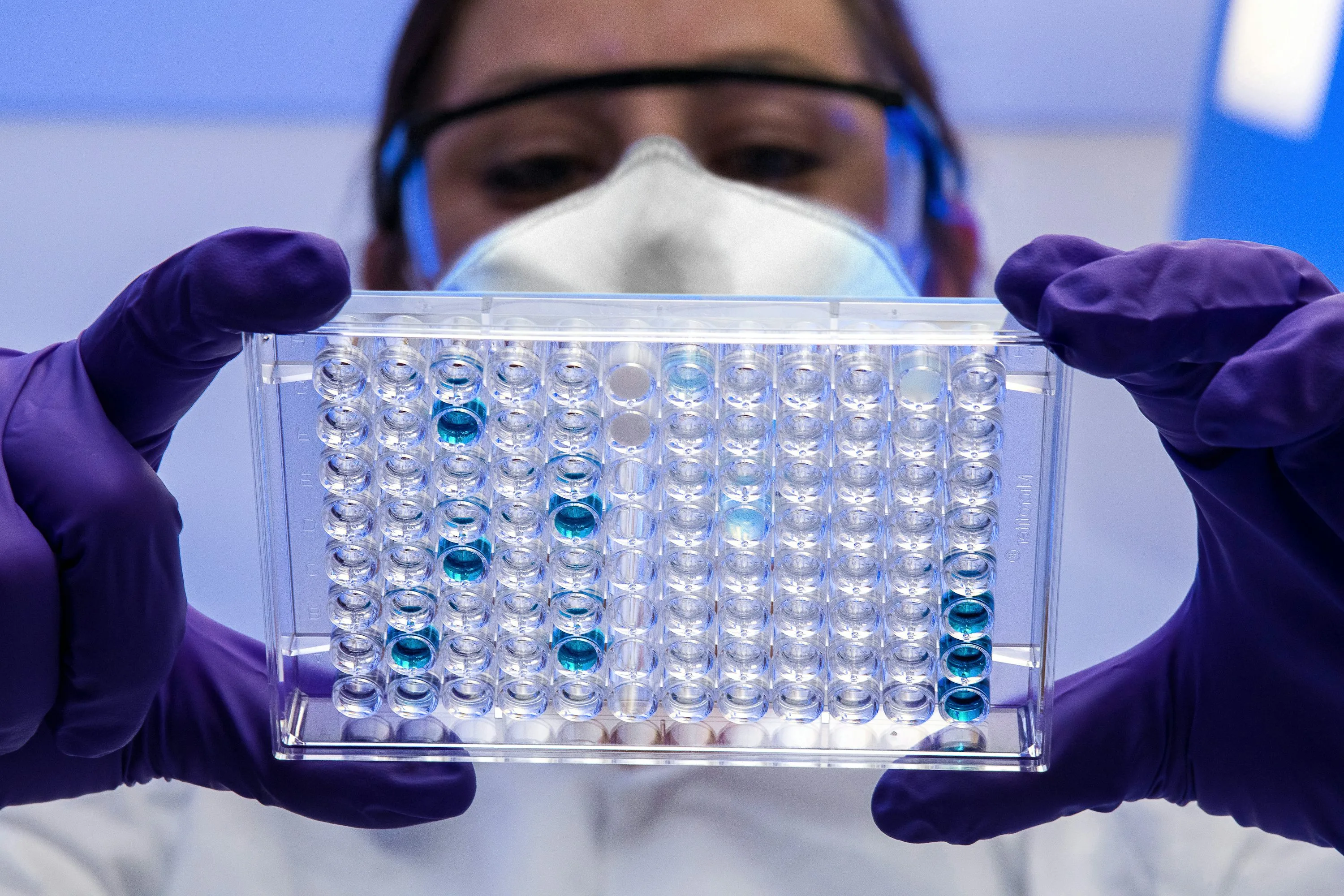
Illustrative archival laboratory photograph of a CDC scientist reviewing serological samples. This image is used for general research context without implying a European location or participation in the initiative. Photo by CDC on Unsplash, used under the Unsplash License.