Nature Will introduces Natura 1 for dexterous robot hands

Nature Will announced Natura 1 on October 13, introducing a model with 50 billion parameters for controlling dexterous robot hands. The company says it was pretrained on more than one million hours of human experience recorded from the wearer’s perspective. Its announcement connects that scale to following instructions in physical tasks.
The system uses a mixture of experts architecture trained across language, images, video and actions. Nature Will reports a control cycle of 100 milliseconds. Those are company specifications, and neither parameter count nor response time alone establishes how reliably a robot will complete a job.
A crucial qualification appears in the technical report. Six extended demonstrations use extra task specific tuning, including making wontons, packing a box and applying a screen protector. Those results need to be read separately from the company’s demonstrations of unfamiliar instructions.
How the evidence breaks down
On its own benchmark, Nature Will reports scores of 53.4 for its base model and 59.1 for its agentic configuration. The scored baselines, pi 0.5 and GPT 6 Astra, used grippers after failing to score on its dexterous platform. Hand design and model capability therefore both affect this comparison. The figures should not be read as a ranking of model quality alone.
The reported scaling results also use teacher forcing, conditioning predictions on prior observations. Better prediction under that setup does not establish the probability of completing an entire physical task without intervention.
For readers evaluating a demonstration, the useful questions are concrete. How many attempts were made? What counted as success? How often did a person reset the scene? A continuous successful recording can show a capability while leaving its repeatability unresolved.
Why the training approach matters
The practical attraction is learning reusable physical skills from human experience. If that knowledge transfers effectively, developers could spend less effort collecting a separate robot demonstration for every new situation. That is a potential benefit of the approach, rather than a deployment result established by this announcement.
There is relevant precedent. Physical Intelligence’s 2025 paper on pi 0.5 combined robot data, web information and supervision about intermediate tasks. It reported cleaning and tidying in homes absent from training. Its roughly 400 hours of mobile robot demonstrations were supplemented by a larger body of other robot data. The lesson is that useful transfer depends on how experience is combined, as well as how much is collected.
That paper also documented failures involving unfamiliar drawer handles, blocked views and distracted task selection. It described limited context and relatively simple prompts as constraints. These examples help explain why a useful robot evaluation should vary the surroundings and instructions, rather than repeat one well arranged scene.
Speed and safety still need testing
Deployment architecture matters alongside the learned policy. In its June 2025 introduction of Gemini Robotics On Device, Google DeepMind emphasized local execution and operation without a data network. It also described adaptation using 50 to 100 demonstrations. These details give developers practical comparison points, including connectivity needs and the amount of new training required. They do not establish a performance ranking against Natura 1.
Google’s description also places safety critical controllers beneath its robotics models and recommends testing the complete system for unsafe behavior. That separation is important when moving from a laboratory example to equipment working around people. Language understanding alone cannot establish safe motion.
What developers should ask next
The Natura launch materials reviewed here do not provide public weights, API pricing or a general availability date. An announcement therefore leaves important access and deployment questions open.
Before planning a pilot, a team should ask which robot and hand combinations are supported, where inference runs and what compute is required. It should request a reproducible evaluation with a declared number of trials, a fixed intervention policy and failure records. The test should include ordinary disruptions such as moved objects or a partially blocked camera.
A useful acceptance test would measure the whole job, including recovery after a mistake and the time a supervisor spends helping. Success across varied settings would make the case for broader use much stronger. Until then, the most decision relevant evidence is a documented path from demonstration to repeatable work.
ByteForward’s reporting on PhoneBot’s smartphone based biped explores another approach to the gap between demonstrations and deployable robotics.
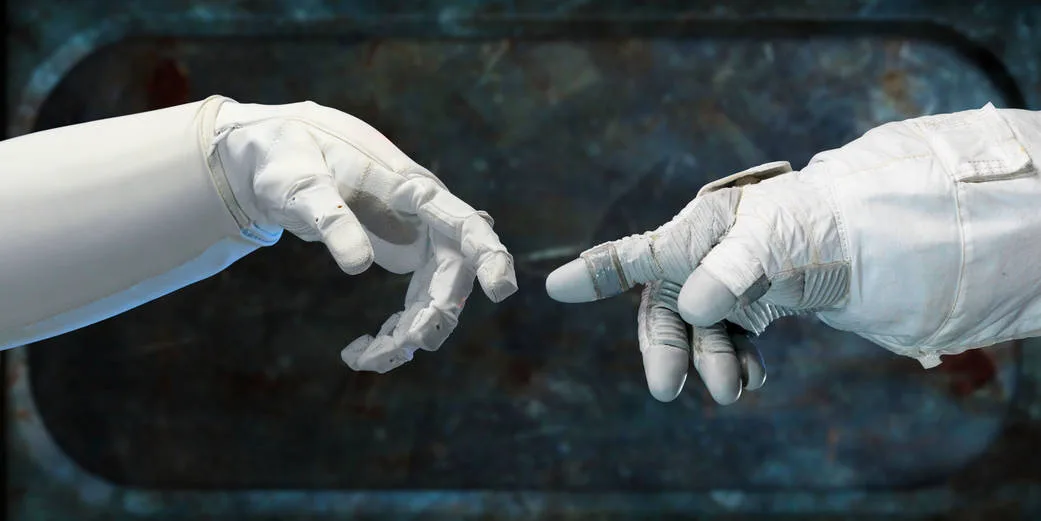
Archival Robonaut photograph illustrating robotic hands. Image courtesy of NASA.