Microsoft previews MAI Image 2.7 for more controlled image editing


Microsoft announced MAI Image 2.7 on October 27, 2026 as an image editing preview, with text to image generation planned later.
For a creator deciding whether to switch tools, the useful question is how faithfully an edit preserves everything outside the brief. A striking result can still be unusable if it changes a product label, a face or a detail the client needed to keep.
Where the preview is available
Microsoft names Arena, Artificial Analysis and MAI Playground as places to try the preview. Its announcement does not supply an API price or a production API launch date.
There is an access detail worth checking. The public Playground page retrieved for this report still listed MAI Image 2.6. We have not independently confirmed access to 2.7 inside that interface. Check the selected model before treating an output as a 2.7 test.
Two leaderboards give different orders
The Artificial Analysis editing board places MAI second in this October 27 snapshot.
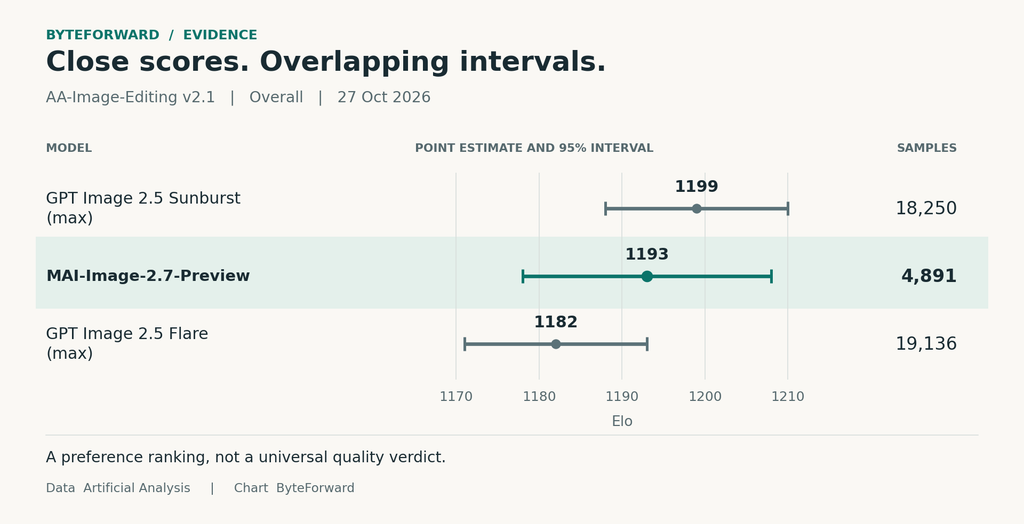
| Model | Elo | 95 percent interval | Samples |
|---|---|---|---|
| GPT Image 2.5 Sunburst (max) | 1199 | 1188 to 1210 | 18,250 |
| MAI Image 2.7 Preview | 1193 | 1178 to 1208 | 4,891 |
| GPT Image 2.5 Flare (max) | 1182 | 1171 to 1193 | 19,136 |
The intervals overlap. MAI has fewer samples, and these model configurations are not interchangeable. Preference scores do not establish a universal winner. The board lists no API for MAI 2.7.
The Arena single image editing board puts MAI third, behind both OpenAI variants, with a displayed rank spread of second through fourth. Its page still carries an October 23 date, so this is the snapshot retrieved for this report, not a claim that Arena refreshed it today.
Where Microsoft says the gains are
Microsoft’s category chart, evaluated on October 22, puts 2.7 first for reasoning based edits, scene and style edits, and text or symbol edits. It places 2.6 seventh, seventh and sixth respectively. These are vendor presented rankings, not a ByteForward editing test.
A background change and a label correction ask different things of an editor. A new setting can look convincing while the package logo drifts. Better lighting can still leave small lettering blurred. For a product asset, inspect the protected label and outline separately from the requested change. A category ranking cannot tell you whether your own image will need repair.
Choose for the work you actually deliver
A practical scorecard needs four separate judgments. Did the requested change happen? Did protected details survive? Is the file usable at its intended size? How much intervention did delivery require? Set your own acceptable thresholds before reviewing the results.
For now, treat the preview as a candidate for a controlled creative trial. Teams planning automated workflows should establish access, integration terms and costs before redesigning a production pipeline around it.