Glyph Cluster access differs across Vercel and coding tools

Vercel opened Glyph Cluster access on October 7, 2026. The model remains anonymous. Its free stealth preview requires a Pro or Enterprise team with purchased AI Gateway credits. No end date or numerical allowance is specified.
The reasoning model accepts text and shares a 256K token window between input and output. Streaming and function calling are supported. Images, file inputs and structured outputs are unsupported.
The API reference provides the exact model identifier and examples for AI SDK, Chat Completions, Responses and Messages. Its maxOutputTokens setting includes reasoning tokens. The maximum output therefore does not represent additional space beyond the shared context window.
The live catalog exposes low, medium, high and xhigh reasoning effort.
Zero Data Retention is unavailable. Prompts and responses may be retained for training and improvement. ByteForward has not tested the model.
Command Code has its own limits
Command Code’s Glyph specific terms describe a separate subscription route. Accounts need at least $1 in credits to start a session. Input, output and cache reads cost no credits, but each account gets 100 requests per day, resetting at midnight UTC. This allowance belongs to Command Code.
An agent can make multiple requests while completing one task. The daily request counter should therefore be checked during longer sessions rather than treated as a promise of 100 completed coding tasks.
The Go plan starts at $1 per month plus a processing fee and includes this model in the coding client. Go excludes API access. Select Glyph through /model in an existing session. The preview can change or end without notice.
Glyph will not run with CMD_ZDR=1 enabled. Command Code’s privacy policy otherwise allows request content retention for up to 30 days, subject to plan or contract exceptions. Its promise not to train its own models leaves downstream provider policies in force.
Connecting through Pi
Pi’s Glyph listing uses the Anthropic Messages format through Vercel AI Gateway. Pi accepts the Gateway key through AI_GATEWAY_API_KEY. The model picker appears under /model and shows providers with usable authentication. /thinking selects supported reasoning levels.
Pi uses your Gateway access, so this route retains Vercel’s account requirements.
Pi records model and thinking changes in the session and restores them when resumed. Those choices do not automatically alter defaults for new sessions.
Stored credentials take precedence over environment variables, so changing a shell variable may leave an existing login active. Check the selected provider and credential source when troubleshooting. Pi starts with a bundled catalog and can overlay newer catalog data, which matters when a recently added model is missing.
Pi’s security documentation says tools inherit the launching account’s permissions and do not request approval for every call. Project trust controls loaded resources rather than containing execution. Use an isolated environment with only the files and credentials required for the experiment.
Our Qwen Code report examines a separate approach to showing tool inputs before an agent action is approved.
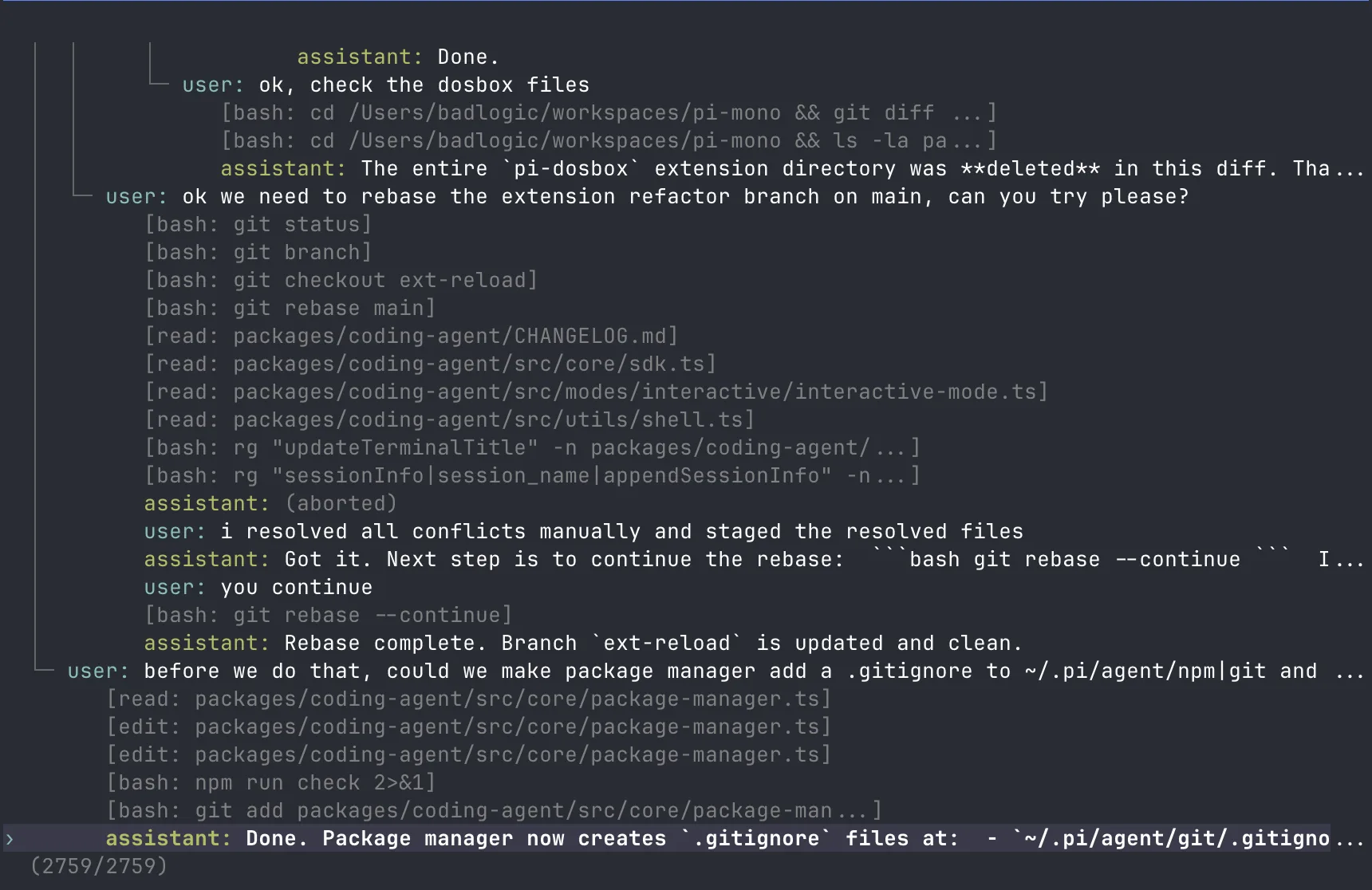
Pi session tree interface from the Pi press kit. The image depicts Pi, without demonstrating Glyph performance.