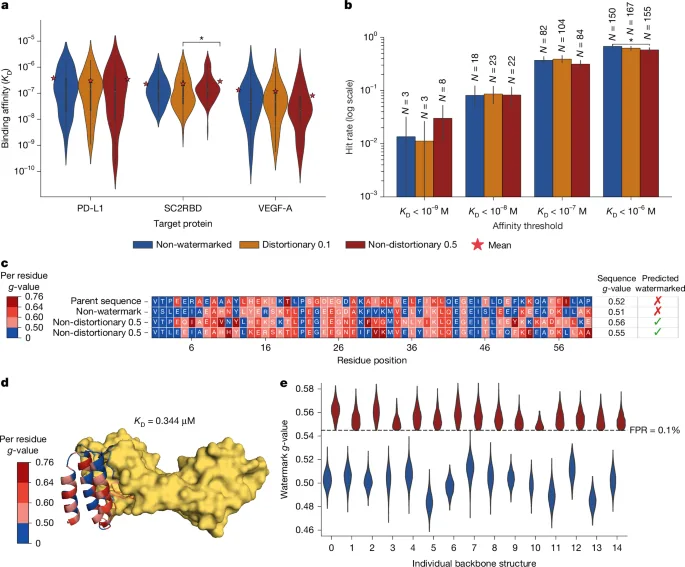
Google SynthID Bio brings AI watermarking to proteins
Google DeepMind’s SynthID Bio marks AI designed proteins while preserving function in lab tests. Here is what the study establishes and what still needs work.
Accessibility Adjustments
Use these optional tools to adjust reading and display preferences. These tools cannot resolve every accessibility barrier. Please contact the website owner if you need assistance.


AI research explains how machine learning systems improve and where their weaknesses remain. ByteForward follows research papers, model evaluations and scientific applications with attention to methods, evidence and practical consequences. Topics include reasoning, training approaches, multimodal learning and the use of AI in scientific discovery. A promising result needs context about the dataset, comparison systems and conditions under which it was measured. We look at those limits so readers can distinguish a research finding from a capability ready for everyday use. Our AI safety and security coverage examines how researchers test reliability, misuse risks and defenses. For research that moves into products, follow the developments in AI models. Read the articles below for clear explanations of new AI research and the questions that determine whether its results will hold up beyond the paper.
Google DeepMind’s SynthID Bio marks AI designed proteins while preserving function in lab tests. Here is what the study establishes and what still needs work.

Encrypted chain-of-thought was supposed to hide proprietary reasoning from competitors and keep sensitive intermediate steps off the public page. A new paper shows those opaque blocks were portable enough that a weaker model in the same provider family could spit…
Curve fits answer “what happened.” They choke on “what if we intervene.” On arXiv:2608.09696, University of British Columbia’s Kevin Murphy posts the Model Discovery Agent (MDA): an LLM proposes candidate mechanistic structures, then classical Bayesian tools pick the next experiment…
October 30, 2026 update: AWS GovCloud US-East availability Eligible customers can now use Daybreak Red on Amazon Bedrock in AWS GovCloud (US-East), according to AWS’s October 30 announcement. This adds a region for the existing model. Customers need OpenAI’s approval…

AI math just got a number you can argue with. On August 10, Anthropic said an unreleased research version of Claude raised a longstanding lower bound on the share of Riemann zeta zeros that lie on the critical line —…

OpenAI just published the safety paperwork for the ChatGPT models people will actually touch this week. Per the Deployment Safety Hub August update, the new GPT-5.6 Sol and GPT-5.6 Luna variants score High under the Preparedness Framework in cybersecurity and…

An autonomous FOFA-to-PoC loop is already operational in the wild — and still brittle. Palo Alto Networks Unit 42 published a July 30 report on a Chinese-speaking operator who used DeepSeek through open-source Hermes Agent to enumerate FOFA targets, pull…

Anthropic’s Frontier Red Team just showed that a frontier model can find mathematical cracks in crypto designs that survived years of human review. Deployed systems are still fine. The research bar just moved. In a July 28 research post, Anthropic…

Microsoft introduced MAI Cyber 1 Flash inside MDASH. Its reported CyberGym score covers a combined system, with access limited to verified defenders.
Paste scored outputs into a prompt and many models climb. That trick powered OPRO-style prompt search and self-rewarding loops, but the theory lagged the demos. A COLM 2026 paper from Masahiro Kaneko and Timothy Baldwin (MBZUAI) argues the mechanism is…
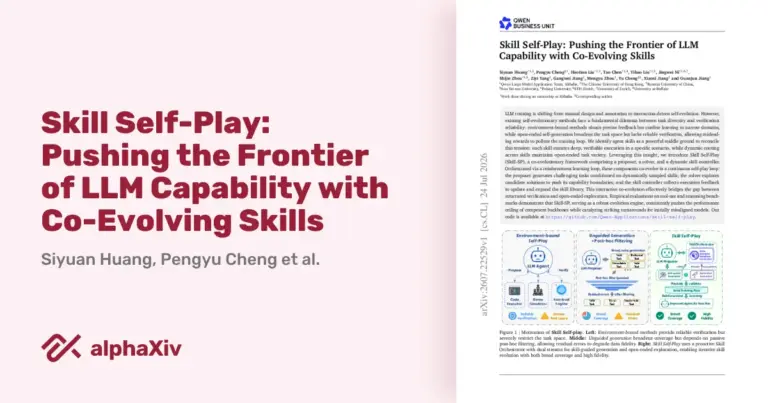
Self-play without a leash collapses into noise or a toy sandbox. Qwen’s application team argues the fix is a skill library that co-evolves with the model. In Skill Self-Play (Skill-SP), a proposer, solver, and skill controller train together so the…
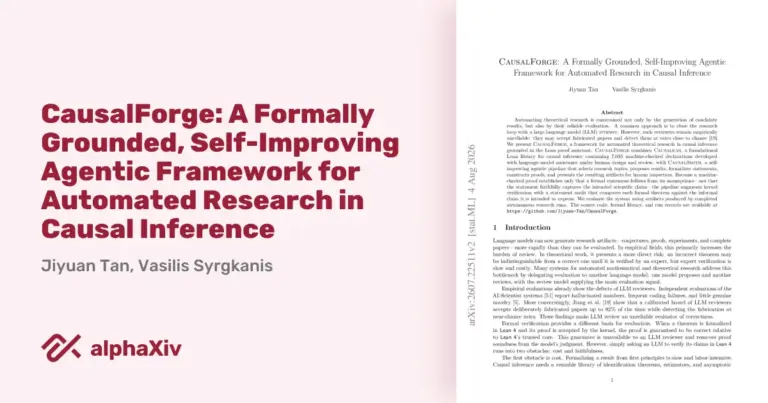
Automated theory research keeps hitting the same wall: models can draft papers faster than anyone can tell if the theorems are real. arXiv 2607.22511 answers with CausalForge — a Lean-grounded loop from Jiyuan Tan and Vasilis Syrgkanis that tries to…

Looped Transformers keep losing the boring argument: if you spend N× the pre-training compute looping, why not just buy a bigger non-looped model? A new paper, Loop the Loopies! (arXiv:2607.16051), says that fight is winnable — if you loop layers,…

OpenAI just showed the safety flywheel it wants you to believe in: train an attacker model hard enough, then use its attacks to harden the next production release. The attacker stays internal. The hardened model ships. In a July 15…

Ask Claude for feedback on a business plan in Hindi and again in Russian, and you may walk away with different impressions of the same idea. Anthropic’s new Claude values research shows that is not a vibes claim. It is…


