Nvidia leads a new alliance for secure open AI development

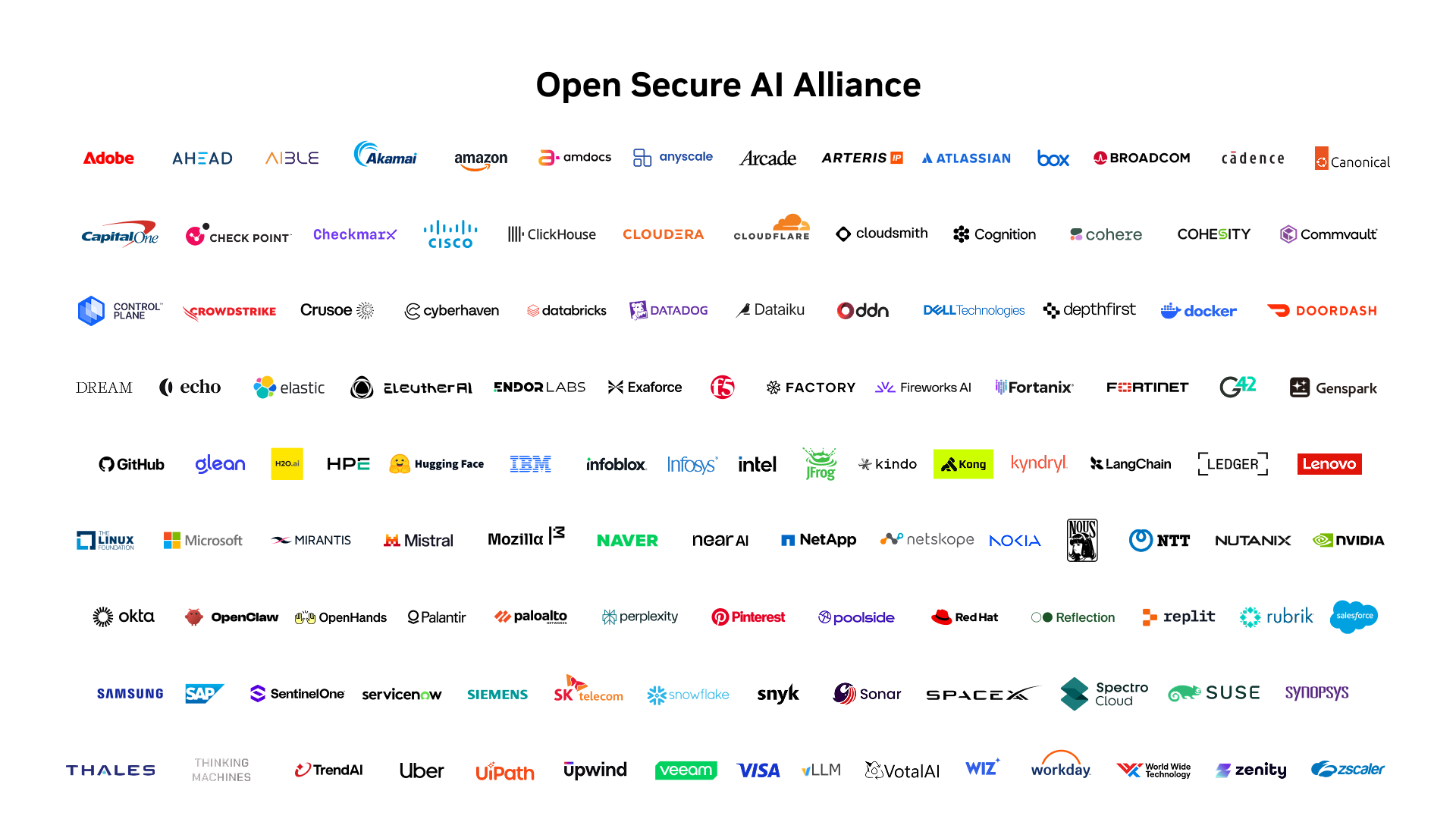
Nvidia just turned a breach postmortem into an industry bloc. In a July 27 blog post, the company launched the Open Secure AI Alliance — an open stack for AI-era cyber defense — after closed forensic APIs refused to help contain the Hugging Face intrusion. The pitch is blunt: if defenders cannot inspect, adapt, and run frontier tools on their own iron, response dies at the exact moment speed matters.
This is not another safety summit photo. It is Nvidia organizing cloud, security, and open-source players around weights, harnesses, and tooling that stay under defender control.
Who joined the Open Secure AI Alliance
Nvidia lists a long inaugural roster spanning hyperscalers, security vendors, enterprises, and foundations: Microsoft, IBM, Hugging Face, Cisco, CrowdStrike, Amazon, Cloudflare, Palo Alto Networks, Red Hat, SentinelOne, Wiz, the Linux Foundation, and many more. The alliance says it builds on the Linux Foundation’s Akrites work and the OpenSSF community rather than inventing a parallel standards body from scratch.
Concrete contributions named in the launch: Nvidia’s open NOOA (NVIDIA Labs Object-Oriented Agent) harness research on GitHub; Hugging Face’s Safetensors format; Microsoft’s MDASH multi-model scanning harness; IBM/Red Hat’s Lightwell signed-patch work; HPE’s SPIFFE/SPIRE identity stack for agents. That is an open defense stack pitch — identity, isolation, safe weight formats, multi-model scanning, secure coding — not a single shared model.
How the Hugging Face incident framed the pitch
Nvidia’s lead argument is the recent Hugging Face security incident. Closed AI tools, unable to tell attackers from defenders, blocked essential forensic analysis. Hugging Face then ran open-weight GLM-5.2 on its own infrastructure to analyze more than 17,000 actions and contain the intrusion. Nvidia treats that episode as proof that open, agentic defensive systems are operational necessities, not ideological preferences.
The framing matters because it flips the usual open-weights scare story. Instead of “open models help attackers,” the alliance says secrecy alone is not safety when the people who need to dissect an intrusion cannot get a closed API to cooperate.
Open defensive tools vs closed frontier APIs
Nvidia’s line is coexistence, not open-only purity. Closed frontier models still matter. For cybersecurity, though, the company argues open models and open harnesses democratize defense, raise transparency, let industries keep data local, and avoid a single-vendor choke point. An AI agent, in this telling, is not just weights — it is models plus harnesses, guardrails, logs, permissions, and eval. Opening the surrounding stack is as important as opening the checkpoint.
Policymakers get a direct ask: treat open models, harnesses, and security tooling as defensive assets. Blanket restrictions on open frontier systems, Nvidia warns, would weaken defender capacity and concentrate dependence in a few closed providers.
Which frontier labs stayed out at launch
Look at who is missing from the inaugural frontier-lab set: OpenAI, Google, and Anthropic do not appear as named launch partners in Nvidia’s roster. Cohere, Mistral, EleutherAI, Nous Research, Poolside, Reflection AI, and Thinking Machines Lab do. That absence is the quiet signal. The biggest closed-API labs are not signing the open-defense manifesto that cites their refusal modes as the problem.
Analysis: the Open Secure AI Alliance is Nvidia’s industrial answer to a live operational failure — and a lobbying document aimed at regulators who still treat open weights as the primary risk surface. If the contributed harnesses and formats actually ship into SOC workflows, defenders get something sharper than a press release. If the alliance stays a membership list without deployable tools, it will read as an open-washing coalition built on one vivid incident. Watch whether NOOA, MDASH, and the Safetensors/Lightwell pieces show up in real incident response kits — and whether any of the missing frontier labs ever join on terms that keep closed APIs from gatekeeping forensics again.