CERN and Mistral plan a shared AI model for particle physics

CERN and Mistral have signed a statement of intent to develop foundation models for science. CERN’s October 15 announcement sets an initial goal of a Large Physics Model trained on billions of simulated collisions between protons, with several uses across particle physics.
The proposed model would help researchers reconstruct collisions, identify particles, flag unusual signals and assess future detector designs. These are goals for the partnership.
Turning detector signals into useful physics
Before researchers can study a collision, they need an account of the particles it produced. A February 18, 2026 CERN explainer describes how particle flow reconstruction combines signals from different parts of the CMS detector to identify those particles. The established approach uses a chain of rules built by physicists. A learned alternative can acquire patterns from simulated events.
For a research team, reconstruction is therefore part of the measurement itself. A useful evaluation needs to ask whether the resulting particle information remains trustworthy, alongside how efficiently the software produces it. Faster processing alone would be an incomplete reason to change a scientific workflow.
Why the coming data volume matters
CERN’s HiLumi LHC media kit gives the longer term motivation. The upgrade aims for roughly ten times the integrated luminosity of the LHC’s original design. That means the accumulated collisions over time, with operations anticipated around 2030 and continuing into the 2040s. The larger sample is intended to sharpen Higgs boson measurements and make extremely rare processes easier to study.
The comparison is with the original design target for accumulated collisions. It should not be read as a tenfold increase in the instantaneous collision rate from today’s operating conditions.
Earlier CMS results provide a useful reference
A CMS Collaboration paper first submitted on January 24 and revised on September 2, 2026, describes machine learning based particle flow reconstruction, or MLPF. Implemented within CMS software, it replaces several reconstruction stages with a learned model running on GPUs. The authors report physics performance comparable to standard reconstruction in both simulation and real data.
One improvement came in simulated top quark and antiquark pairs under LHC Run 3 conditions. For jets with transverse momentum from 30 to 100 GeV, the paper reports a 10 to 20 percent improvement in energy resolution. Those conditions define the result. It is evidence from earlier CMS work, not a performance measurement of the planned Mistral system.
Shared representations already have research behind them
A separate June 12, 2026 preprint by Farouk Mokhtar, Joosep Pata, Michael Kagan and Javier Duarte explored reusing information learned during particle reconstruction. They used MLPF representations for identifying jet flavour, estimating jet energy and estimating missing momentum. Adding those representations improved results against baselines using kinematic features alone.
The authors describe MLPF as a foundation model. Their work gives a concrete example of how learning for one physics task can help another. It does not establish which architecture CERN and Mistral will use.
The practical appeal of reuse is straightforward. Researchers could start from information that is already useful for describing an event, then test how well it transfers to another measurement. The important question is what survives that transfer. A shared representation should be judged task by task, including cases where a specialised method remains stronger.
What researchers should ask for next
The announcement supplies no model weights, benchmark results, delivery timetable or access terms for the proposed system.
A useful technical release would let a research group answer four questions before planning an integration.
- How does the model perform on real detector data and conditions outside its training sample?
- Which physics measurements improve, and where does accuracy worsen or remain unchanged?
- What hardware, memory and processing time does each evaluated workload require?
- What can researchers download, reproduce and adapt under the eventual licence?
Our coverage of NVIDIA’s European science pledge examines another part of the scientific AI picture, access to courses, tools and computing resources.
For this project, the next meaningful milestone is a reproducible evaluation that connects the proposed shared model to specific scientific work. Researchers need enough detail to compare the benefit with the cost of adopting and maintaining it.
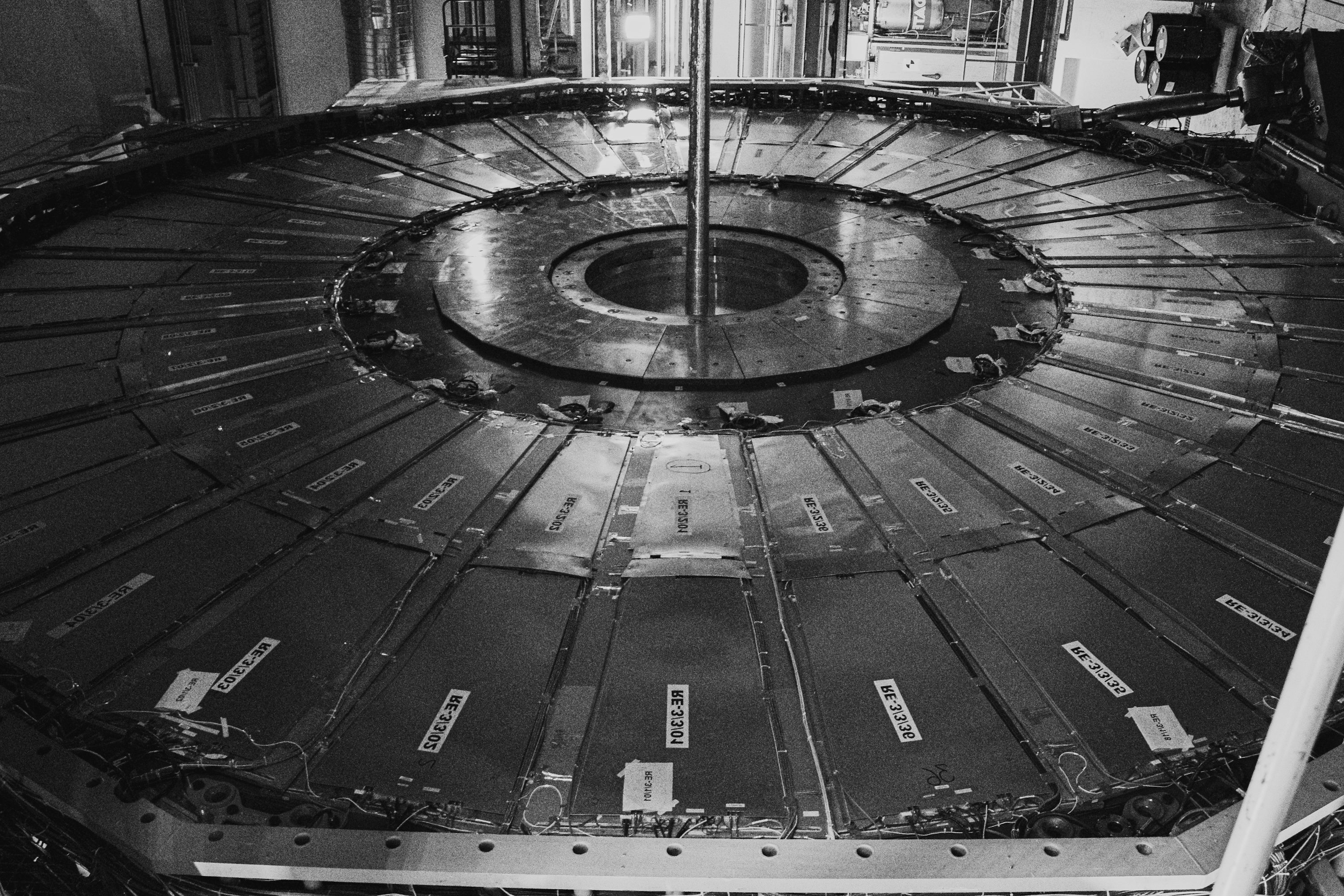
Archival photograph of the CMS experiment at CERN in Cessy, France. Photo by Antonio Vivace on Unsplash, published on 15 February 2023 and used under the Unsplash License.