Claude Code 2.1.296 adds finer controls for delegated work

Anthropic’s Claude Code 2.1.296 release adds more specific controls for delegated work and large text files. The practical question is how much context each worker needs to finish its part of a job.
The npm registry records publication on October 9. At our October 10 check, the latest and next tags pointed to 2.1.296, while stable remained on 2.1.287. Availability therefore depends on the update channel.
The release notes establish the additions, but the reference pages checked for this report had not yet documented their full configuration details. That leaves enough information to explain the changes, with important limits on any setup advice.
A worker can compact before the main session
The new autoCompactWindow field in subagent frontmatter lets a worker compact earlier than the main conversation. It also works in agent definitions supplied at launch.
An automatic compaction window determines when Claude Code summarizes a growing conversation. The underlying model still determines its maximum capacity. Existing session controls already let developers choose an earlier threshold, subject to that capacity.
Anthropic’s context guide explains the tradeoff. Compaction replaces conversation history with a summary, and previously read material may return in reduced form or as a file reference. For a worker tracing a bug, the useful question is whether the evidence needed to connect its findings remains available afterward.
The subagent reference did not yet list the new field’s accepted values or range. Existing session settings are useful background, but their numeric formats and precedence cannot safely be assumed to apply to this new location.
Workflow agents get a more specific model choice
CLAUDE_CODE_WORKFLOW_SUBAGENT_MODEL selects one model across workflow agents while leaving other subagents’ model choices alone.
In Claude Code, a workflow is a JavaScript orchestration script that coordinates agents. This article concerns that coding environment. ByteForward’s separate coverage of Claude Managed Agents dynamic workflows addresses the hosted service and its deployment considerations.
The broader environment variable reference already documents a general subagent model default and a force setting that applies across subagents, teammates and workflow agents. The new dedicated variable was absent when checked. Its interaction with those older settings and the model identifiers it accepts remain unverified here.
That makes checking the model actually used particularly important. The subagent guide says organization model restrictions can result in substitutions and that /tasks displays a running worker’s model. A requested model name alone is weaker evidence than the model shown for the job.
Larger reads still need a reason
The Read tool gains allow_large for reading an entire text file beyond ordinary size limits when sufficient context remains. The release supplies no new universal maximum and makes the available context an explicit condition.
The existing Read reference describes oversized ordinary reads returning an initial portion with a PARTIAL view notice. Offset and limit parameters allow focused reads of the rest. Images, PDFs and notebooks have separate handling. The new text file option should not be treated as a change to those formats.
Consider a worker reviewing a generated API definition. Loading the complete file may help it compare distant sections. For a known error in one function, a targeted read may be enough. The useful evaluation is whether the extra material changes the answer or merely occupies room that later reasoning will need.
Evaluate a complete task before widening the rollout
Anthropic’s workflow cost guidance recommends trying a small portion of the job first. A workflow can use considerably more tokens than handling the task in one conversation, and /workflows shows usage for individual agents. A model setting alone does not establish a saving.
Our suggested check is a small repository task with a known expected result. Record the starting files, the active model, any compaction and the final finding. When comparing complete file reads with targeted reads, keep the task and starting state consistent. Check missed dependencies and unnecessary edits alongside token usage. These are proposed evaluation steps. ByteForward has not run a comparative test of this release.
The previous Claude Code 2.1.295 update focused on failed policy checks and other tool behavior. This release’s controls raise a different adoption question. Can a team give each delegated task the information it needs, then verify the result without assuming that more context or one model choice automatically improves the work?
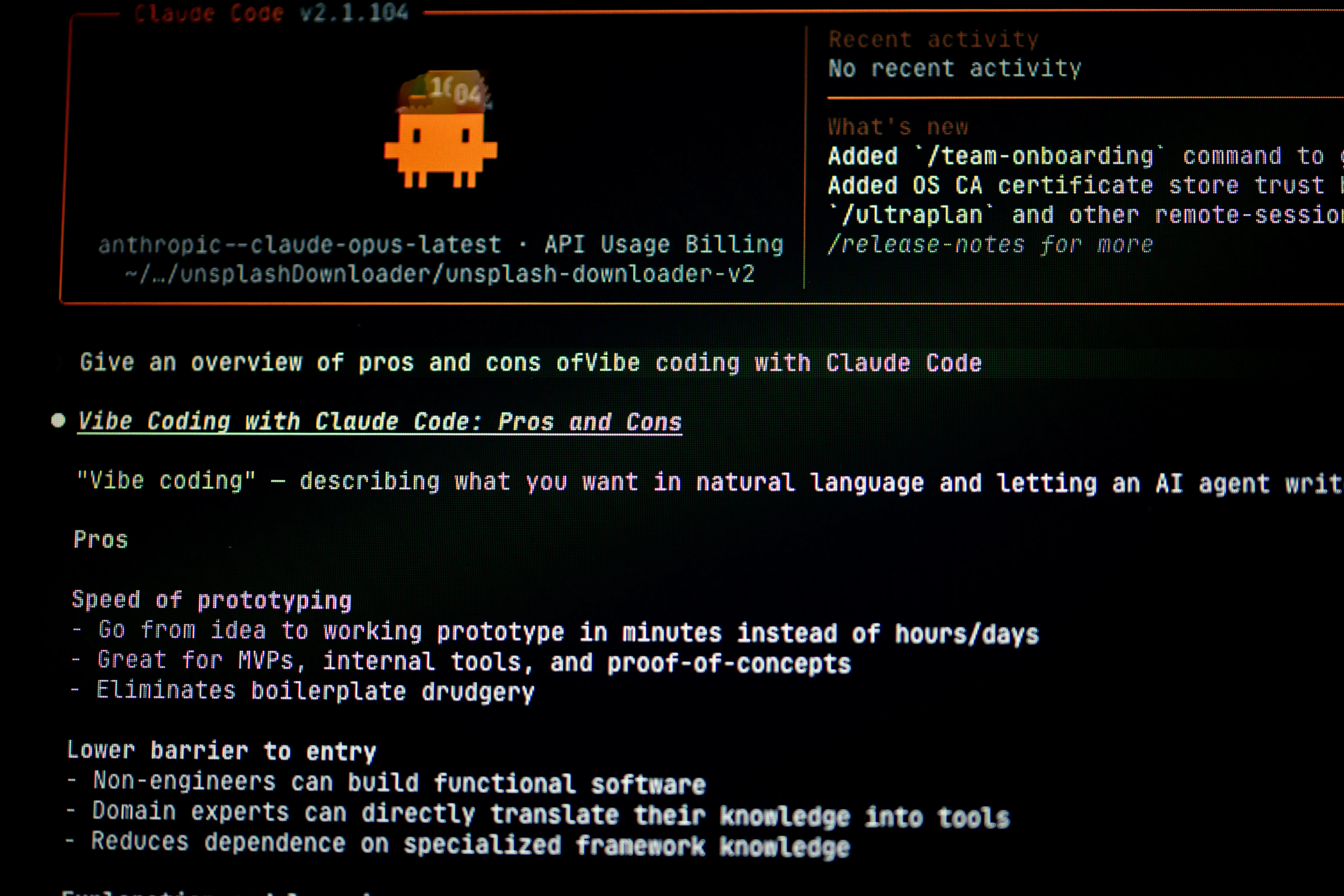
Claude Code running in a terminal in an earlier version. Photo by Bernd Dittrich on Unsplash. Used under the Unsplash License.