Sabi raises $50 million for its wearable brain interface

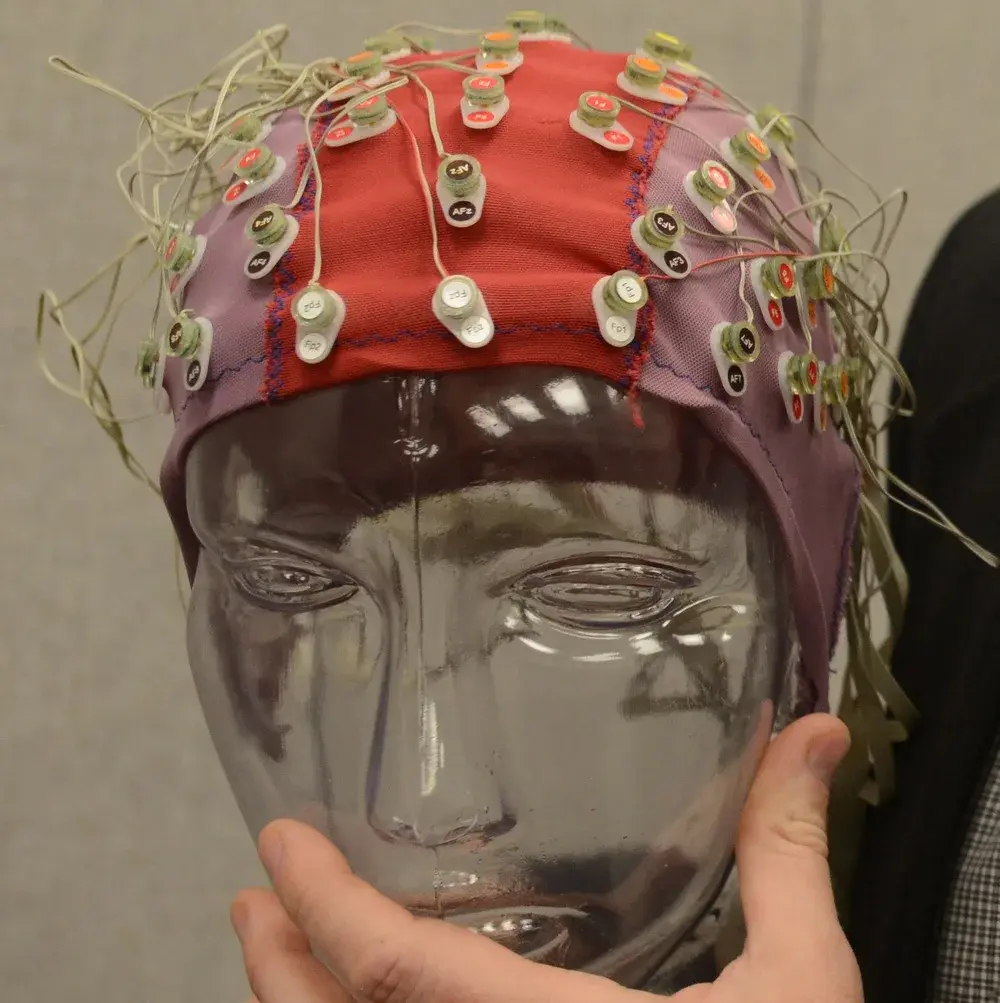
Sabi announced a $50 million seed round on October 9, led by Khosla Ventures, to develop a brain interface inside a baseball cap. The company plans an early prototype demonstration at CES 2027. That puts a concrete public milestone ahead of a much larger ambition to turn imagined speech into instructions for AI.
The commercial question is whether a wearable can make an instruction easier to give without making it harder to verify. An interface that guesses a plausible sentence still needs to preserve the person’s actual intent, particularly when the receiving AI can take action.
Funding for the work before a consumer product
Accel, Initialized Capital, DST Global and former OpenAI product chief Kevin Weil are among the investors. Sabi says the money will support neural data collection, chip development, early manufacturing and hiring.
The company’s website shows cap, beanie and bucket hat designs alongside a waitlist. It describes custom sensors and a model that maps brain signals to thoughts. Those materials explain the intended experience, but they do not provide a consumer performance test.
The familiar shape helps communicate the ambition. The harder commercial test is the complete routine around it. Fitting the device, teaching it about a new wearer, correcting mistakes and charging it all count toward whether someone would keep using it.
A large dataset still needs an output test
Sabi reports training on more than 100,000 hours of labeled neural recordings. Its funding announcement supplies no independent decoding accuracy result, consumer price or general availability date.
Recording hours describe an input to development. A useful evaluation would also show how many different people contributed data, whether test users were excluded from training, and how performance changes when the same person returns on another day. A model could learn a familiar participant well and still require substantial setup for someone new.
Sabi CTO Atmadeep Banerjee is an author of MindEye, published at NeurIPS 2023. That work reconstructed and retrieved viewed images from fMRI recordings. The research team’s explanation says models were trained separately for each participant. It provides relevant research background, but it did not test imagined speech through Sabi’s wearable EEG hardware.
Why fluent text can be the wrong result
A separate Brain2Qwerty v2 preprint dated June 29 offers useful context. Its authors recorded nine healthy volunteers typing sentences with MEG, which measures magnetic signals. They reported an average word error rate of 39 percent. This was a typing experiment with a different recording system, so its score cannot be transferred to Sabi.
The researchers also describe a revealing failure mode. A language model could produce a coherent sentence that differed entirely from the target when the neural signal was insufficient. Improved fluency did not automatically mean faithful decoding.
For an AI interface, that distinction changes the product design. A wrongly decoded shopping item or message recipient can look perfectly reasonable on screen. Users need a practical way to notice and correct those errors before a command becomes an action.
What a useful demonstration would establish
The most informative demonstration would show the requested words beside the decoded output, disclose any language model correction, and include failures. It would report setup time, response delay and performance across several wearers rather than only the best session. Testing unfamiliar phrases would help distinguish flexible communication from recognition of a small rehearsed command set.
Control deserves equal attention. A wearer should be able to tell when recording is active, inspect a proposed instruction and stop an unintended one. The separate issue of approving consequential agent actions also appears in ByteForward’s coverage of RSA Agent ID.
For now, the investment gives Sabi resources to pursue that work. The next convincing advance would be a repeatable account of what people can communicate, how often the system gets it wrong and how easily they can recover. Those details will determine whether a cap becomes a useful interface.