
Flow Engineering raises $50 million for hardware AI agents
Flow targets engineering coordination as its hardware AI platform attracts new funding.

Flow Engineering announced a $50 million Series B at a $750 million valuation on September 30. Antonio Gracias of Valor Equity Partners and Gavin Baker of Atreides Management led the round. Sequoia Capital participated after leading the earlier Series A.
Roelof Botha also invested personally and joined the board as an independent director. Flow says adoption at Rivian grew from 40 to 1,500 users in seven months.
AI agents for engineering changes
The company’s product overview describes a connected record of requirements, design artifacts and tests. Agents analyze the effects of a change and check requirements and test coverage. Proposed changes can sit on branches for review before joining the main record. Engineers retain architectural decisions. This is Flow’s description of its product, rather than an independent evaluation of its performance.
The practical problem is easy to picture. A team changes the weight or power demand of a component. Someone then has to find the requirements, interfaces and tests that might need revision. An assistant that reliably identifies those dependencies could reduce coordination work. The useful measure is how often it finds a real conflict and how much checking the engineer still has to do.
What the company expects from agents
In a separate letter, founder Pari Singh says Flow has deployed systems engineering agents in live hardware programs. He expects the work to move from coordinating engineering information toward carrying out more engineering tasks. His prediction that agents will increasingly perform that work over the next year is a forecast, not evidence that the transition is already complete.
That distinction matters when judging an engineering assistant. Finding an inconsistency in a document is one task. Selecting a safe design change and demonstrating that the finished system behaves as intended are additional tasks. Buyers need to know which steps are automated, which require approval and which tools are actually available in their deployment.
Where the new money goes
Flow plans to expand review, branching and evaluation capabilities, grow its engineering and sales teams, and pursue FedRAMP authorization. The announcement presents that authorization as a future goal.
For teams considering the product, a useful pilot would use a known engineering change and compare the proposed dependencies with an expert review. Track missed conflicts, unnecessary warnings and review time. Those results would give the adoption figures more operational meaning.
ByteForward’s coverage of Anthropic’s robotics cost study offers a related reminder that the economics of physical automation depend on more than a model’s capabilities.
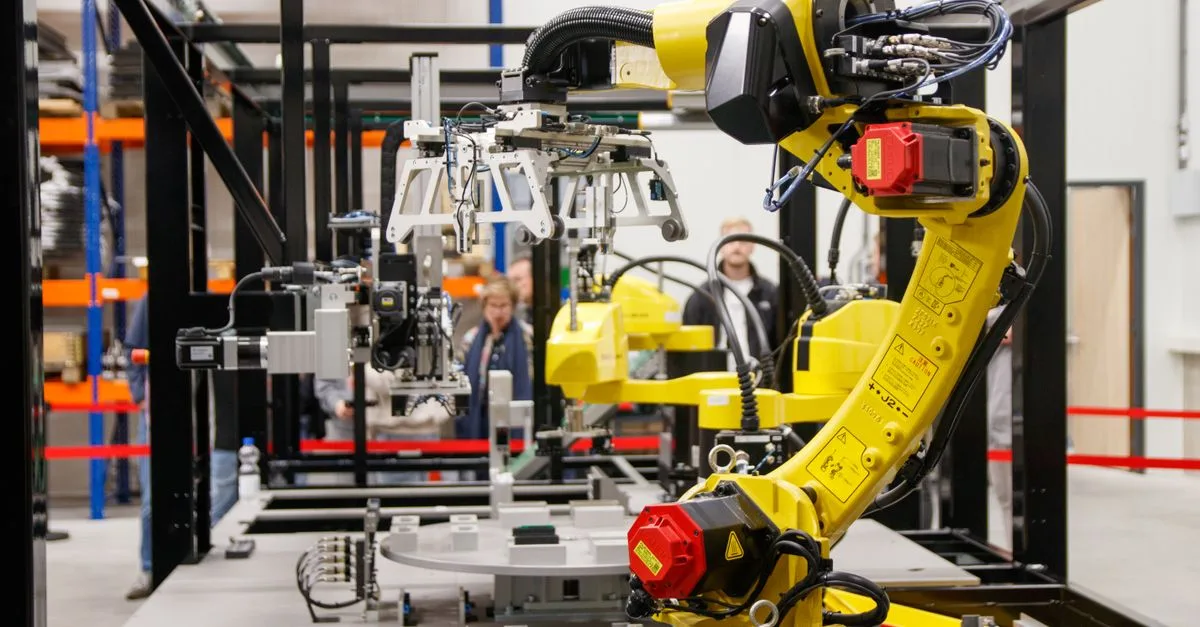
Illustrative industrial equipment photographed by Freek Wolsink on Pexels under the Pexels License. The photograph does not show a Flow installation.