Z.ai releases GLM 5.3 with reported gains on coding tasks

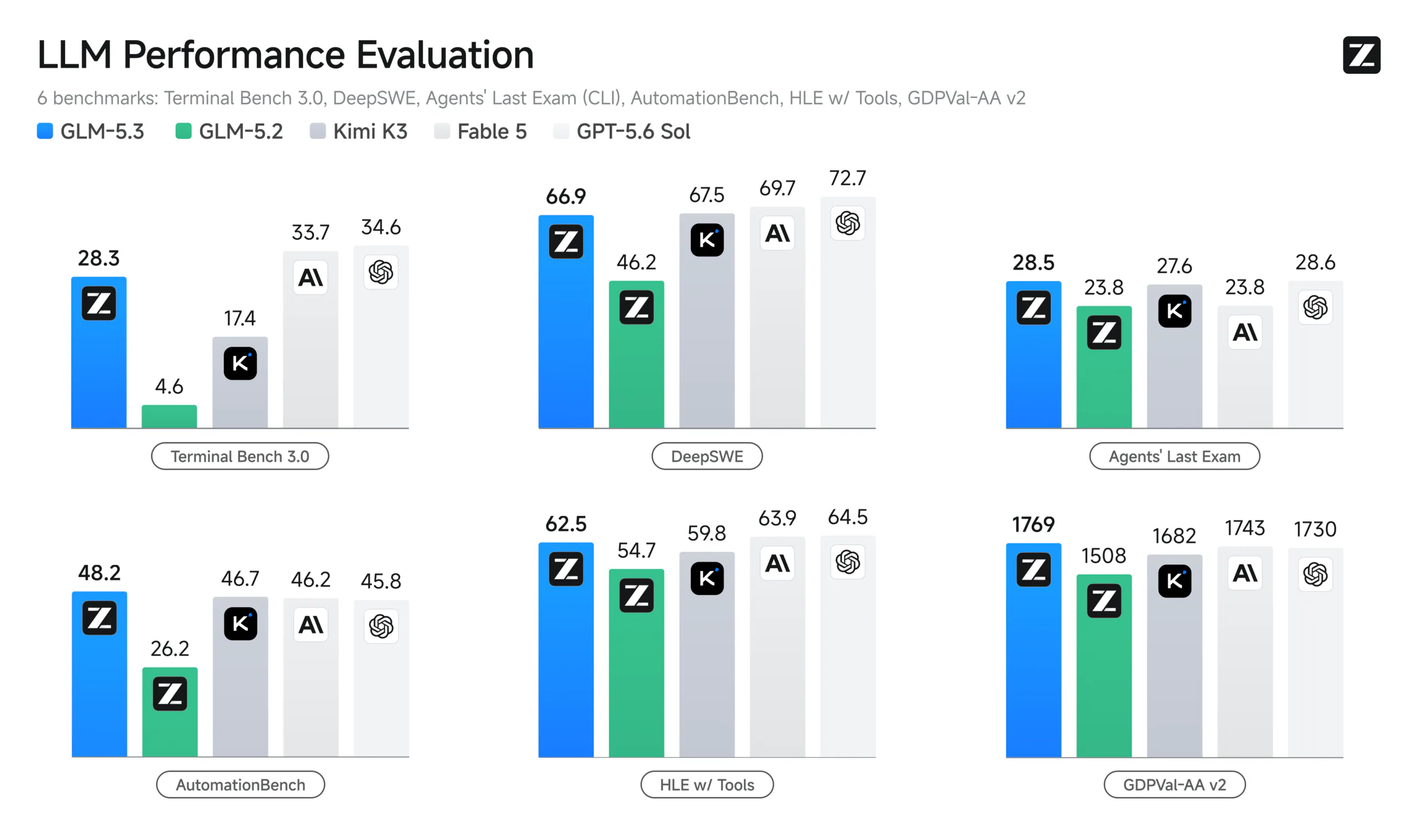
In its August 14 launch report, Z.ai attributed GLM-5.3’s gains over GLM-5.2 to more post-training, not a new base model. The results below are historical vendor claims, not ByteForward tests.
What Z.ai reported at launch
Its public benchmark comparisons were Terminal-Bench 3.0: 4.6 to 28.3; DeepSWE v1.1: 46.2 to 66.9; and Agents’ Last Exam: 23.8 to 28.5. GLM-5.3 still trailed closed models on several coding tests.
On private Z.ai Code Bench, at Max effort it reported 34.5% completion at roughly 75K output tokens versus 23.4% at 96K for GLM-5.2. At High effort, GLM-5.3 scored 31.4% at 50K tokens versus Opus 4.8’s 29.5% at 120K. Fable 5 led at 39.5% Max.
Z.ai also reported stronger cyber results: ExploitBench rose from 24.4 to 54.4, and ExploitGym from 29/39 to 105/130 under two time budgets. These benchmarks do not establish safe deployment or production reliability.
Weights are available, with a specific license
Availability checked November 1, 2026: the official GLM-5.3 repository now contains downloadable Safetensors weights. The earlier promise of a later release is no longer the current access picture. This check establishes that files are listed, not that ByteForward has downloaded or deployed them.
Read the actual GLM-5.3 license before choosing a deployment. It permits use and modification subject to its conditions, including notices. A specific condition requires Z.ai security review before commercial use when a licensee or affiliate operates a model-as-a-service business and their aggregate revenue exceeds $10 billion over any consecutive 12 months. This is a custom model license, not an unrestricted MIT grant. A code repository’s license should not be substituted for the weights’ own terms.
Check reasoning defaults before testing local weights
Checked November 16, 2026. The official model card accepts low, high and max values for reasoning_effort. Omitted or unrecognized values fall back to max. A configuration copied from another provider can therefore select the highest budget rather than fail visibly. Set low or high explicitly when comparing those modes.
The card also says the chat template defaults clear_thinking to false and recommends explicitly setting it to true for chat. Treat this as a separate template control, not a synonym for reasoning effort. Record both settings when testing multi-turn behavior.
For context, the reported Terminal-Bench 3.0 result used Claude Code 2.1.207, max effort, 400K context and up to 128K output tokens. Each rollout allowed 600 agent turns and a ten-hour timeout, with three rollouts per task. A short interactive coding trial is not the same evaluation. Compare your actual task success, time and token use rather than expecting a launch score from an unspecified configuration. ByteForward has not reproduced these runs.
Mistral-hosted users have a separate migration
Mistral’s September 29 notice scheduled its zai-glm-5-2 endpoint to retire on October 31, with zai-glm-5-3 as the same-price replacement. That schedule concerns Mistral’s hosting, not every Z.ai service or downloaded weights. We have not tested enforcement. Its lifecycle policy says retired identifiers return 404 errors; do not assume an automatic redirect.
Before migrating, check the provider and model identifier your application actually sends, then rerun representative tool calls and structured-output checks. Compare measured usage rather than assuming unchanged token prices mean unchanged total task costs.
Watch the original ByteForward breakdown: GLM 5.3 coding gains explained.
Featured chart: Z.ai, from its August 14 launch report; vendor-reported results.