XREAL AURA opens orders, with Gemini and a wired compute puck

Google and XREAL announced AURA on October 28, opening orders for wired Android XR glasses with Gemini. This is an order launch, not immediate delivery. The advertised starting price is $1,099 in US dollars through the end of 2026. Orders opened in the United States, Canada and Korea, with Japan following on November 2.
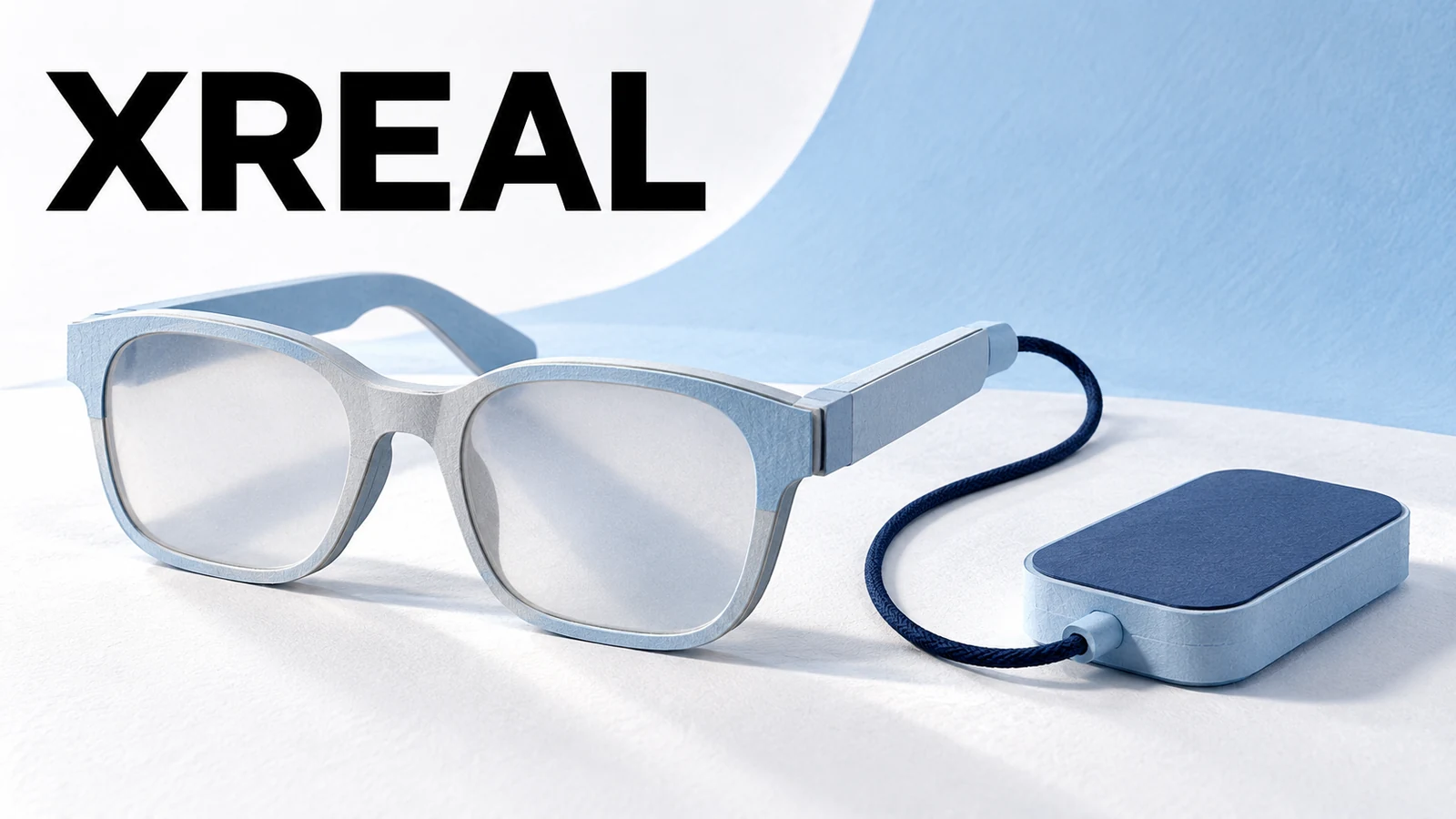
The important hardware distinction is the separate compute puck. AURA is not a pair of self-contained smart glasses. Its screen experience depends on a wired companion that carries processing and battery hardware.
What you carry and what you see
The manufacturer’s specifications list glasses weighing 95 grams and a 265-gram puck. The lenses are optical see-through rather than a camera feed of the outside world. A 70-degree field of view frames the digital content, with 1920 by 1200 pixels per eye and refresh rates up to 120 Hz. These are published specifications, not ByteForward measurements.
| Component | Published specification | Practical distinction |
|---|---|---|
| Glasses | 95 g | Not the weight of the whole system |
| Compute puck | 265 g | Separate hardware connected by cable |
| Controls | Hands, voice, puck touchpad and Bluetooth devices | A keyboard or mouse can complement gestures |
| Fit | M for 60 to 66 mm IPD, L for 66 to 72 mm | Choose the appropriate interpupillary distance range |
A laptop window beside Android apps
Google describes Wired Mirroring as a way to put a laptop display beside Android XR apps. It requires a USB-C connection that supports video output and does not require a software installation. Gemini can help with visible material across those windows. Google also announced highlighting through Share your view, while the Google Photos spatial gallery is planned for later this year.
For example, an evaluation could place a browser reference beside a mirrored document and check whether the text stays comfortable to read during normal work. That is a proposed test, not one we performed. A larger virtual screen alone does not establish sharper text, better ergonomics or faster work.
Shipping dates are estimates, not arrival promises
The US store lists 12 GB RAM with 256 GB storage and 16 GB with 512 GB. Its starting price should not be treated as a quote for every configuration or bundle. Taxes are calculated at checkout. The page also says final price, delivery and specifications are subject to confirmation.
Shipping is expected to begin in batches in mid-November. The store explicitly says priority fulfillment does not guarantee a specific shipment or delivery date. Production, inventory and destination can affect timing. Buyers should check the selected configuration and regional store rather than assuming the launch date is the day the device arrives.
Business deployment has a separate checklist
Google’s October 28 enterprise announcement describes Android Enterprise management, including Managed Google Play, zero-touch enrollment and fully managed device mode. It also identifies laptop display input as a way to use existing applications alongside Android apps. That is deployment context, not proof that every employer has approved the device or its AI features.
Google limits AURA use to adults 18 and older in the United States, Canada, Japan and South Korea. A compatible account is required. Some apps and features need setup, downloads or subscriptions. Before an organizational rollout, establish which account, apps and information are approved for the intended workflow.
ByteForward reviewed the launch announcement, product specifications and store conditions. We have not worn AURA, measured its display or battery life, or tested Gemini on the device.
Featured image: AI-generated editorial illustration by ByteForward. XREAL logo reference used for editorial identification. XREAL marks belong to their owner. No affiliation or endorsement is implied.