Fable 5.5 leak faces correction after LiteLLM entry fuels launch rumors

The Fable 5.5 rumor faces a LiteLLM correction. A project maintainer proposes removing the catalog entry after reported Azure checks failed to find the model.
The repository change is genuine. It does not establish a release date or a working Fable 5.5 service, and the original submission already warned that key specifications were copied from Fable 5.1.
How the Fable 5.5 rumor started
The Reddit thread in r/ClaudeAI argues that Fable 5.5 could arrive at any moment and points readers to LiteLLM. The post is a community observation. Its author says they are not affiliated with Anthropic. The discussion also contains skepticism about turning a software catalog change into a launch prediction.
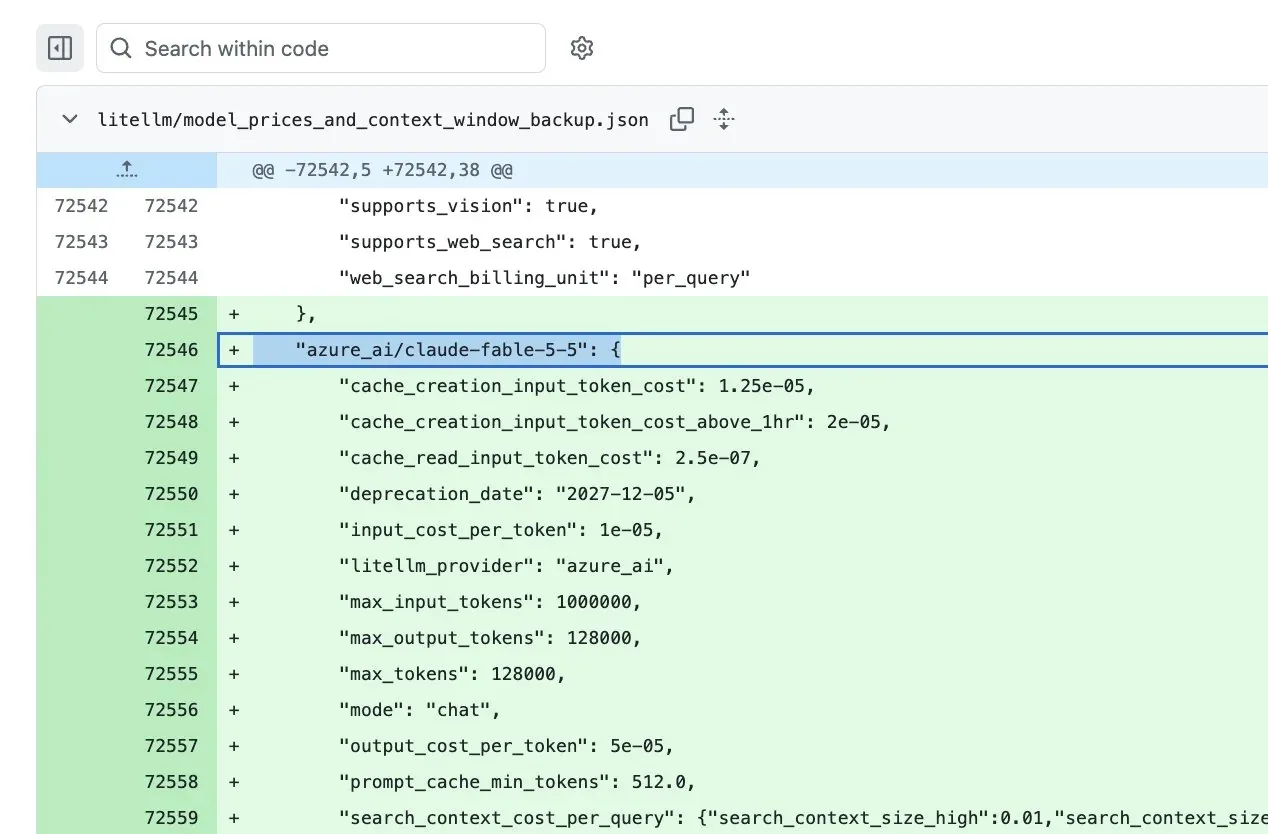
There is a concrete artifact to inspect. Commit 7dd53d6 adds the identifier azure_ai/claude-fable-5-5 to two JSON catalog files, including litellm/model_prices_and_context_window_backup.json. The patch adds 33 lines to each file. Its timestamp corresponds to October 13, 2026 at 1227 UTC.
Those additions establish that the identifier entered LiteLLM’s repository. A repository entry can explain why a model name appears in a screenshot or a model picker. Establishing that customers can use the service requires separate evidence.
The original submission already limited the claim
The description of pull request 46201 says the Azure Models API reported Fable 5.5 in East US 2 with a generally available lifecycle label. It also says the model’s pricing, limits and capabilities were inherited from the existing Azure Fable 5.1 entry because those details had no supporting source for Fable 5.5.
The submission treats the December 5, 2027 deprecation date differently, attributing that field to the reported API row. That distinction matters when describing the entry. The original claim was more specific than a blank placeholder, but it still did not provide independently sourced Fable 5.5 specifications.
The visible values include $10 per million input tokens, $50 per million output tokens, a million token input limit and 128,000 output tokens. These are values recorded in the catalog change. They should not be presented as announced Fable 5.5 pricing or performance.
The October 14 correction changes the story
The October 14 removal request reports no Fable 5.5 in six checked Azure regions. East US 2 listed Fable 5 and Fable 5.1 instead. Reported completion tests returned DeploymentNotFound.
The cause of the original appearance remains unresolved.
The replacement pull request 46345 carries the same commit and was opened under a different account so a human could approve it. Both requests remained open at 0826 UTC on October 14. The replacement had maintainer approval and automatic merging enabled.
What a catalog listing can actually tell us
Microsoft’s Models API documentation describes an operation scoped to a subscription and a location. Its schema includes lifecycle status and model properties. Reading a claim about that endpoint therefore requires context about the queried account, region and time. A label reported from one response does not establish availability for every customer.
The practical distinction is straightforward. A catalog can describe a model, while a deployment has to serve it. A successful request would be stronger evidence of access in the tested environment. Even that would leave broader rollout timing and access conditions to be established.
A generally available label in an API response is also different from a public launch announcement. Here, readers encounter that label through the disputed LiteLLM submission rather than a Microsoft announcement naming Fable 5.5.
The official documentation still points to Fable 5.1
Anthropic’s current model overview lists Fable 5.1 alongside Opus 5.5, Sonnet 5.5 and Haiku 5.5. Its dedicated Fable page marks Fable 5.1 as the latest version and gives September 1, 2026 as its release date. It does not provide a Fable 5.5 launch date.
The Fable 5.1 page publishes the same $10 input and $50 output prices per million tokens, a million token context window and 128,000 maximum output tokens. That gives readers an official reference for the existing product. It does not turn inherited catalog values into specifications for a successor.
Microsoft’s Claude models documentation likewise lists Fable 5.1 and Fable 5, with Fable 5.1 marked as a preview hosted on Anthropic infrastructure. Microsoft also explains that availability can differ by hosting version. It does not list Fable 5.5 as of October 14.
What would change the assessment
The next useful evidence should resolve a specific gap rather than repeat the same screenshot. Readers should look for the following.
- An Anthropic announcement or official model page that identifies Fable 5.5 and states when access begins
- A current provider listing with clear access conditions and a reproducible deployment path
- Published pricing and capability documentation that specifically names the new model
- A completed correction or explanation from LiteLLM that clarifies how the disputed entry was created
Until those gaps close, developers should avoid basing a migration or budget on the copied numbers. Anyone evaluating a future model can prepare representative tasks now, then test the released service against the same tasks when access is actually available.
This report reflects public sources checked on October 14, 2026. Repository status and provider documentation can change.