A 76,000-line Lean proof makes the Claude-assisted Riemann result easier to check
A compact Lean edition cuts the reported 17-million-line formal proof to about 76,000 lines. Independent machine checks passed. Human review is a separate step.
 Jordan Reid
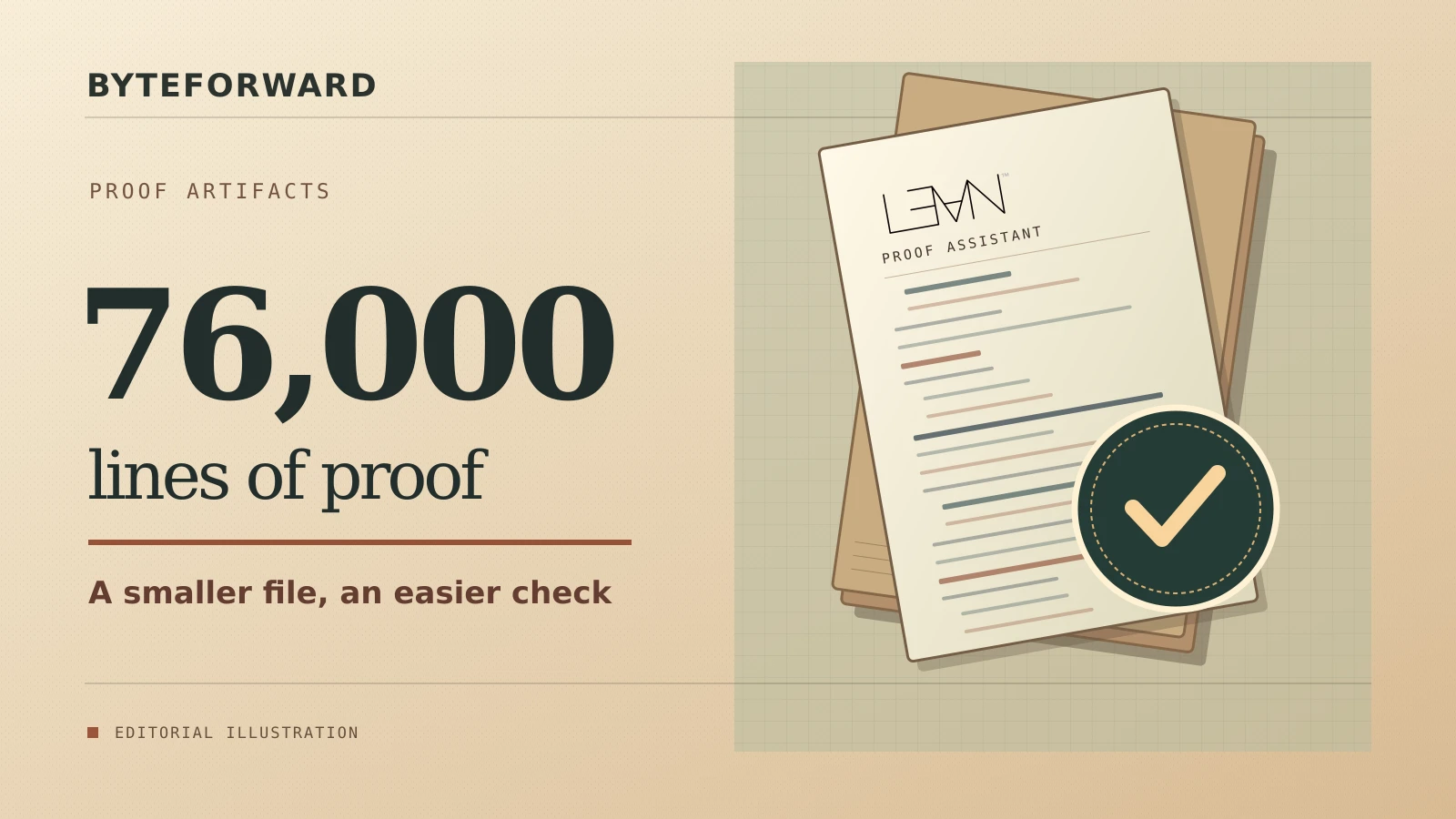
On November 25, Anthropic researcher Luke Sernau and collaborators released a shorter Lean 4 formalization of Levent Alpöge’s result with Claude. Its compact edition is about 76,000 lines of source code, down from roughly 17 million in the original formal artifact. It covers the classical Riemann Hypothesis and the Generalized Riemann Hypothesis for Dirichlet L-functions, not every conjecture that goes by the broader GRH label.
The two editions make different tradeoffs
The repository has a roughly 300,000-line edition intended to be easier to read and a roughly 76,000-line compact edition. Both formalize the same five theorem statements. The compact edition has fewer lines, but that does not mean it provides the clearer explanation. Start with the readable edition’s guide if your goal is to understand the argument. Use the compact edition and its checks if your first question is whether the formal result reproduces.
What independent checks actually established
University of Waterloo mathematician Michael Rubinstein reports that all 794 compact-edition modules compiled and passed a replay through Lean’s kernel. The five theorems used only Lean’s three standard axioms. MIT mathematician Andrew Sutherland independently verified both editions and checked that their five theorem statements matched the challenge file. In his standalone lean4lean check, the compact edition took 28 minutes 39 seconds and used 7 GB of memory; the readable edition took about 2 hours 35 minutes and used 332 GB. Those are results for one checker on Sutherland’s setup, not requirements for the full verification.
These are consequential checks, not just a successful build badge. They narrow the gap between what the project claims and what the proof assistant accepted. We did not rerun the builds. The authors say there is no accompanying paper and no mathematician has read the whole shortened proof. That is separate from whether the five stated results passed the machine checks.
Why the size reduction matters
The practical win is not just fewer lines. The compact edition was much cheaper to check in Sutherland’s lean4lean run, even though it produced a larger file of fully elaborated proof terms: 5.17 GB versus 4.49 GB. Start there to reproduce the checks; start with the readable guide to follow the argument. As with the earlier Lean proof artifacts, the next milestone would be a mathematical explanation that lets readers follow the strategy without taking a checker’s verdict as a substitute for understanding it.
For the classical zeta-function case, Rubinstein’s 265-page working guide is a separate place to start. It puts the argument in the language of analytic number theory, but it leaves the main inequality unproved. It is not a complete explanation of the shorter formalization or of the Dirichlet L-function results.
The compact proof has already been reused. In a separate November 26 check, Sutherland combined it with a formal equivalence to verify Schoenfeld’s error bound for a weighted count of prime powers. That is an existing result checked end to end, not a new bound or a human review of the underlying proof.
Featured image: ByteForward editorial illustration. The Lean proof assistant logo is a trademark of Lean FRO.