MAI Code 2 and Flash arrive in Copilot with promotional pricing

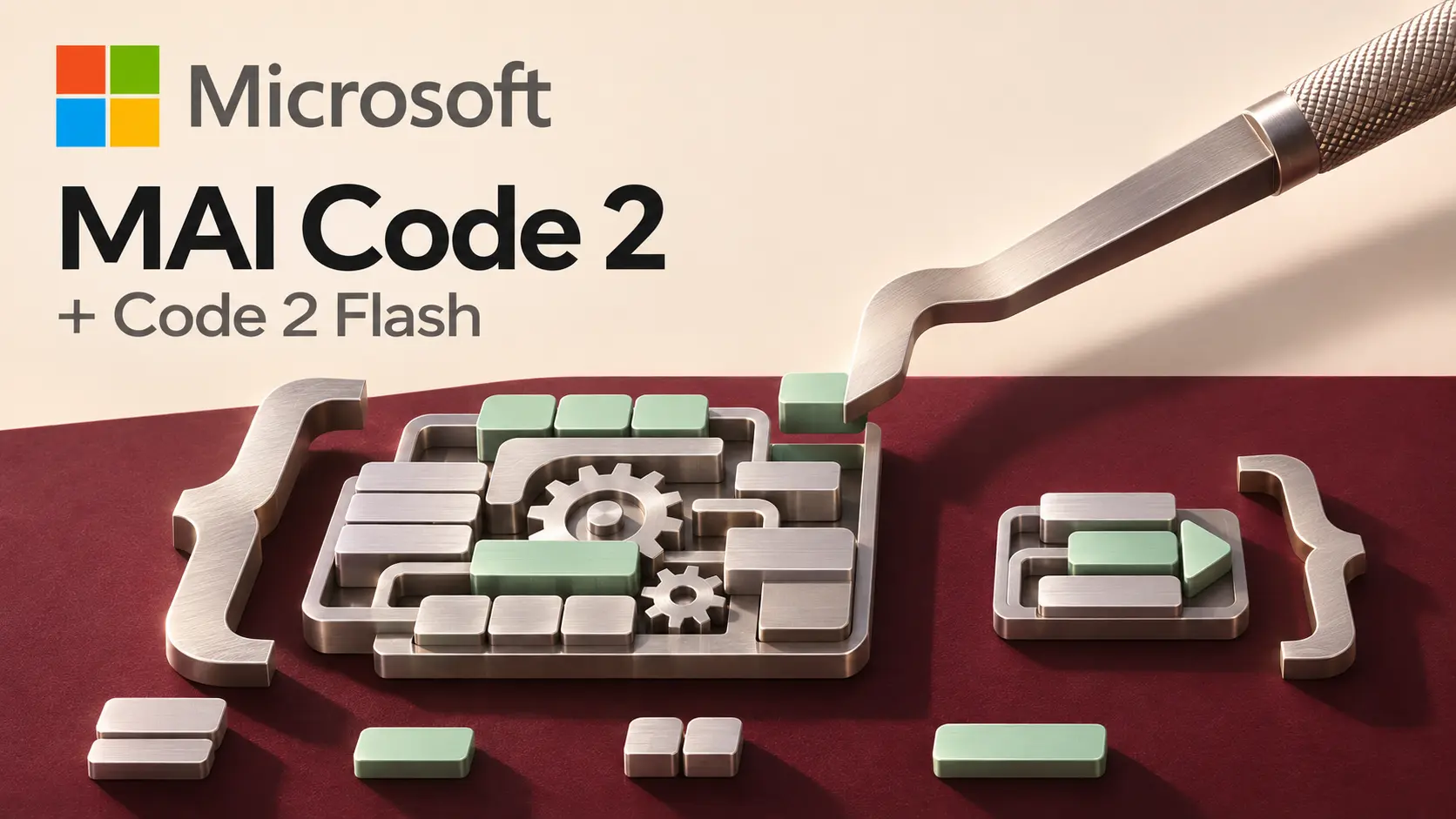
Microsoft launched MAI Code 2 and MAI Code 2 Flash on November 17, giving GitHub Copilot users two new coding options. The larger model targets complex repository work. Flash is aimed at routine fixes and rapid edits. Both arrive with promotional prices that double in May, a detail worth keeping beside the performance claims.
Which Copilot plans get the new models?
GitHub’s release notice lists MAI Code 2 for Pro, Pro+, Max, Business and Enterprise. Code 2 Flash also reaches Free and Student plans. Eligible annual subscribers are included.
The model picker is available across VS Code, Visual Studio, Copilot CLI, the cloud agent, the Copilot app, github.com, mobile, JetBrains, Xcode and Eclipse. Business and Enterprise administrators control access through model policies. GitHub says new models are enabled automatically under the default policy unless the administrator has disabled that behavior or the individual model.
Microsoft’s announcement puts Code 2 Flash in limited-access preview on Foundry. OpenRouter, Vercel, Hermes, OpenCode and Kilo are described as forthcoming, not launch-day access channels.
Promotional pricing ends in May 2027
GitHub’s billing documentation gives these US dollar rates per million tokens. These are Copilot rates, not a promise of identical billing on every future provider.
| Model and period | Input | Cached input | Output |
|---|---|---|---|
| Code 2, promotional | $0.50 | $0.025 | $2.50 |
| Code 2, from May 17, 2027 | $1.00 | $0.05 | $5.00 |
| Code 2 Flash, promotional | $0.05 | $0.005 | $0.25 |
| Code 2 Flash, from May 17, 2027 | $0.10 | $0.01 | $0.50 |
Usage is converted into GitHub AI Credits, with one credit equal to one US cent. Included allowances depend on the plan. Usage beyond them can incur charges. Existing annual plans that still use request-based billing have separate model multipliers.
For an ongoing service, budget against the post-promotion rates as well as the initial discount. A lower token price does not automatically mean a cheaper finished feature if the model needs more retries or produces changes that take longer to review.
What Microsoft’s benchmark claims actually compare
Microsoft says Code 2 averages 98% of GPT-6.1 Sol’s performance at 40% of its cost across four coding benchmarks. Its footnotes matter: models ran at maximum reasoning effort, three tests used Microsoft’s evaluation platform with Copilot CLI and no subagents, and the MAI costs use the 50% promotional price.
That is a vendor-reported comparison under specified conditions, not a general ranking across all coding work. Microsoft explicitly says these models are not yet tuned for fundamental science research or very long-horizon agentic work. ByteForward has not independently tested them. This comparison names GPT-6.1 Sol, not the new GPT-6.2 Astra and Sol models.
Large context, with a supervised workflow
The model card lists a 1,050,000-token context window, up to 922,000 input tokens and 128,000 output tokens for both models. They accept text and images and generate text. Reasoning effort ranges from low through maximum, trading latency and cost against quality.
Microsoft describes hosted deployment rather than downloadable weights for these offerings. The card says release optimization is for English code production and calls for human review and testing before generated code reaches production. Flash’s Foundry integration uses an OpenAI-compatible Responses API with Azure authentication, quotas and content filtering.
A useful first comparison is a small batch of familiar repository tasks: one contained bug fix, one multi-file change and one visual implementation. Give both models the same acceptance tests. Record whether the patch passes, whether it introduces unrelated edits and how much review it needs. That tests the distinction Microsoft is selling without assuming that a large context window guarantees a correct result.