Salesforce SOV-Transcribe-1 opens speech weights, with serving limits

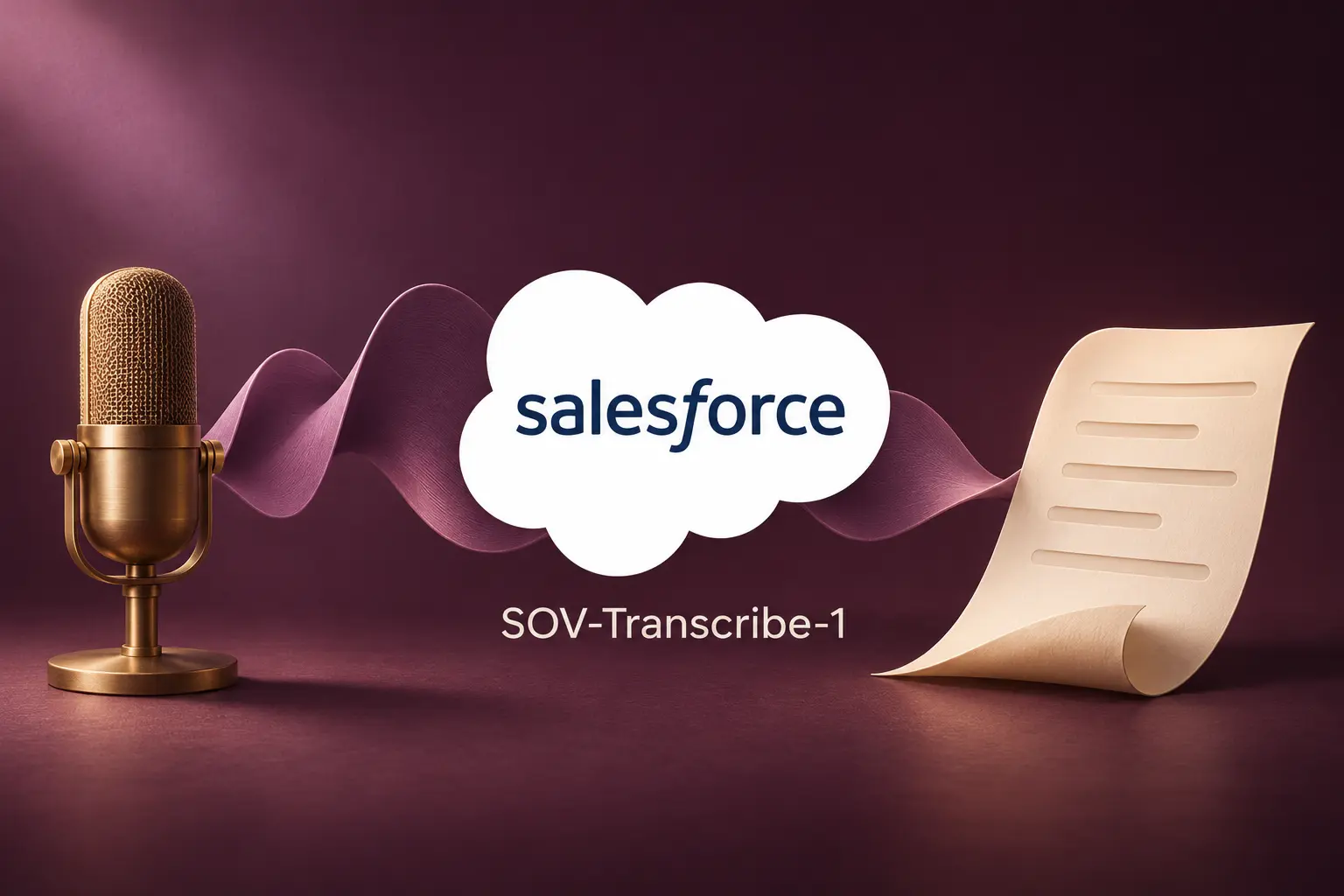
Salesforce announced SOV-Transcribe-1 on November 12, 2026, releasing open weights for speech recognition under Apache 2.0. The important boundary is non-streaming transcription: this is a model to evaluate for recorded audio, not evidence of a ready-made live voice agent.
The launch announcement emphasizes control over transcript style and recognition of difficult names, numbers and other key terms. Developers can supply instructions or relevant vocabulary rather than accepting one fixed transcription style. Salesforce says a technical report is still forthcoming.
What you can download and run
The model card specifies 26.6 billion total parameters and 4.6 billion active parameters, including the audio encoder. Those are more precise than the launch post’s rounded 26B and 4B figures. It combines a Whisper large-v3 audio encoder with a Gemma 4 mixture-of-experts model.
Inputs are 16 kHz audio with optional text instructions and context. Output is transcript text. The card lists English, French, German, Spanish, Italian, Portuguese and Dutch, and says audio up to 30 minutes has been tested. That is a documented test boundary, not a guarantee for every half-hour recording.
The public repository file list contains 16 Safetensors weight shards and shows a total size of 53.3 GB. Active parameter count should not be mistaken for download size or the memory required to load the full model. Plan storage and runtime capacity separately.
Framework support still needs attention
Native Transformers and vLLM support is being upstreamed. For now, the card provides repository modeling code for Transformers and a plugin for vLLM 0.32.0. Its Transformers examples use trust_remote_code=True. Review and pin that code before running it, rather than treating a familiar library name as proof that every loaded component is built in.
The optional DFlash helper is a separate download. Adding speculative decoding introduces another component to validate, so first establish a reproducible baseline without it. Compare correctness, memory use and end-to-end processing time on the same recordings before deciding whether the extra serving complexity pays off.
What the accuracy results do and do not show
On November 12, Artificial Analysis listed SOV-Transcribe-1 as its most accurate open-weight non-streaming model, at a rounded 2.3% AA-WER. Its index combines three datasets, weighted 50% for AA-AgentTalk and 25% each for cleaned VoxPopuli and Earnings22 data. That is a specific benchmark result, not a universal ranking across every language and acoustic condition.
Salesforce separately reports a 76.3% recording-level task success rate and 93.4% entity recovery on VoiceCodeBench. These are the vendor’s reported figures, not ByteForward measurements. Their difference is useful: recovering most entities can still leave a recording with at least one critical error. A wrong digit in a contact number can matter more than several harmless punctuation differences.
Choose a transcript workflow, not just a score
Start an evaluation with consented recordings that reflect the intended microphones, accents and terminology. Score names and numbers separately from overall word error rate. Test both useful vocabulary hints and irrelevant hints, then inspect whether the model inserts suggested terms that were not spoken. Keep the source audio available for human review where accuracy matters.
If the product must react while someone is still talking, compare a streaming system instead. Our Scribe v3 and Live guide explains why speaker revisions and turn detection create different integration requirements. Faster processing of a completed file does not establish those capabilities.
Open weights give teams a deployment option, not a finished operational policy. Access controls, recording consent, retention and transcript review remain the operator’s work. ByteForward has checked the release materials and public artifacts, but has not run SOV-Transcribe-1 or measured its performance.