OpenAI Pando: what its Git backend means for coding-agent infrastructure

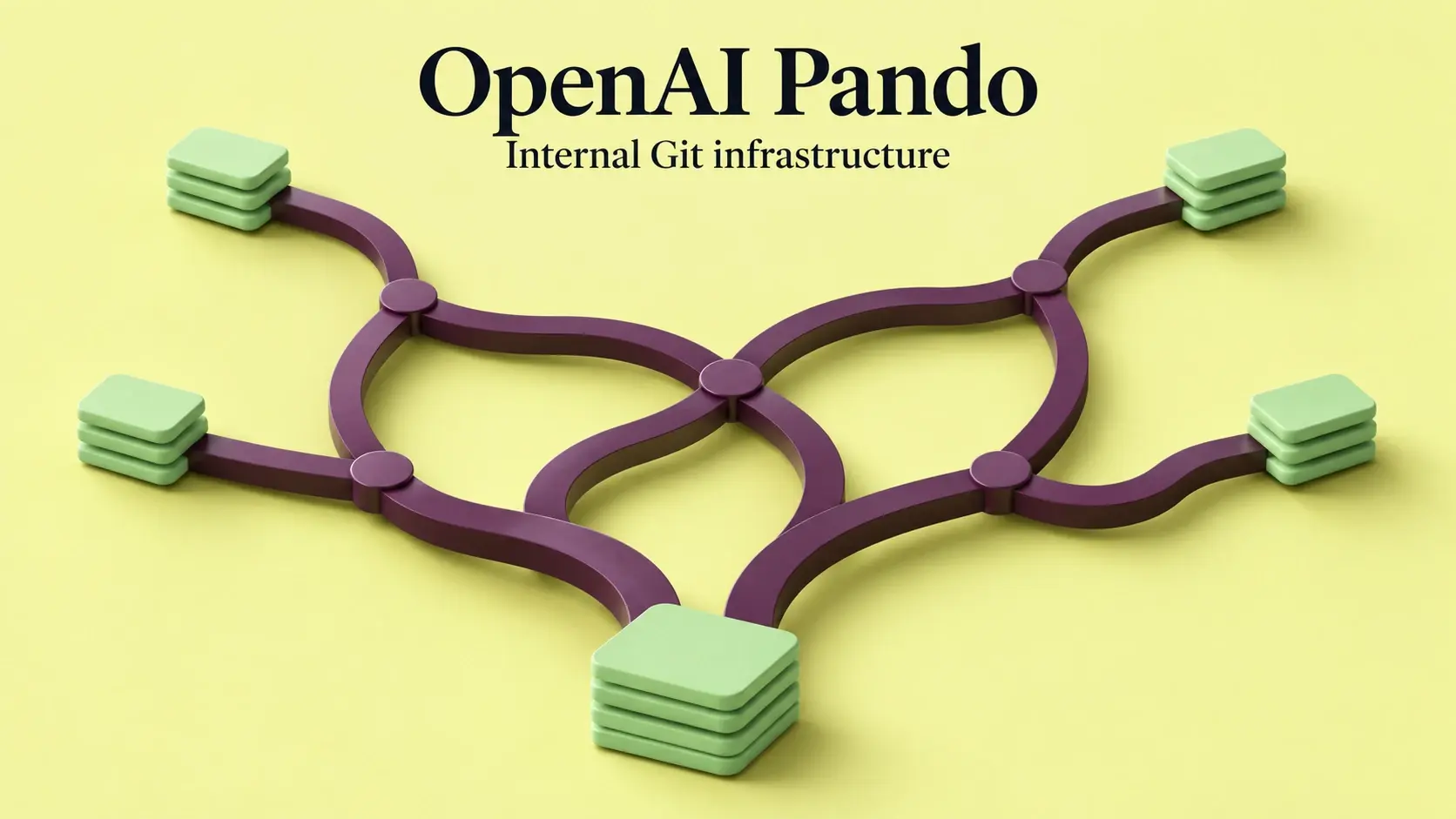
OpenAI’s November 2 engineering report describes Pando, an internal Git backend in production since April. It is not a public server release. Separate branches can accept concurrent updates, while reusable packs serve readers. Cross-branch reads need not represent one repository-wide snapshot. OpenAI is exploring sharing the technology; the report gives no public product pricing.
That distinction matters when evaluating infrastructure for coding agents. “Git is slow” is not a diagnosis. Waiting to push, downloading repository objects and preparing a working directory are different problems. A useful first step is to identify which one delays useful work before choosing a remedy.
First locate the bottleneck
Record these measurements separately for a representative task, then repeat under realistic concurrency. Keep repository revision, machine size and network location consistent enough to explain differences. Compare a cold start with a repeat run rather than mixing them into one average.
| Symptom | Evidence to collect | Decision it informs |
|---|---|---|
| Pushes wait or fail | Push duration, concurrent writers, branch targets and error messages | Whether to investigate write contention or branch coordination |
| Workers spend time fetching | Bytes transferred and fetch duration for cold and repeated runs | Whether network transfer and reusable local data deserve attention |
| Agents wait before editing | Time from task assignment to a ready working directory | Whether checkout preparation is a larger delay than the remote operation |
| Only some tasks slow down | Task type, requested revision and files actually needed | Whether a universal optimization would penalize exceptional workloads |
These are diagnostic questions, not benchmark results. A fast median can conceal a small set of long waits, so keep the slow cases visible. Include retries and failed tasks in the accounting. An optimization that looks quick only after discarding failures is not a useful operational improvement.
Three existing Git tools, three different jobs
The official Git documentation describes options available independently of Pando:
| Tool | Documented behavior | Boundary |
|---|---|---|
| Partial clone | --filter=blob:none delays file-content blobs until needed | It changes what is fetched initially, not the coordination of remote writers |
| Reference clone | --reference borrows an existing local object store; --dissociate copies necessary objects to stop borrowing | A borrowing clone depends on that object store |
| Linked worktree | Multiple working directories share repository data, with separate HEAD and index | Git normally refuses a branch already checked out elsewhere |
Sources: Git clone documentation; Git worktree documentation. For a concrete checkout workflow, see our nodeterm guide to branch identity and application runs.
For a pilot, choose a representative set of tasks before changing the default. Include one that reads little code, one that searches broadly and one that needs history. Record both completion time and transferred bytes. If an early saving merely moves the wait to the middle of a task, that may still be useful, but it should be reported as a tradeoff rather than disappearing from the measurement.
A worktree also should not be mistaken for a security boundary. Decide separately how untrusted code runs, what credentials a worker receives and what it can modify. This article does not establish a safe execution policy for agent-generated code. Our Claude Code policy-hook guide examines why approval checks and execution isolation need separate review.
Protocol support is not a downloadable backend
Git’s protocol-v2 documentation describes packfile-uris as an advertised capability: a client can request HTTP(S) locations for packed objects and downloads the referenced packs before checking connectivity. Support for a protocol mechanism does not by itself supply a hosted service or an operational design.
When assessing any proposed backend, ask how failures are recovered, how clients with different capabilities behave, and how costs change during bursts. Require a rollback plan and a comparison against the current workflow. Those questions remain useful even when the chosen solution is a small configuration change rather than new infrastructure.
Where to examine the original work
The source report includes an interactive simulator explicitly labeled synthetic teaching models, not production benchmarks. Use it to explore the explanation, not to predict your own latency.
Read OpenAI’s engineering report and its simulator; consult the Git protocol reference alongside the clone and worktree documentation. No hands-on Pando testing was performed for this article.