OpenAI Signals shows a broader mix of work in ChatGPT

OpenAI released a new Signals work-activity dataset on October 26, mapping ChatGPT use to 165 activity categories across nearly 100 countries. The quarterly series runs from early 2025 through the third quarter of 2026. It offers a more detailed view of what people bring to the chatbot than a single count of workplace users.
The useful finding is a change in the mix of requests, not a count of jobs automated. To make that distinction visible, ByteForward downloaded the published data and calculated the concentration of work messages across every available quarter.
The biggest activities take a smaller share
We retained the 74 countries present in all seven quarters, summed each country’s ten largest activity buckets, including Other IWA, in each quarter, then averaged those country totals equally. The published CSV produces the following series.
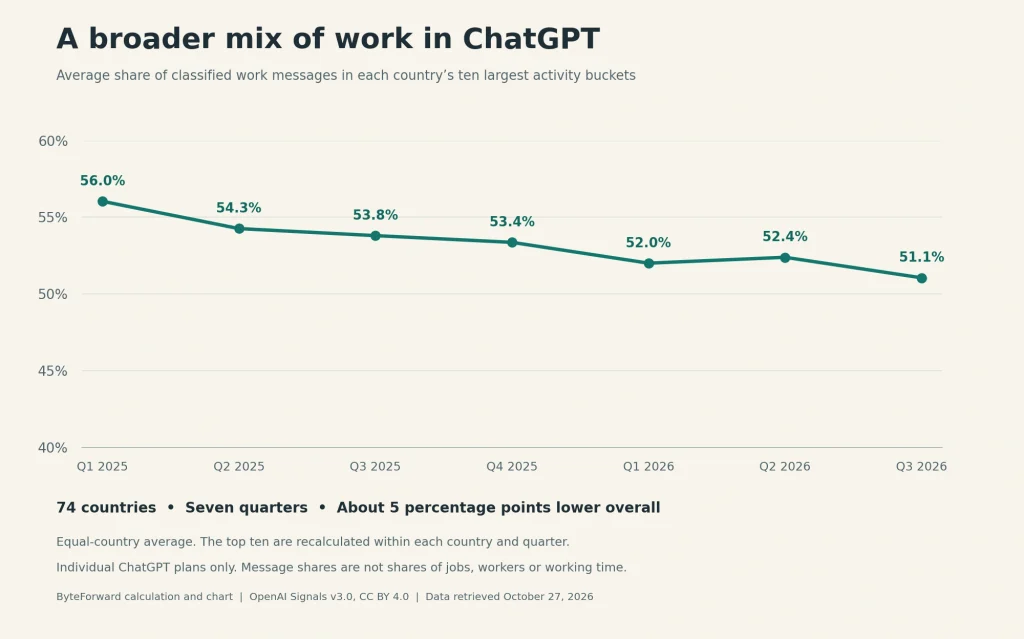
| Quarter | Mean top-ten share |
|---|---|
| Q1 2025 | 56.0% |
| Q2 2025 | 54.3% |
| Q3 2025 | 53.8% |
| Q4 2025 | 53.4% |
| Q1 2026 | 52.0% |
| Q2 2026 | 52.4% |
| Q3 2026 | 51.1% |
The calculation reproduces OpenAI’s rounded start and end figures. It also shows that the decline was not uninterrupted. The ten categories are selected separately in each country and quarter, rather than tracking one fixed list. This is not the share of all global messages pooled together.
A smaller top-ten share means the remaining activities account for more of the classified work-message mix. It does not establish that everyone is using more features, or that a particular occupation has become more automated. Changes in who uses ChatGPT can change the mix too.
What an activity looks like in the data
In the U.S. third-quarter 2026 rows, editing written material accounts for 17.1% of classified work messages. Creating marketing or promotional material accounts for 5.0%. These are message categories, not percentages of American workers or of their working hours.
That distinction changes the story a reader can tell. A long back-and-forth revising one document can generate many messages. A completed task might involve only one. Without measuring the underlying work and its outcome, those counts cannot establish which task saved more time or delivered more value.
The data dictionary maps messages to O*NET Intermediate Work Activities. That creates a common vocabulary for tasks across occupations. A category is inferred by an automated classifier, not a user’s declaration of their job title.
The sample leaves out important kinds of work
The analysis covers individual ChatGPT plans, excluding enterprise messages and Codex. The wider Signals sample uses one million messages per month from accounts declaring an age of at least 18. It excludes deleted accounts and users who opted out of training.
OpenAI says researchers do not read the raw messages. Classifiers operate on de-identified data, and the release adds privacy-protecting statistical noise. Smaller groups are less precise. The figures should therefore not be read as an exact census of activity.
There is a second coverage gap when comparing the data with employment. OpenAI says roughly 43% of the employment-weighted task mix in mapped U.S. occupations falls outside the individually reported activity categories. Physical work such as moving materials or operating vehicles is among the examples.
A research input, not a replacement forecast
The download page provides the CSV files and methodology under a reusable data license. Researchers can investigate differences in requested activities, but should keep the comparison population and denominator explicit.
For example, a training team could use the writing categories to frame questions about document review and drafting. It would still need to measure quality, time saved and mistakes in its own workplace. A shift in chatbot requests cannot answer those operational questions by itself.
Original calculation and chart by ByteForward, using OpenAI Signals v3.0 by Chatterji and colleagues, under CC BY 4.0. Data retrieved October 27, 2026.