Google previews Genie 4 with native audio and live world editing

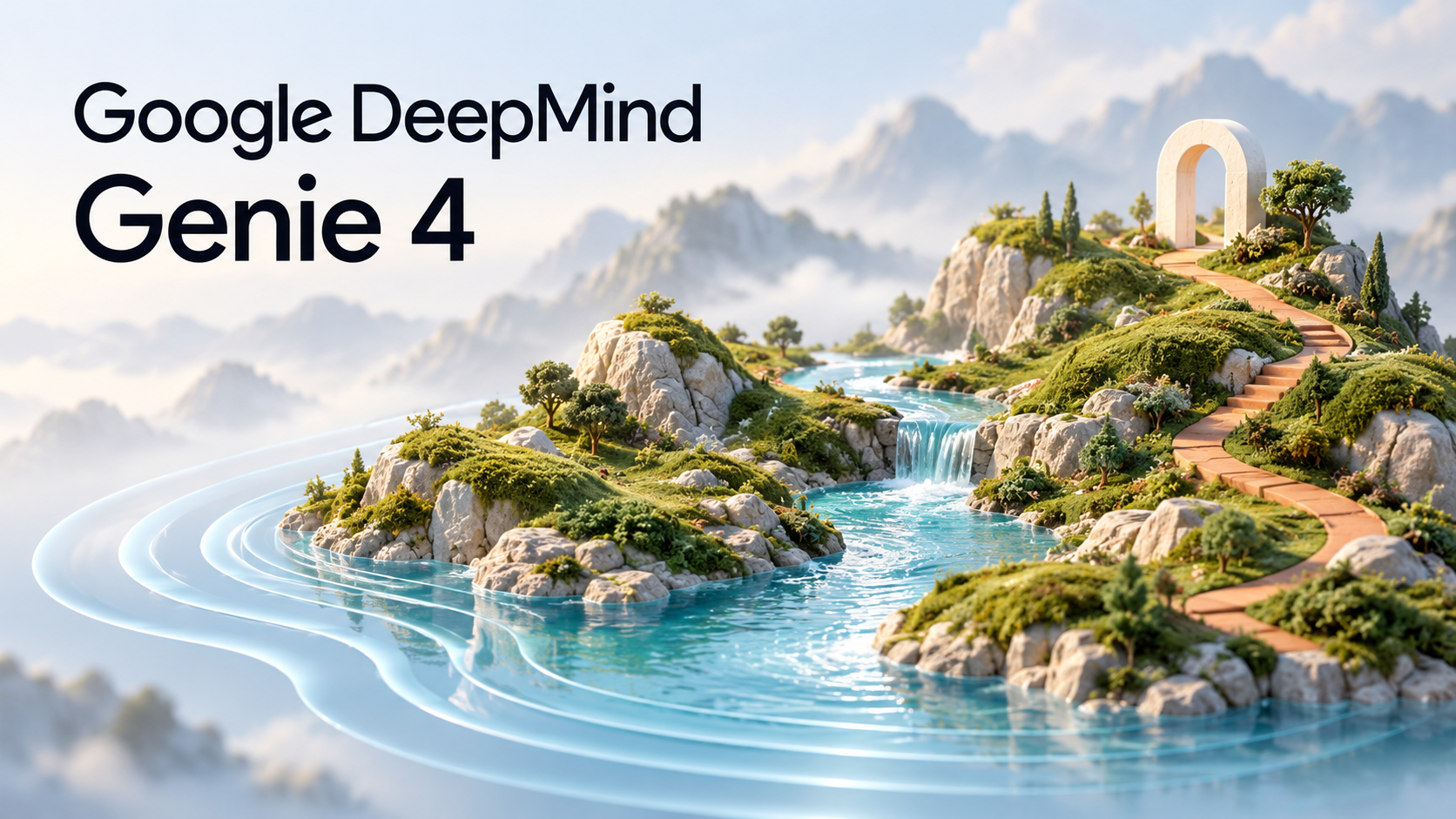
Google DeepMind announced Genie 4 on October 27, 2026. The world model combines navigable scenes with native sound and dialogue, and lets users change an unfolding simulation through text. Access starts with trusted testers. Google AI Ultra in Project Genie and early access through the Gemini API and Google AI Studio are still forthcoming.
The useful distinction is between seeing a convincing scene and directing an experience that stays consistent. For creators, the first can help communicate an idea. For a game, training environment or repeatable experiment, the second is essential.
What is new in the preview
Google describes keyboard navigation alongside natural language scene changes. It says Gemini 3.8 Flash observes the simulation, plans steps and checks progress, while separate work with Gemini 4 Argon and robotics remains experimental. Generated video and audio carry SynthID watermarks. These are the company’s descriptions, not results from ByteForward testing.
Sound makes the evaluation more demanding. A scene can look coherent while a voice, impact or ambient noise belongs somewhere else. Reviewers should therefore listen without watching once, then watch without sound, before judging the combined experience. That separates an attractive soundtrack from a convincing response to an action.
Do not confuse Genie 4 access with January’s Project Genie launch
Google’s January 29 Project Genie announcement introduced a Genie 3 powered prototype for adult Google AI Ultra subscribers in the United States. That initial release limited generations to 60 seconds and did not include the previously demonstrated promptable events. Those are historical conditions for that prototype, not a specification for Genie 4.
The current Genie 4 model page describes a few minutes of continuous interaction rather than extended sessions. It also warns that locations are not reproduced perfectly, readable text often depends on the input description, and audio accuracy remains unfinished research. A waitlist or an existing Ultra subscription should not be treated as proof that a particular account already has the new model.
Two demonstrations worth inspecting
Google’s model gallery makes the steering claim concrete. In one sequence, a saxophonist stands on a planted platform in a lake. Snow appears as the camera moves closer. Another starts with a watermelon on a stone plinth, then introduces a falling sculpted bust. These are selected demonstrations, not repeatable tests. Watch what changes around the requested action, not just the most dramatic frame.
For filmmakers, weather changes and impacts need different acceptance criteria. Visual appeal alone does not establish repeatability. A usable shot must also preserve the details that matter to the brief.
Keep three judgments separate while watching. Does the scene communicate the intended atmosphere? Does the intervention leave unrelated details intact? Is there evidence that the sequence can be produced again? A highlight reel can demonstrate an attractive result without answering the last question. That missing repeatability matters more to a production handoff than another impressive frame.
An explorable draft is not a finished game
Google acknowledges remaining problems with object permanence, complex physics, spatial precision, text and long term consistency. Its announcement supplies no general access date, price or complete production service specification.
For a filmmaker exploring a camera move, a short successful sequence may already be useful. A developer needs a different handoff with editable assets, explicit rules, predictable state and a way to reproduce defects. Before committing a project, ask what can be exported and retained, what remains dependent on a live service, and how revisions are reviewed. Do not assume a convincing recording answers those questions.
ByteForward’s earlier look at AI game demos and the work behind them separates generated worlds from games assembled with code and prepared assets. Genie 4 makes that distinction more important, not less. The immediate question is which part of a creative workflow the preview can support reliably, rather than whether an impressive scene replaces the whole workflow.