UniWALM tests text memory for robot control

An October 20 preprint introduces UniWALM, which produces robot actions and text together. It feeds its own generated text into subsequent decisions, preserving details that current camera views may omit.
On Find the Item, objects are covered before the robot identifies their locations. The authors report 61.1 percent success versus FastWAM’s 11.1 percent across 18 physical trials per method. UniWALM’s reported 95 percent confidence interval spans 39.6 to 82.6 percent. Testing used Flexiv Rizon arms. This comparison changes several components, so it cannot isolate language’s contribution.
Memory has a cost
The paper’s unoptimized timing test used ten denoising steps and 32 actions per chunk. Language increased inference from 76 to 123 milliseconds. These are model timings, not a complete control loop measurement.
Physical evaluation covered three tasks. In simulation, UniWALM trailed leading baselines on two short grasping tasks. The authors also report incorrect task transitions despite accurate memory. Broader deployment reliability remains unestablished.
Text feedback has a history
The Inner Monologue paper from 2022 offers useful context. It supplied a language model planner with success reports, scene descriptions and human feedback, then selected from previously trained robot skills. Feedback could change the plan as a task unfolded.
Its authors also described limits that matter when evaluating language guided robotics. Some experiments relied on human or scripted scene descriptions. Incorrect success detection could trigger needless retries or conceal a failed action, and the available control skills constrained what the planner could achieve.
ByteForward’s VPP2 coverage examines a separate approach using earlier camera observations. Comparing memory systems requires checking what information they retain and how the experiment tests its later use.
ByteForward has not independently reproduced these results.
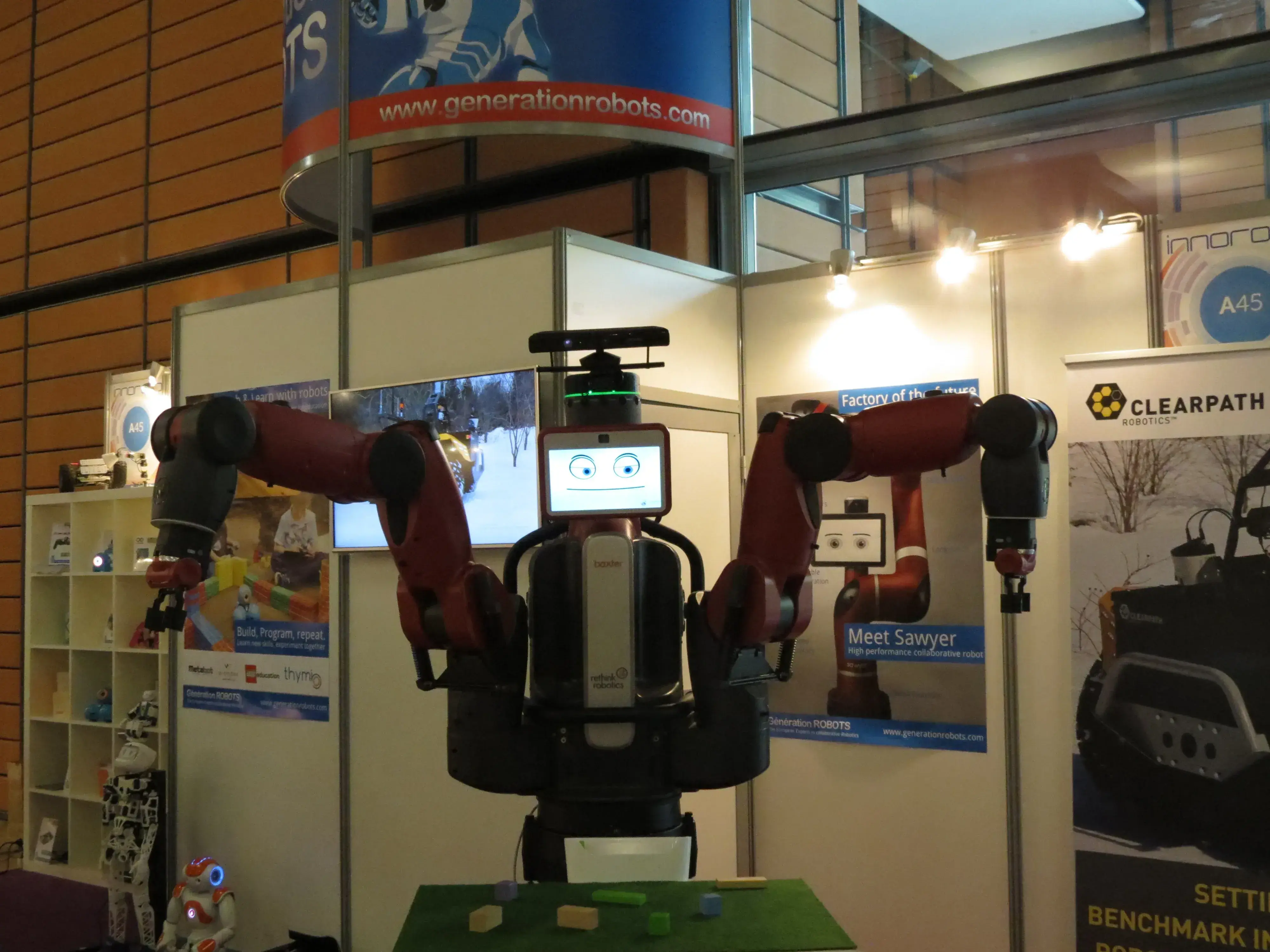
Baxter at Innorobo 2015. Photograph by Scailyna, under CC BY SA 4.0. Taken July 2, 2015. This archival photograph provides robot context and does not show UniWALM hardware or testing. Converted to WebP for display.