DeepSeek Flash 1017 demos show the cost of waiting

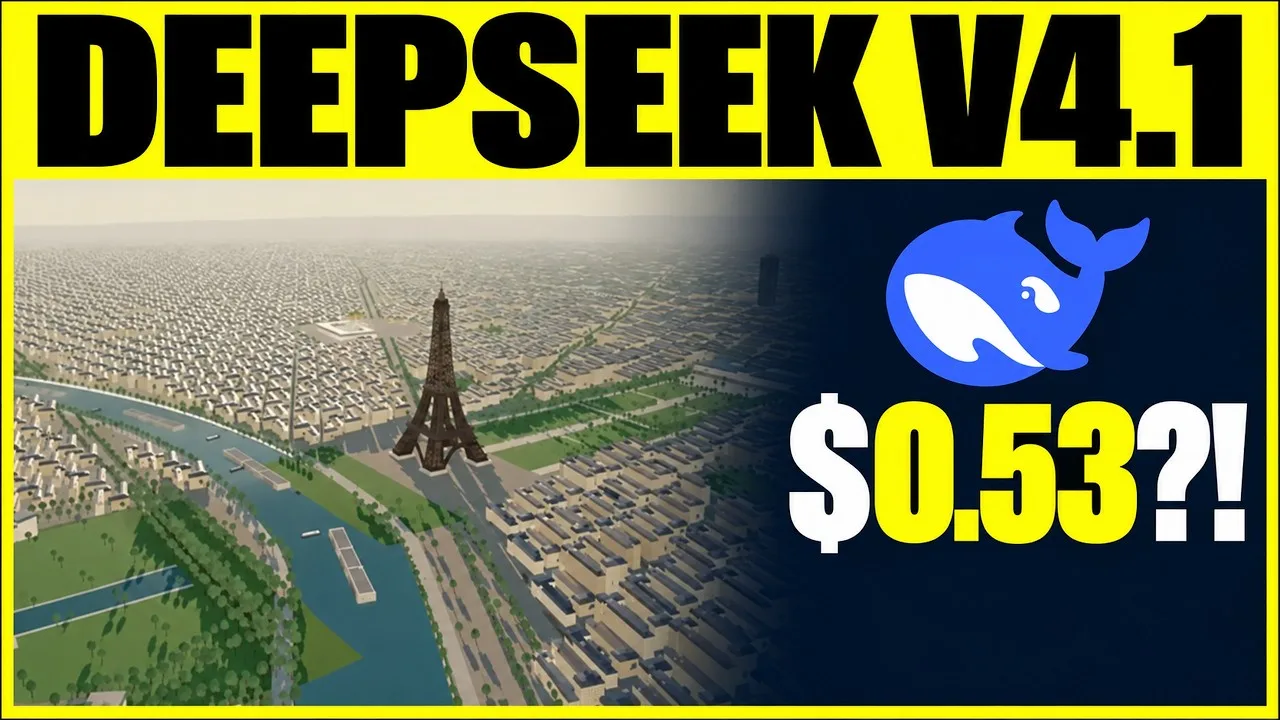
DeepSeek Flash 1017 demos make the cost of waiting hard to ignore. One creator reported paying $0.53 for a Paris scene, but the run took about 70 minutes. Other examples produced an explorable medieval world and interactive animations, with different costs and compromises.
ByteForward’s latest video walkthrough brings those creator results together. The examples below follow the full video and its source descriptions. They are reported demonstrations, with costs and timings supplied by their creators. ByteForward has not replicated them as controlled benchmark runs.
The Paris build makes waiting part of the price
In the walkthrough’s account of Tony’s Paris comparison, four models received the same request. DeepSeek cost $0.53, Claude Haiku $0.43 and Gemini $3.68. The fourth run was listed as free. Gemini took about 38 minutes, compared with DeepSeek’s roughly 70.
The video favors Gemini’s tower detail while finding DeepSeek’s scene worth developing further. That makes the decision personal. An unattended experiment can tolerate a longer wait. An interactive session loses momentum while the next change sits on hold. The reported bills also lack enough setup detail to predict prices for another project.
A five dollar world with room to explore
The medieval example has a different appeal. In the section beginning at 32 seconds, the walkthrough describes soldiers, a castle and a surrounding town, with roads, a river and hills beyond the walls. Changing the lighting gives the same place another time of day.
Its creator, Marcel, reported more than two million blocks in a single file, about 25 minutes of work and around $5 through the API. The setup used DeepSeek’s coding agent with reasoning turned up. Those details describe one particular run. They do not establish a standard charge for a world of that size.
What makes the example useful is its continuity. The video describes narrow streets, varied roof directions and scenery that remains present as the camera pulls away. For a prototype, that gives the creator several connected parts to develop rather than a single object to place in an empty scene.
Animated scenes reveal details a screenshot misses
The jellyfish comparison, credited to zhallen, makes interaction the main attraction. The video describes tentacles trailing, curling and settling as the creature is dragged. It prefers the brighter DeepSeek result, while recognizing that the quieter Claude version could suit a different page.
The setup limits the comparison. DeepSeek used an agent run, while Opus produced a single response. Each system had a different opportunity to revise its output. The result demonstrates an available creative direction, but cannot establish a fair ranking of the underlying models.
Movement also matters in Token Gremlin’s flock. The walkthrough describes a request for 5,000 starlings and a hawk using Three.js, with a flock that changes shape above a lake and reflects in the water. It also calls out excessive glare from the sun. That is a specific defect a creator could ask the agent to fix while preserving the behavior already working.
A lighthouse scene from the same creator supplies another test of atmosphere. The video describes rain crossing the view, water around the island and a beam sweeping out from the tower. These are running scenes made with code. Their value depends partly on how they behave over time, something a still image cannot fully communicate.
Stopping at a usable result matters
The turtle example, attributed to Teortaxes, adds a useful complaint. The creator reported that the updated model completed most of the work faster, then spent time on small improvements near the end and needed guidance. The walkthrough describes a detailed shell, plants and moving fish, alongside this concern about when the agent should stop.
For a creative workflow, record the first usable result as well as the final run time. Those moments can be far apart. Set a small initial task, preserve a working version and ask for one change at a time. A lighting adjustment is easier to evaluate when the rest of the scene remains stable. This is a practical way to test an agent, rather than a claim that these examples prove a particular stopping rule works.
The update changes more than one comparison
The walkthrough also cites Wësche’s pagoda comparison between the old and new Flash versions on the same two computers. The reported time fell from about 21 minutes to 17, with roughly 18 percent fewer output tokens. That is a separate comparison from the Paris exercise against other providers. A model can improve on its own previous release and still take longer than another model on a different task.
DeepSeek’s official model card reports 77.0 on DeepSWE v1.1 for the update, up from 74.2, and 42.3 on Terminal Bench 4.0, up from 31.2. The same table gives Opus 5 a Terminal Bench score of 51.8. These are the company’s published results under the stated test setups. They support a narrower conclusion about improvements across particular workloads, with strengths still varying by task.
Token prices still need a project budget
Checked on October 18, DeepSeek’s pricing page lists Flash at $0.15 per million input tokens without a cache hit and $0.60 per million output tokens during off peak periods. Peak rates are $0.30 and $1.20. Cached input has a separate lower rate. The page identifies the served Flash model as the October 17 update.
An agent can make several model calls while building, checking and revising a scene. The completed run therefore needs its own budget. Record token use, retries, tool charges and elapsed time alongside whether the result actually works. If an existing subscription already covers the task, an additional API bill also needs to earn its place in the workflow.
Our earlier Flash 1017 coverage explains the release, search charges and integration details. These demos add a more concrete question for creative work. Does a particular result justify the money and waiting it took to obtain? For experiments that can run in the background, the answer may be yes. For rapid iteration, compare the usable output and turnaround together before choosing.