Recova teaches robots separate recovery skills
Robot recovery research reports gains across four physical tasks

An October 1 preprint introduces Recova, a robot learning framework that trains task execution and recovery as separate capabilities.
Learning how to put things right
The author project page describes a workflow that begins in a digital twin, a simulated version of the robot’s workstation. An agent explores the task, identifies failures and develops corrections. Successful task attempts and recovery demonstrations provide different training data for the two policies.
During physical data collection, the system monitors progress and calls on a recovery policy when needed. A human takes over if autonomous recovery cannot restore the scene. Those corrections become examples for improving recovery, while successful task rollouts improve the task policy.
What the physical trials show
Across four physical tasks, the authors report mean success rising from 77.5 percent after DAgger training to 87.5 percent with recovery enabled. That is a gain of 10 percentage points. Each task and configuration had 20 trials, with an operator judging outcomes.
DAgger is the repeated collection and training process used here to update policies with robot experience and human demonstrations. The tasks covered pencil box packing, ring stacking, drawing mahjong tiles and discarding them. Real robots used learned recovery policies. Simulation benchmarks used recovery programs and reused published baseline results.
Where the evidence stops
One separate collection experiment reached zero human takeovers in seven final round episodes on the mahjong drawing task. This does not establish reliable unattended operation or safety.
The project’s data collection demo makes supervision visible. Four station views share a timeline with numbered human intervention markers. Readers can use those markers to inspect when assistance enters the workflow.
Longer trials could measure recovery time and supervision costs. ByteForward has not independently tested Recova.
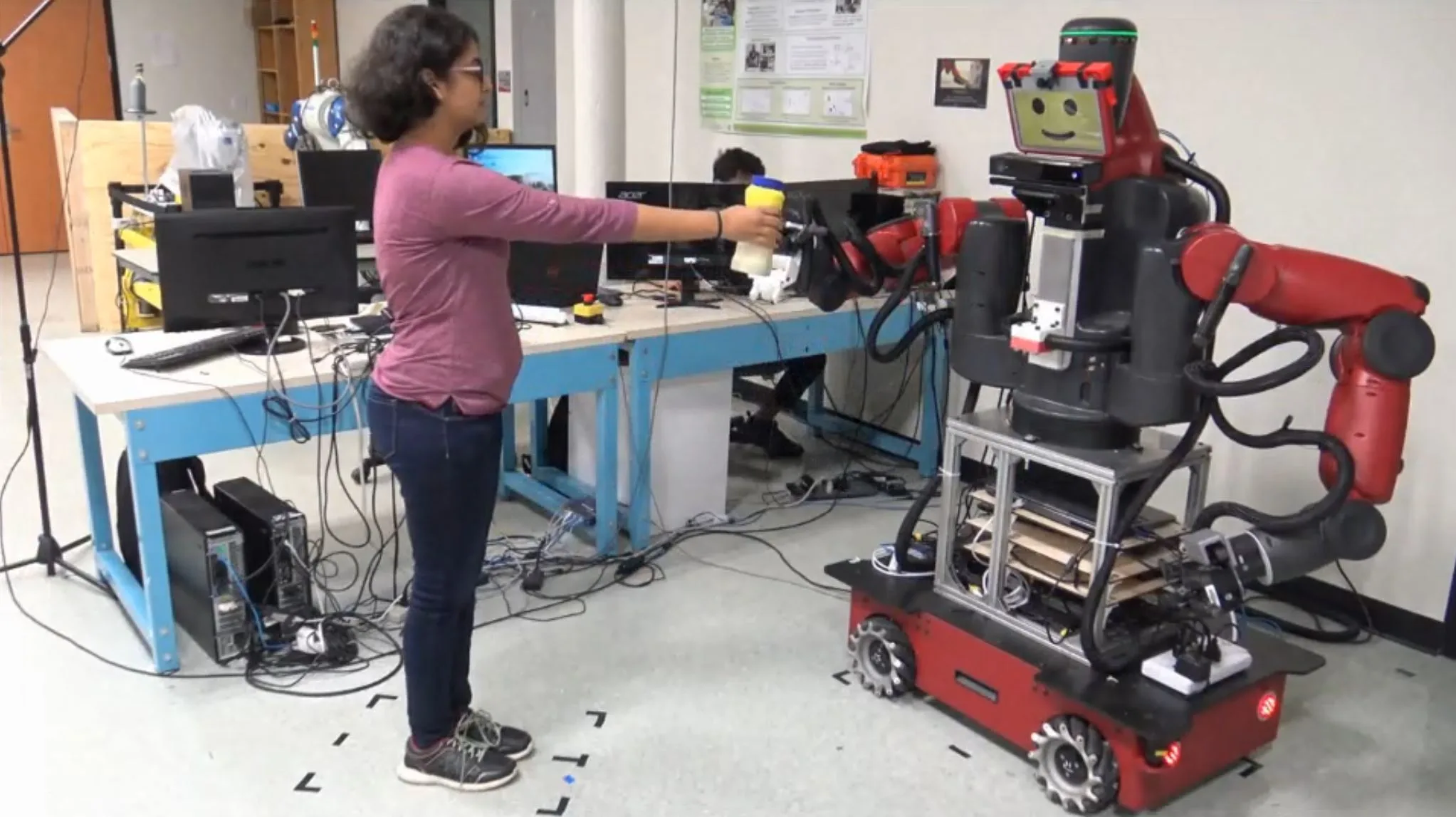
Illustrative archival photograph of a person handing a cup to a Baxter robot by QuarkyTale, dated September 2018. Licensed under Creative Commons Attribution ShareAlike 4.0. Converted to WebP for site delivery. This photograph does not depict Recova.