GitHub Agentic Workflows reaches GA with Actions-based automation

GitHub Agentic Workflows reached general availability on October 28, bringing Markdown-defined agent tasks into GitHub Actions. It is available on github.com for Free, Team and Enterprise accounts. That is platform eligibility, not a promise of free inference. The default Copilot CLI engine requires a Copilot license.
The practical distinction is where the automation lives. A maintainer describes a repository task, compiles it into an Actions workflow and reviews its output alongside the repository’s other automation. This is not another name for an interactive Copilot conversation.
What changed at general availability
GitHub lists support for self-hosted ARC runners with Docker-in-Docker, refreshed engine and model options, model routing and improved budget forecasting. The forecast command now includes threat-detection credits and monthly ranges. These are capabilities to evaluate, not measured savings from ByteForward testing.
Start with a report, not an automatic fix
The official quickstart uses a daily repository status report. It gathers issues, pull requests, discussions, releases and code changes, then opens an issue with a summary and suggested next steps. You need repository write access, Actions enabled, an authenticated GitHub CLI and an appropriate AI account.
The setup wizard adds a Markdown source file and a generated lock file to .github/workflows. Both belong in version control. Changing the YAML frontmatter requires recompiling the workflow. Before enabling it, review the selected engine’s data handling, integrations and access to logs and artifacts.
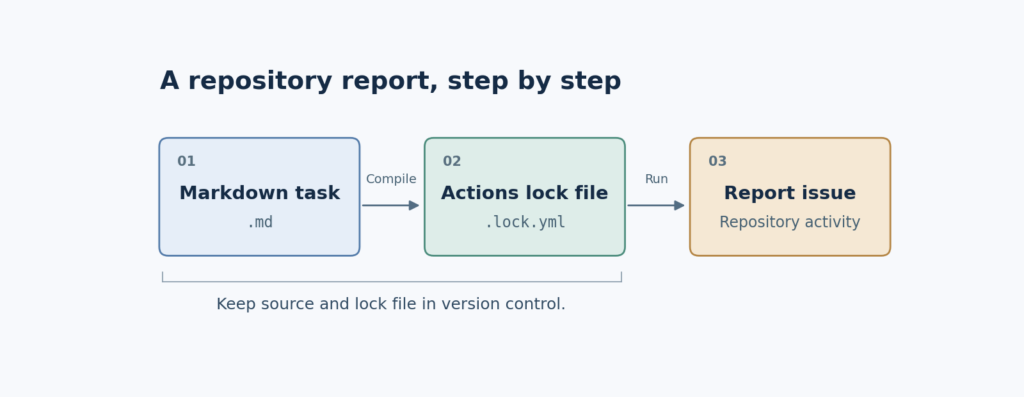
An illustrative pilot could summarize unresolved documentation requests from one small repository. Ask a maintainer to compare the report with the underlying issues, mark invented or stale conclusions and record whether any recommendation was worth acting on. This is an evaluation proposal, not a workflow we installed or tested.
Preview writes without calling the pilot free
The safe-output documentation provides staged mode. With staged enabled globally under safe outputs, write operations are skipped and proposed results appear in the Actions step summary. Handlers can still read target data to validate filters. Enabling staging for one output type does not automatically stage every other type.
For the reporting pilot, inspect the proposed issue before permitting real publication. Staging is a useful boundary for checking output quality, but it is not evidence that an agent’s reasoning is correct. Nor does previewing writes remove the cost of running the agent.
Budget for two separate cost categories
GitHub’s cost guide separates Actions compute from AI-provider inference. Its AI-credit estimates use a pricing catalog and may differ from the provider’s invoice. Reconcile actual billing rather than treating a workflow footer as the final charge.
| Pilot decision | Cost consequence |
|---|---|
| Manual or scheduled trigger | Easier to bound the number of runs |
| Trigger on every push | A busy repository can create many agent runs |
| Agent credit cap | Separate threat-detection budget still matters |
The guide recommends starting with scheduled or manually triggered work while evaluating cost. It also distinguishes the main agent’s credit cap from threat detection’s separate cap. Review both rather than assuming one number covers the complete workflow.
A useful adoption test
Choose a task whose output a maintainer can verify quickly. Measure corrections required, useful recommendations and total spend together. If a deterministic check already answers the question reliably, adding an agent needs a reason beyond novelty. Keep successful reporting separate from authority to change code or merge a pull request.
ByteForward reviewed the announcement and documentation. We have not installed the extension, run the sample or measured its accuracy, runtime or cost. The sources support the release and configuration distinctions, not a guarantee that unattended automation will improve a particular repository.
AI-generated editorial illustration by ByteForward. GitHub logo reference from the official GitHub Brand Toolkit. GitHub marks belong to GitHub, Inc. No affiliation or endorsement is implied.