SuperMimic cuts reported humanoid training costs

UC Berkeley researchers posted SuperMimic on October 20. It learns simulator dynamics to train humanoid motion tracking. Authors report higher tracking return than SONIC’s checkpoint after three hours on one H100. The policy learns from short imagined rollouts through that shared dynamics model.
What the benchmark measures
The 129,514 benchmark motions were training examples for both systems. Reported failures of 25 versus SONIC’s 179 measure coverage, using SuperMimic’s termination rules. The counts do not test generalization to unfamiliar motions.
The compute comparison also differs in hardware and training data. SONIC used 128 L40 GPUs for seven days and 611 hours of motion data. SuperMimic used 264.56 hours of motion data. Its training cost excludes checkpoint evaluation.
Physical evidence remains limited
The authors demonstrate four motions on a physical Unitree G1. Dynamics learning uses simulation alone, and training excludes terrain and object interaction. Broader reliability remains unestablished.
Why motion libraries matter
The earlier DeepMimic research from 2018 helps explain the approach. It combined imitation of motion clips with task objectives in simulated characters, including recovery from disturbances and adaptation to different bodies. A reference supplies the desired movement, while the controller learns actions that make a physical simulation reproduce it.
That research illustrated why imitation and control belong together. Copying a pose is only part of the problem. A moving body also has to respond to forces and remain coordinated as circumstances change. DeepMimic explored such behavior within its simulated environments.
ByteForward’s coverage of GreenWAM examines a related distinction between robot model benchmarks and a physical packing task. Readers comparing research should check exactly what is counted, whether a motion clip, an instruction or a complete job, before interpreting a success rate.
ByteForward has not tested SuperMimic or independently reproduced these results.
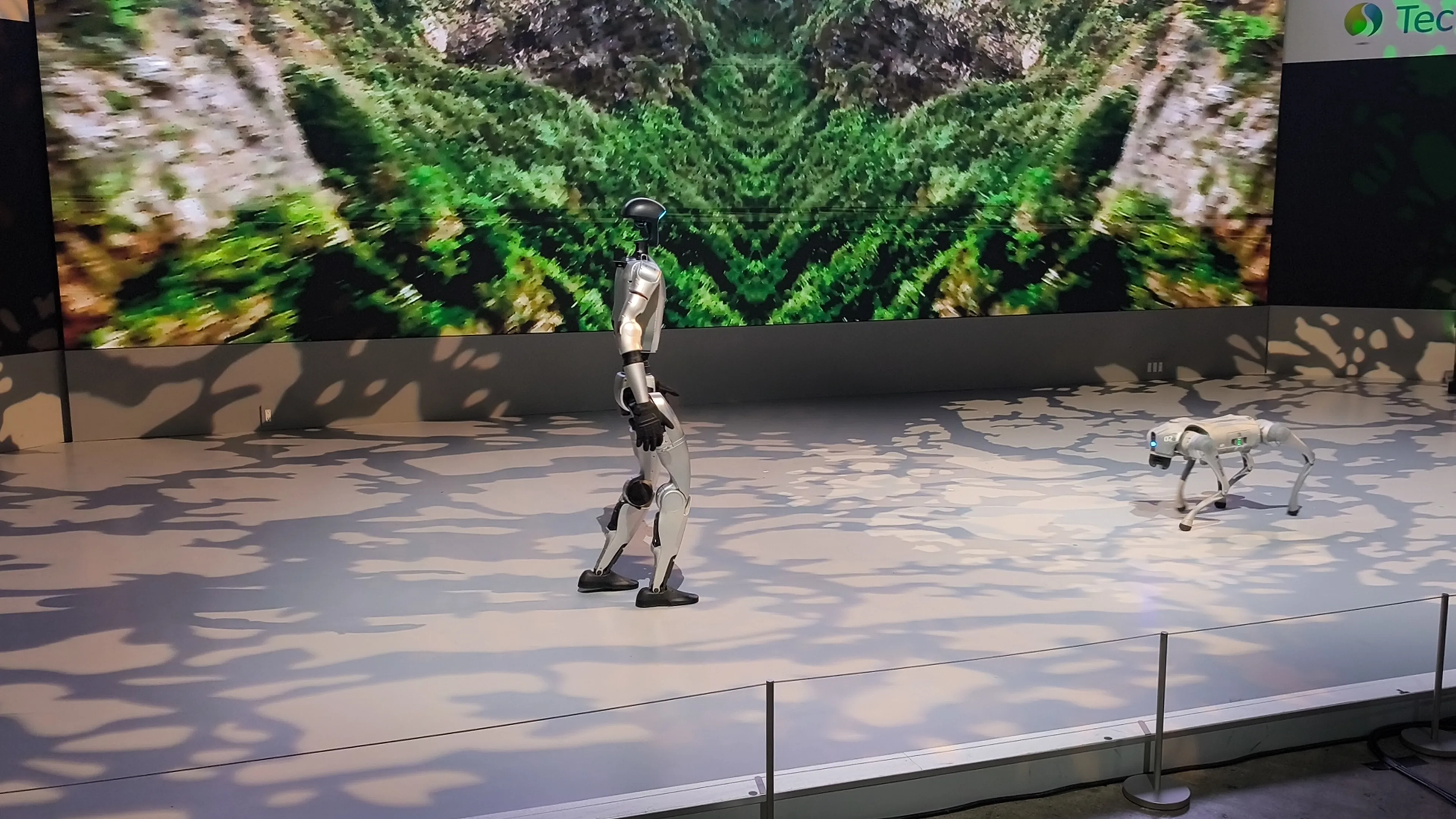
Unitree G1 and Go2 robots at Japan Mobility Show 2025. Photograph by RuinDig, Yuki Uchida, under CC BY 4.0. Taken October 31, 2025. This archival photograph provides hardware context and does not show a SuperMimic experiment.