GreenWAM connects robot prediction and control across bodies

Sber Robotics Center researchers introduced GreenWAM in an October 13 preprint, pairing predictions of a robot’s surroundings with policies that choose its movements.
A shared foundation still needs adaptation
Built on Cosmos 3 Edge, it maps 20 robot families into 79 shared anatomical coordinates. Adaptation for each benchmark produces different policies, rather than one unchanged controller for every setting.
The authors report 86.98% success on clean RoboTwin scenes and 48.10% with randomized scenes. Those simulated results show how much changed surroundings still affect performance.
Physical testing covers one packing task
Their physical evaluation covered one humanoid and one packing task, measured as 70 instructions across 14 scene configurations. GreenWAM scored 95.6% in familiar conditions and 84.0% in changed conditions. The distilled version scored 91.1% and 80.0%, respectively.
Each instruction had one attempt, with no scene reset between instructions.
Distillation reduced median policy inference to 35.4 milliseconds on an RTX 4090, compared with 134.6 milliseconds for the optimized teacher. Running the student on the robot’s onboard computer remains future work.
Instruction success and completion of an entire job answer different questions. A useful replication should report both, alongside interventions and recovery after mistakes. ByteForward has not tested these policies or independently reproduced the reported results.
The release supports evaluation with clear limits
The public repository provides evaluation code and four benchmark checkpoints covering RoboTwin, LIBERO, CALVIN and WorldArena. The Hugging Face file listing contains the four corresponding folders and lists 35.5 GB in total. That is the combined repository size, not a stated memory requirement for one policy.
The release excludes training recipes, data pipelines, the base checkpoint from the robotics training stage and training data. Users also need separate Wan2.2 VAE assets and a specific revision of the Cosmos 3 Edge tokenizer.
Code and released weights use OpenMDW License 1.1. Other components have separate terms. The README identifies gated SAM 3 weights, a noncommercial license for the V JEPA judge and a missing license file for the referenced LIBERO Plus revision.
The authors also report matching recorded requests on H100 hardware. Their README distinguishes that check from complete benchmark runs, which retain benchmark randomness.
What to check before building on it
A sensible first test is a narrow reproduction using a released checkpoint and its documented evaluation setup. Record the revision, hardware and result distribution before changing the robot interface. Treat a successful installation, a reproduced benchmark and a dependable physical workflow as separate milestones. Each needs its own evidence.
Readers comparing access options can also see ByteForward’s report on Physical Intelligence’s Pi API beta applications.
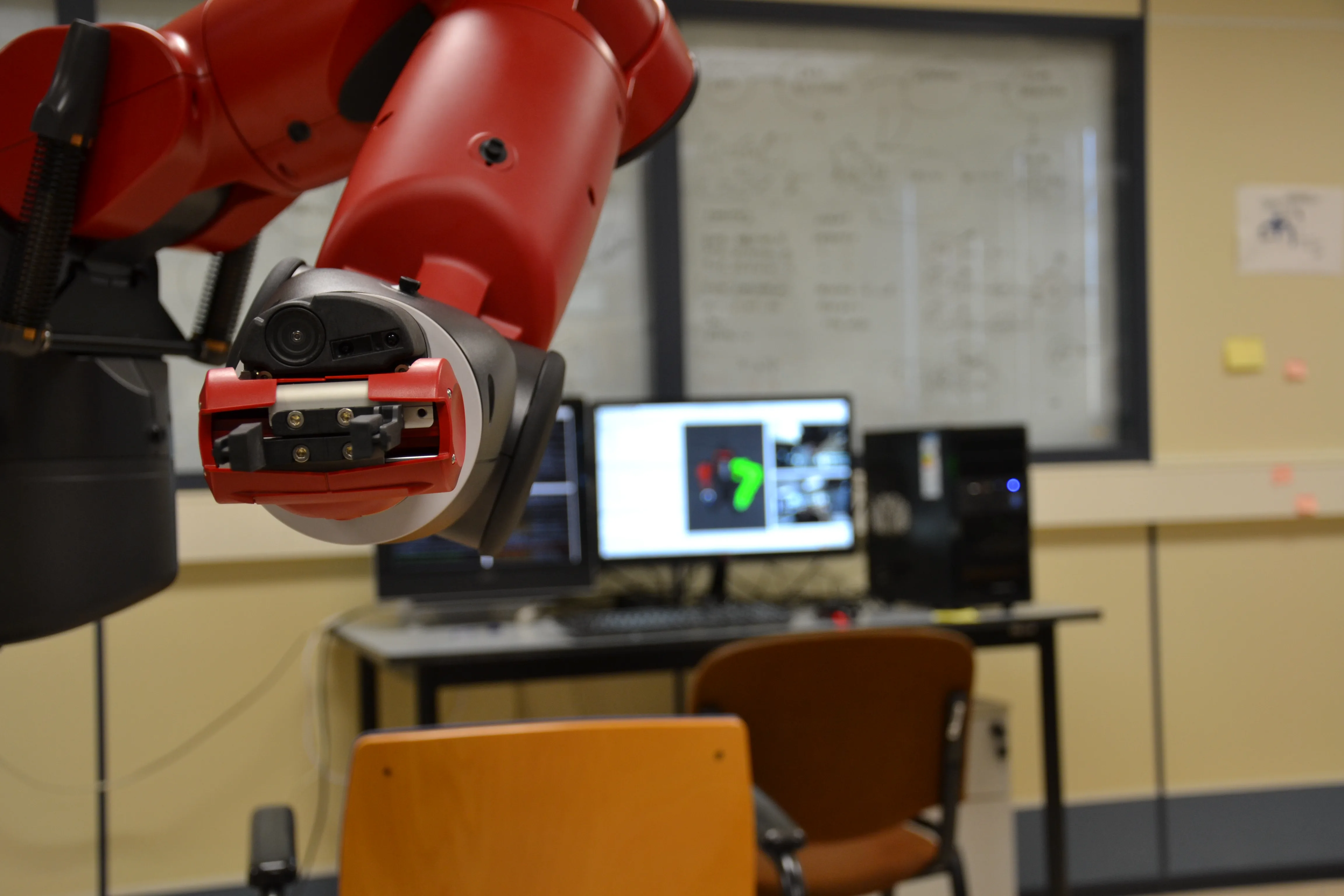
The featured image is an illustrative 2014 photograph of a Baxter robot gripper by Gustavo A. Casañ, Robotic Intelligence Laboratory, Universidad Jaume I, under CC BY SA 4.0. It does not show GreenWAM or its test robot. WebP conversion and display crops retain the same image license.